
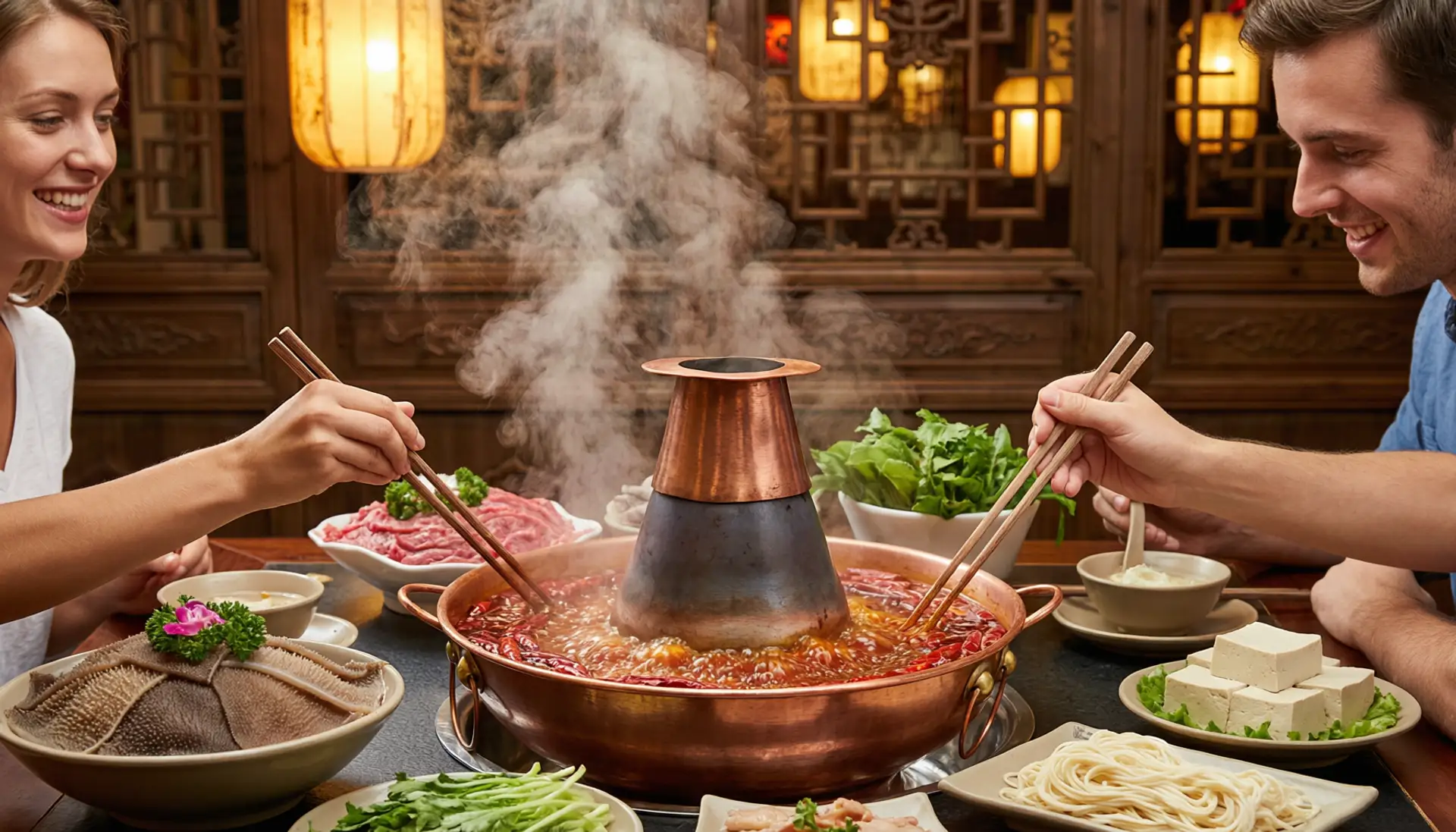
In the heart of Sichuan province, where the air hangs thick with the scent of dried chilies and numbing peppercorns, a pot of crimson broth bubbles over an open flame. This is Chengdu hot pot — not merely a meal, but a social ritual that has defined the city's culinary identity for centuries. Gathered around a steaming cauldron, friends and strangers alike dip, swish, and savor their way through an elaborate spread of tripe, lotus root, hand-pulled noodles, and wagyu beef, all united by the legendary mala — the tingling, electrifying combination of numbing and spicy that only Sichuan can deliver.
This guide distills everything you need to know about Chengdu hot pot: the six best restaurants (from century-old heritage brands to modern chains), the four spice levels and how to navigate them, the must-try ingredients and their precise blanching times, the classic dipping sauce formula, and a complete three-day hot pot itinerary. Every price, address, and recommendation comes from firsthand dining experience and ongoing local research.
Quick Answer: What You Need to Know About Chengdu Hot Pot
Chengdu is the spiritual home of Sichuan hot pot, the bold, numbing-spicy (mala) broth culture that has spread across China and the world. A typical Chengdu hot pot meal costs 80–200 RMB per person ($11–28), with premium venues reaching 300–500 RMB ($42–70). The two essential decisions at any hot pot restaurant are your broth type — spicy red oil, mild clear broth, or split pot — and your dipping sauce base: sesame oil garlic versus sesame paste. For first-timers, a yuanyang (split) pot with sesame oil dip is the safest and most authentic combination.
Chengdu hot pot restaurants range from century-old heritage brands like Huangcheng Laoma to modern chains like Haidilao known for theatrical service. The best areas for hot pot are Yulin and Wuhou districts, where dozens of top-rated restaurants cluster within walking distance. Most restaurants open from late afternoon through midnight, with peak hours from 7–9 PM when waits can exceed two hours at popular spots.
Understanding Chengdu Hot Pot: The Soul of Sichuan Cuisine
Sichuan hot pot is not just a meal — it is a social ritual, a flavor philosophy, and the beating heart of Chengdu culinary identity. Unlike Chongqing hot pot, which leans heavily into extreme spice and beef tallow intensity, Chengdu hot pot emphasizes a more balanced approach: the numbing (ma) and spicy (la) are present but layered with aromatic complexity, herb undertones, and a broader ingredient vocabulary.
What Makes Chengdu Hot Pot Different
Several key characteristics distinguish Chengdu hot pot from other regional styles. Balanced Mala: Chengdu hot pot aims for harmony between numbing Sichuan peppercorns and spicy dried chilies, rather than pure heat — the broth should tingle, not burn. Beef Tallow Base: Authentic Chengdu hot pot uses beef tallow (niuyou) as the fat foundation, giving the broth a rich, velvety mouthfeel that vegetable oil cannot replicate. Herb and Spice Complexity: Beyond chilies and peppercorns, the broth often includes star anise, bay leaves, cinnamon, fennel, dried tangerine peel, licorice root, and other aromatics. Ingredient Variety: Chengdu features a wider range of ingredients than other styles — from beef tripe and duck intestines to lotus root, tofu skin, and even pig brain. Social Dining Culture: Hot pot is inherently communal — friends and family gather around a single pot, cooking and sharing for hours.
Chengdu vs Chongqing Hot Pot: Key Differences
Dimension | Chengdu Hot Pot | Chongqing Hot Pot |
|---|---|---|
Broth Fat | Beef tallow, more balanced | Beef tallow, heavier and richer |
Spice Level | Moderate, layered complexity | Extremely spicy, intense heat |
Sichuan Peppercorn | Generous, strong numbing effect | Moderate, heat-forward |
Pot Style | Often split (yuanyang) pot | Single spicy pot preferred |
Dipping Sauce | Sesame oil + garlic + coriander | Sesame oil + garlic, simpler |
Ingredient Range | Wide, creative selections | Focus on offal and beef |
Dining Atmosphere | Refined, sit-down, social | Rustic, loud, fast-paced |
Average Price | 80–200 RMB/person | 60–150 RMB/person |
Key takeaway: If you want to experience the full spectrum of Sichuan mala flavors in a more approachable setting, Chengdu hot pot is the better choice. Chongqing hot pot is for those who want maximum spice intensity.
Types of Hot Pot Broths: Choosing Your Base
Choosing your broth is the first and most important decision at any hot pot restaurant. The broth determines the entire flavor profile of your meal, since every ingredient you cook absorbs its character.
Spicy Red Oil Broth (Hong You Guo Di)
The classic and most iconic Sichuan hot pot broth. Made with a base of beef tallow, dried chili peppers, Sichuan peppercorns, doubanjiang (chili bean paste), ginger, garlic, and a complex blend of aromatics. The oil floats on top of a concentrated stock, creating a layer that coats each ingredient with intense mala flavor. Best for: adventurous diners, beef and offal lovers, those seeking authentic Sichuan heat.
Clear / Mushroom Broth (Qing Tang Guo)
A mild, clear broth made from chicken, pork bone, or mushroom stock. This is the safe harbor in a split pot — where you cook delicate ingredients like seafood, vegetables, and tofu that would be overwhelmed by the spicy broth. Many restaurants now offer premium clear broths with jujube, goji berry, and tomato for added depth. Best for: first-timers, spice-sensitive diners, vegetables and delicate ingredients.
Split Pot (Yuanyang Guo) — The Best of Both Worlds
A pot divided down the middle with spicy red oil on one side and clear broth on the other. This is the recommended choice for most visitors, especially first-timers. You get the authentic spicy experience while having a mild side for recovery and delicate ingredients. The name yuanyang refers to mandarin ducks, a symbol of harmonious pairing in Chinese culture.
Tomato Broth
A modern innovation that has become increasingly popular in Chengdu. Made from fresh tomatoes simmered into a tangy, slightly sweet broth. It offers a completely different flavor dimension — umami-rich, refreshing, and non-spicy. Some restaurants now offer four-section pots (si wei guo) with spicy, clear, tomato, and mushroom broths.
Broth Type Comparison
Broth Type | Spice Level | Oil Level | Best Ingredients | Recommended For |
|---|---|---|---|---|
Spicy Red Oil | High | High | Beef tripe, duck intestines, offal | Adventurous diners |
Clear / Mushroom | None | Low | Seafood, vegetables, tofu | First-timers, mild palates |
Split (Yuanyang) | Adjustable | Mixed | Everything | Mixed groups, best overall |
Tomato | None | Low | Beef, mushrooms, tofu | Vegetarians, children |
Mushroom Premium | None | Low | Wild mushrooms, premium cuts | Health-conscious diners |
Understanding Spice Levels: Ma vs La
The concept of mala — the combination of numbing (ma) and spicy (la) — is fundamental to Sichuan cuisine. Ma (Numbing): Caused by Sichuan peppercorns (huajiao), which contain hydroxy-alpha-sanshool — this triggers a tingling, vibrating sensation on the lips and tongue. La (Spicy/Hot): Caused by dried chili peppers (lajiao), which contain capsaicin — the conventional heat sensation that builds with each bite.
The genius of Sichuan hot pot is that ma and la work together: the numbing effect partially blocks pain receptors activated by capsaicin, allowing you to enjoy more heat than you otherwise could.
Spice Level Guide
Level | Chinese Name | Description | Who Should Order |
|---|---|---|---|
Mild | Wei La (微辣) | Light chili presence, gentle warmth | First-timers, spice-sensitive diners |
Medium | Zhong La (中辣) | Noticeable heat and numbing, balanced | Casual spice eaters, most visitors |
Hot | Te La (特辣) | Strong spice and numbing, sweat-inducing | Experienced spice lovers |
Extreme | Bao La (暴辣) | Maximum intensity | Locals and competitive eaters only |
Pro Tip: Always start one level lower than you think you can handle. You can ask for extra chili oil at the table, but you cannot reduce the spice once the broth is made.
How to Reduce Spice at the Table
Order a split pot (yuanyang) with one side mild — cook spice-sensitive ingredients on the clear side
Use plenty of sesame oil in your dipping sauce — oil coats the tongue and reduces capsaicin burn
Drink soy milk, sweetened tea, or yogurt — dairy and sugar neutralize capsaicin better than water
Order cooling sides: ice jelly (bingfen), sweet glutinous rice balls (tangyuan), or fresh fruit
Avoid beer — alcohol can intensify the burning sensation; opt for sweet drinks instead
Best Hot Pot Restaurants in Chengdu: Our Top 6 Picks
After extensive research across Chengdu's hot pot scene — from heritage brands to modern chains and neighborhood favorites — here are our top 6 recommended restaurants for visitors. Each offers a distinct experience.
5.1 Da Long Yi (大龙燚) — The Local Favorite
Style: Traditional Chengdu beef tallow hot pot | Price: 80–120 RMB/person ($11–17)
Item | Details |
|---|---|
Address | Multiple locations; flagship at 2 Yulin Middle Road, Wuhou District |
Phone | +86 28 8555 6677 |
Hours | 11:00 AM – 2:00 AM (late-night dining available) |
Must-Try | Beef tripe (mao du), duck intestines, fresh beef slices, lotus root, sticky rice cakes |
Spice Level | Medium-High (adjustable: mild to extreme) |
Da Long Yi is the restaurant that locals actually eat at. Founded in 2013, it exploded in popularity through word-of-mouth rather than marketing, earning a reputation as the most authentic Chengdu-style beef tallow hot pot at an accessible price. The broth is rich, deeply aromatic, and balanced — the kind that coats your lips with a satisfying tingle without overwhelming. The beef tripe here is legendary: blanched for exactly 15 seconds, it emerges tender with a satisfying snap.
Ordering Tip: Ask for the staff-recommended blanching times — they will tell you exactly how many seconds to cook beef tripe (15s), duck intestines (10s), and beef slices (8s) for perfect texture.
5.2 Xiaolongkan (小龙坎) — The Style Icon
Style: Chengdu hot pot with vintage decor | Price: 100–150 RMB/person ($14–21)
Item | Details |
|---|---|
Address | Multiple locations; flagship at 88 Chunxi Road, Jinjiang District |
Phone | +86 28 8666 8899 |
Hours | 11:00 AM – 1:00 AM |
Must-Try | Premium beef platter, fresh shrimp paste, black fungus, handmade shrimp balls |
Spice Level | Medium (adjustable, known for balanced flavor) |
Xiaolongkan has become one of China's most recognizable hot pot brands, but it started right here in Chengdu. What sets it apart is the extraordinary attention to ambiance — each restaurant is designed as a vintage Chinese scene with carved wooden screens, brass fixtures, warm lighting, and traditional Sichuan architectural elements. The split pot here is particularly well-executed, with the clear side featuring a rich mushroom and goji berry broth that is almost drinkable on its own.
Photo Tip: Request a table near the carved wooden screens for the best interior shots. Try the shrimp paste: staff will squeeze it from a piping bag directly into the pot.
5.3 Huangcheng Laoma (皇城老妈) — The Heritage Brand
Style: Premium traditional Chengdu hot pot with Sichuan opera | Price: 200–400 RMB/person ($28–56)
Item | Details |
|---|---|
Address | No. 20 Erhuan Road South, Wuhou District (flagship) |
Phone | +86 28 8511 7777 |
Hours | 11:00 AM – 10:30 PM |
Must-Try | Premium Wagyu beef slices, abalone, hand-cut beef, duck tongue, seasonal vegetables |
Spice Level | Medium (adjustable, emphasis on flavor over heat) |
Founded in 1986, Huangcheng Laoma is the grand dame of Chengdu hot pot — the restaurant that elevated hot pot from street food to fine dining. The flagship store is a multi-story cultural complex with private rooms, art galleries, and a Sichuan opera stage where bianlian (face-changing) performers entertain diners. The broth is a masterclass in balance: the beef tallow base is simmered for hours with over 20 spices.
Booking Tip: Reserve at least 3 days in advance for opera performance nights (Friday–Sunday). Request a table with opera view when booking.
5.4 Shu Daxia (蜀大侠) — The Theatrical Experience
Style: Martial arts-themed Chengdu hot pot | Price: 90–130 RMB/person ($13–18)
Item | Details |
|---|---|
Address | Multiple locations; flagship at 66 Hongpai Road, Wuhou District |
Phone | +86 28 8555 3322 |
Hours | 11:00 AM – 2:00 AM |
Must-Try | Hero beef (hand-sliced tableside), dragon boat platter, fresh shrimp paste, bamboo shoots |
Spice Level | Medium-High (adjustable) |
Shu Daxia brings theatrical flair to hot pot without sacrificing quality. The restaurant is themed around Sichuan martial arts culture — staff wear period costumes, the decor evokes ancient training halls, and the signature dish involves a server dramatically hand-slicing beef with a massive blade at your table. The dragon boat platter — a massive wooden boat-shaped platter loaded with assorted meats and vegetables — is both a visual centerpiece and a practical way to sample many ingredients.
Experience Tip: Order the Hero Beef for the tableside slicing show. The dragon boat platter is great value for groups of 4+.
5.5 Haidilao (海底捞) — The Service Legend
Style: Modern chain hot pot with legendary service | Price: 120–180 RMB/person ($17–25)
Item | Details |
|---|---|
Address | Multiple locations; flagship at Times Square, 8 Zongfu Road, Jinjiang District |
Phone | +86 28 8666 9999 |
Hours | 24 hours (most locations) |
Must-Try | Noodle dance (fresh hand-pulled noodles), tomato broth, beef tripe, DIY dipping sauce bar |
Spice Level | Adjustable (full control via DIY sauce bar) |
Haidilao is not just a restaurant — it is a phenomenon. Founded in Sichuan in 1994, it has grown into China's most famous hot pot chain, renowned worldwide for service so attentive it borders on the theatrical. While waiting, you get free manicures, shoe shines, snacks, and board games. At the table, noodle dancers perform acrobatic stretching of fresh noodles beside your pot, and a DIY sauce bar lets you customize your dipping sauce with dozens of ingredients. The tomato broth is a standout.
First-Timer Tip: Haidilao is the easiest hot pot experience for non-Chinese speakers. Download the Haidilao app or use Dianping to join the waitlist remotely.
5.6 Luo Er Hot Pot (老码头火锅) — The Authentic Neighborhood Gem
Style: Old-school neighborhood Chengdu hot pot | Price: 70–100 RMB/person ($10–14)
Item | Details |
|---|---|
Address | No. 8 Shujun Road, Wuhou District (near Wuhou Temple) |
Phone | +86 28 8555 4455 |
Hours | 5:00 PM – 2:00 AM (dinner and late-night) |
Must-Try | Fresh beef tripe, duck blood, yellow throat (huanghou), pig stomach, sweet potato noodles |
Spice Level | High (authentic local intensity, adjustable down) |
Luo Er is the kind of place that does not have a website, does not advertise, and does not need to. Located in an old neighborhood near Wuhou Temple, this is where Chengdu residents go when they want real, unpretentious, deeply authentic hot pot at neighborhood prices. The copper pots are the old style — wider and shallower than modern pots. The ingredient list focuses on traditional offal cuts that represent the true soul of hot pot.
Adventurer Tip: Order the yellow throat (huanghou) and duck blood (yaxue). Ask staff for cooking times — these ingredients need specific blanching to achieve the right texture.
The Complete Ordering Guide for Chengdu Hot Pot
Ordering at a hot pot restaurant can be overwhelming — menus often list 100+ items with no descriptions in English. This guide breaks down the process into clear steps.
Step-by-Step Ordering Process
Choose Your Broth: Select spicy, clear, split (yuanyang), or tomato. For first-timers, split pot is strongly recommended.
Choose Spice Level: Mild (weila), medium (zhongla), or hot (tela). Start one level below what you think you can handle.
Build Your Dipping Sauce: At restaurants with a sauce bar, create your dip. At traditional spots, order sesame oil + garlic + coriander.
Order Proteins: Beef tripe, fresh beef slices, lamb, chicken, shrimp. Aim for 3–4 protein items for 2 people.
Order Vegetables: Lotus root, potato slices, bamboo shoots, black fungus, leafy greens. Aim for 3–4 vegetable items.
Order Starches: Sweet potato noodles (fen tiao), fresh noodles, rice cake slices. 1–2 starch items per 2 people.
Order Cooling Sides: Ice jelly (bingfen), sweet dumplings (tangyuan), fresh fruit, soy milk.
How Much to Order by Group Size
Group Size | Broth | Proteins | Vegetables | Starches | Sides | Est. Cost |
|---|---|---|---|---|---|---|
2 People | 1 split pot | 3–4 items | 3–4 items | 1–2 items | 1–2 items | 160–300 RMB |
4 People | 1–2 split pots | 6–8 items | 5–6 items | 2–3 items | 2–3 items | 350–600 RMB |
6 People | 2 split pots | 8–10 items | 7–8 items | 3–4 items | 3–4 items | 500–900 RMB |
8+ People | 2–3 pots | 12+ items | 10+ items | 4+ items | 4+ items | 700+ RMB |
Rule of thumb: Order 1.5 items per person total (proteins + vegetables + starches). It is better to order slightly less and add more than to waste food.
Must-Try Ingredients for Your Chengdu Hot Pot
The ingredient selection is what separates a good hot pot experience from a great one. Here are the essential ingredients every visitor should try.
Proteins
Ingredient | Chinese Name | Texture | Blanch Time | Notes |
|---|---|---|---|---|
Beef Tripe | Mao Du (毛肚) | Tender-crisp, snap | 15 seconds | The #1 must-order |
Fresh Beef Slices | Xian Niu Rou (鲜牛肉) | Tender, melts | 8–10 seconds | Order hand-sliced if available |
Duck Intestines | Ya Chang (鸭肠) | Crisp, slightly chewy | 10 seconds | Rinse in broth, dip quickly |
Lamb Slices | Yang Rou (羊肉) | Soft, rich | 30 seconds | Classic hot pot protein |
Shrimp Paste | Xia Hua (虾滑) | Springy, bouncy | 3–5 minutes | Often squeezed tableside |
Pig Blood | Zhu Xue (猪血) | Soft, silky | 3–5 minutes | Absorbs broth flavor |
Yellow Throat | Huang Hou (黄喉) | Crisp, crunchy | 2–3 minutes | Adventurous but beloved |
Chicken | Ji Rou (鸡肉) | Tender | 5–8 minutes | Best in clear broth side |
Vegetables & Tofu
Ingredient | Chinese Name | Blanch Time | Best Broth Side |
|---|---|---|---|
Lotus Root | Lian Ou (莲藕) | 3–5 min | Spicy or clear |
Potato Slices | Tu Dou (土豆) | 5–8 min | Clear |
Bamboo Shoots | Zhu Sun (竹笋) | 3–5 min | Spicy |
Black Fungus | Hei Mu Er (黑木耳) | 3–5 min | Either |
Tofu Skin | Dou Fu Pi (豆腐皮) | 1–2 min | Spicy |
Fresh Tofu | Dou Fu (豆腐) | 5–8 min | Clear |
Napa Cabbage | Da Bai Cai (大白菜) | 2–3 min | Clear |
Water Spinach | Kong Xin Cai (空心菜) | 1–2 min | Either |
Starches & Noodles
Sweet Potato Noodles (Fen Tiao): The classic hot pot noodle — chewy, translucent, absorb broth beautifully. Cook 3–5 minutes. Add near the end of the meal.
Fresh Hand-Pulled Noodles: Often made tableside at Haidilao and Xiaolongkan. Cook 2–3 minutes. Best ordered in the last 15 minutes.
Rice Cake Slices (Nian Gao): Chewy, satisfying texture. Cook 5–8 minutes. Absorbs broth and sauce.
Tangyuan (Sweet Glutinous Rice Balls): A dessert cooked in the clear broth side. Sweet sesame or peanut filling. Cook until they float (3–5 minutes).
The Dipping Sauce Guide: Chengdu Style vs Northern Style
The dipping sauce is your personal flavor amplifier — it cools the broth, adds richness, and lets you customize every bite. There are two main schools of hot pot dipping sauce in Sichuan.
Chengdu Style: Sesame Oil + Garlic
The authentic Chengdu approach: a bowl of sesame oil (xiang you) with minced fresh garlic, chopped coriander, and optionally scallions, oyster sauce, and a splash of vinegar. The oil coats the cooked ingredient, cooling it slightly and adding a nutty richness that balances the spicy broth. Base: Sesame oil | Add: Minced garlic, coriander, scallions | Optional: Oyster sauce, vinegar, sesame seeds.
Northern Style: Sesame Paste (Zhi Ma Jiang)
A thicker, richer dip based on sesame paste (similar to tahini). Common in northern Chinese hot pot styles, it provides a creamy, savory coating. Base: Sesame paste | Add: Coriander, garlic, chili oil | Optional: Fermented tofu (furu), scallions.
DIY Sauce Bar: Build the Perfect Dip
Layer | Ingredient | Amount | Purpose |
|---|---|---|---|
Base | Sesame oil | 2–3 spoonfuls | Cooling, coating, richness |
Aromatics | Minced garlic | 1 spoonful | Flavor, spice management |
Fresh | Chopped coriander | 1 spoonful | Freshness, aroma |
Fresh | Chopped scallions | 1 spoonful | Aroma, texture |
Savory | Oyster sauce | 0.5 spoonful | Umami depth |
Heat | Chili oil | To taste | Additional spice control |
Nutty | Sesame seeds | Sprinkle | Texture, aroma |
Tangy | Rice vinegar | Splash | Cuts richness, aids digestion |
Sauce Tip: The golden ratio is 2 parts sesame oil to 1 part garlic to 1 part coriander. Adjust chili oil last — you can always add more, but cannot remove it.
Hot Pot Etiquette and Practical Tips for Visitors
Dining Etiquette
Use your chopsticks to cook: place raw ingredients into the broth with your chopsticks. Use separate serving chopsticks (gongkuai) if provided. Do not overcook — each ingredient has an optimal blanch time. Do not double-dip: once an ingredient has been in your mouth, do not return it to the communal broth. Share the pot — hot pot is communal; do not claim a section as yours. Pace yourself — a hot pot meal lasts 1.5–3 hours; do not rush.
Practical Tips
Wear clothes you do not mind smelling — hot pot aroma lingers on fabric
Tie long hair back — reaching over a boiling pot with loose hair is impractical
Bring wet wipes — hot pot is messy; some restaurants provide wipes
Use Dianping app — China's Yelp equivalent has photos of every dish for ordering
Ask for blanching times — staff know exactly how long each ingredient needs
Save starches for last — noodles and rice cakes absorb the accumulated broth flavor
Price Comparison: All Recommended Restaurants
Restaurant | Price/Person (RMB) | Price/Person (USD) | Budget Tier | Best Value Dish |
|---|---|---|---|---|
Luo Er Hot Pot | 70–100 | $10–14 | Budget | Beef tripe platter |
Da Long Yi | 80–120 | $11–17 | Budget-Mid | Beef tripe + lotus root combo |
Shu Daxia | 90–130 | $13–18 | Mid | Dragon boat platter |
Xiaolongkan | 100–150 | $14–21 | Mid | Premium beef platter |
Haidilao | 120–180 | $17–25 | Mid-High | DIY sauce bar |
Huangcheng Laoma | 200–400 | $28–56 | Premium | Wagyu beef + opera |
Value Tip: Lunch at most hot pot restaurants is 20–30% cheaper than dinner, with shorter waits. Haidilao between 2–5 PM often has no wait at all.
Best Hot Pot by Neighborhood in Chengdu
District | Restaurant Count | Best For | Atmosphere | Price Range |
|---|---|---|---|---|
Wuhou (武侯) | 500+ | Authentic local hot pot | Bustling, traditional | $ – $$$ |
Jinjiang (锦江) | 400+ | Chic modern hot pot | Stylish, central | $$ – $$$ |
Qingyang (青羊) | 300+ | Heritage dining | Old-world, cultural | $$ – $$$$ |
Gaoxin (高新) | 200+ | Chain hot pot, English-friendly | Modern, clean | $$ – $$$ |
Wuhou District is the undisputed hot pot capital of Chengdu, particularly the Yulin area where Da Long Yi and many local favorites are located. Jinjiang District, centered around Chunxi Road, offers the most stylish and modern restaurants. Qingyang District has heritage brands like Huangcheng Laoma.
What to Drink with Hot Pot: The Complete Guide
Drink | Chinese Name | Why It Works |
|---|---|---|
Soy Milk | Dou Jiang (豆浆) | Protein and fat coat the tongue, neutralize capsaicin |
Sour Plum Drink | Suan Mei Tang (酸梅汤) | Sweet and tart, refreshing, traditional pairing |
Ice Jelly | Bingfen (冰粉) | Cold, sweet, slippery texture cools the mouth |
Yogurt Drink | Suan Nai (酸奶) | Dairy neutralizes capsaicin effectively |
Barley Tea | Da Mai Cha (大麦茶) | Warm, neutral, aids digestion |
Coconut Water | Ye Zi Shui (椰子水) | Sweet, hydrating, electrolytes |
Avoid: Hot water (intensifies burning), carbonated sodas (fizz spreads capsaicin), strong alcohol (amplifies heat), ice water (only temporary relief).
Cooling Strategy: The most effective way to cool the burn is ice jelly (bingfen) followed by sour plum drink (suan mei tang). Both are cheap and available everywhere.
Vegetarian and Dietary Options for Hot Pot
Hot pot is surprisingly vegetarian-friendly if you know how to order. The key is choosing the right broth and selecting the right ingredients.
Best Broth for Vegetarians
Tomato Broth: The best vegetarian option — rich, tangy, and completely plant-based. Mushroom Broth: Earthy, umami-rich, and vegetarian — ask if the base stock is vegetable or bone. Avoid Spicy Red Oil: Traditional beef tallow broth is not vegetarian.
Best Vegetarian Ingredients by Category
Category | Ingredients | Blanch Time |
|---|---|---|
Tofu | Fresh tofu, tofu skin, frozen tofu, tofu puff | 2–8 minutes |
Mushrooms | Enoki, shiitake, oyster, king oyster | 3–5 minutes |
Root Vegetables | Lotus root, potato, sweet potato, radish | 5–10 minutes |
Leafy Greens | Napa cabbage, water spinach, bok choy | 1–3 minutes |
Starches | Sweet potato noodles, rice cakes, fresh noodles | 3–8 minutes |
Allergy Considerations
Peanut Allergy: Sichuan cuisine uses peanuts extensively — avoid peanut-based sauce ingredients and ask staff to check the broth. Gluten-Free: Opt for rice noodles and bring gluten-free soy sauce. Shellfish Allergy: Cross-contamination is possible in shared pots. Beef Allergy: Ask for vegetable oil broth alternatives — Haidilao and modern chains can accommodate.
Hot Pot for First-Timers: A Complete Survival Guide
The First-Timer Checklist
Choose a restaurant with English support — Haidilao is the easiest for first-timers
Order a split pot (yuanyang) — spicy on one side, mild on the other
Request mild spice level (weila) — you can always add more heat later
Order beef tripe (mao du) — the essential hot pot experience
Order sweet potato noodles (fen tiao) for the end of the meal
Get ice jelly (bingfen) and sour plum drink (suan mei tang) immediately
Ask staff for blanching times — never guess
Use plenty of sesame oil in your dipping sauce — it cools the heat
What to Expect: The Hot Pot Meal Timeline
Phase | Time | What Happens |
|---|---|---|
Arrival & Seating | 0–10 min | Order broth, build dipping sauce, order ingredients |
First Cook | 10–25 min | Broth reaches boil. Start with proteins — beef tripe, fresh beef |
Main Course | 25–60 min | Cook and eat proteins and vegetables in rotation |
Starch Phase | 60–75 min | Add noodles, rice cakes to absorb remaining broth flavor |
Cooling | 75–90 min | Eat ice jelly, sweet dumplings, drink tea, relax |
Total | 90–120 min | A typical hot pot meal for 2–4 people |
A 3-Day Chengdu Hot Pot Itinerary
Day 1: The Introduction
Meal | Restaurant | Price | Why This Choice |
|---|---|---|---|
Lunch | Haidilao (Jinjiang) | ~150 RMB | English-friendly introduction; DIY sauce bar |
Dinner | Xiaolongkan (Chunxi Road) | ~130 RMB | Stylish ambiance, balanced broth, great photos |
Day 1 gives you two different hot pot experiences — the service legend and the style icon. Both are comfortable for visitors and offer split pots.
Day 2: The Authentic Experience
Meal | Restaurant | Price | Why This Choice |
|---|---|---|---|
Lunch | Da Long Yi (Wuhou) | ~100 RMB | Where locals eat; authentic beef tallow broth |
Dinner | Shu Daxia (Wuhou) | ~110 RMB | Theatrical martial arts experience; tableside show |
Day 2 dives deeper into authenticity. By now you will be comfortable with the hot pot process and ready to try more adventurous ingredients.
Day 3: The Full Spectrum
Meal | Restaurant | Price | Why This Choice |
|---|---|---|---|
Lunch | Luo Er Hot Pot (Wuhou) | ~85 RMB | Hidden gem; old-school copper pot; most authentic |
Dinner | Huangcheng Laoma (Wuhou) | ~300 RMB | Premium heritage dining; Sichuan opera; grand finale |
Pro Tip: If budget is tight, swap Day 3 dinner for a second visit to Da Long Yi — you will save 200 RMB and many locals would argue Da Long Yi is actually better.
Hot Pot vs Other Sichuan Dining Experiences
Experience | What It Is | Price | Spice Level | Best For |
|---|---|---|---|---|
Hot Pot | Cook your own ingredients in simmering broth | 80–400 RMB | High (adjustable) | Groups, social dining |
Chuan Chuan (Skewers) | Ingredients on sticks cooked in broth | 40–80 RMB | Medium-High | Casual, solo or small groups |
Mapo Tofu | Silky tofu in spicy meat sauce | 30–50 RMB | Medium | Quick lunch, classic dish |
Dan Dan Noodles | Noodles in spicy sesame sauce | 15–30 RMB | Medium | Fast, affordable, solo dining |
Sichuan BBQ (Shao Kao) | Grilled skewers with cumin and chili | 50–100 RMB | Medium | Late night, beer pairing |
Sichuan Banquet | Multi-course Sichuan fine dining | 200–1000 RMB | Varies | Special occasions |
Practical Tips Before, During, and After Your Hot Pot Meal
Before You Go
Download Dianping app — it has photos of every dish, restaurant addresses in Chinese, and virtual queuing
Save restaurant addresses in Chinese characters for taxi drivers
Set up Alipay or WeChat Pay — most restaurants do not accept foreign credit cards directly
Bring wet wipes and a hair tie (for long hair)
Wear casual clothes — hot pot aroma lingers on fabric
During the Meal
Ask for blanching times for each ingredient — never guess
Cook proteins first, vegetables second, starches last
Keep raw and cooked chopsticks separate
Pace your eating — a hot pot meal should last 1.5–2 hours
Add water to the broth if it reduces too much — staff usually do this automatically
After the Meal
Drink warm tea — aids digestion after a rich, spicy meal
Avoid cold drinks immediately after — the temperature contrast can upset your stomach
Take a walk — Chengdu evenings are pleasant and aid digestion
Quick Reference: Your Chengdu Hot Pot Cheat Sheet
Topic | Key Takeaway |
|---|---|
Best Overall | Da Long Yi — authentic, affordable, where locals go |
Best for First-Timers | Haidilao — English-friendly, comfortable, DIY sauce bar |
Best Atmosphere | Xiaolongkan — vintage decor, stylish, photogenic |
Best for Special Occasions | Huangcheng Laoma — Sichuan opera, premium dining |
Best for Entertainment | Shu Daxia — martial arts theme, tableside show |
Best for Authenticity | Luo Er — old-school neighborhood, copper pots |
Best Broth Choice | Split pot (yuanyang) — spicy + mild in one |
Best Spice Level | Weila (mild) for first-timers, Zhongla (medium) for most |
Best Dipping Sauce | Sesame oil + garlic + coriander (Chengdu style) |
Best Cooling Drink | Ice jelly (bingfen) + sour plum drink (suan mei tang) |
Best Must-Try Ingredient | Beef tripe (mao du) — 15 seconds, tender-crisp |
Average Cost | 80–200 RMB/person ($11–28) |
Average Meal Duration | 90–120 minutes |






Traveler Discussions
Questions from travelers