
I
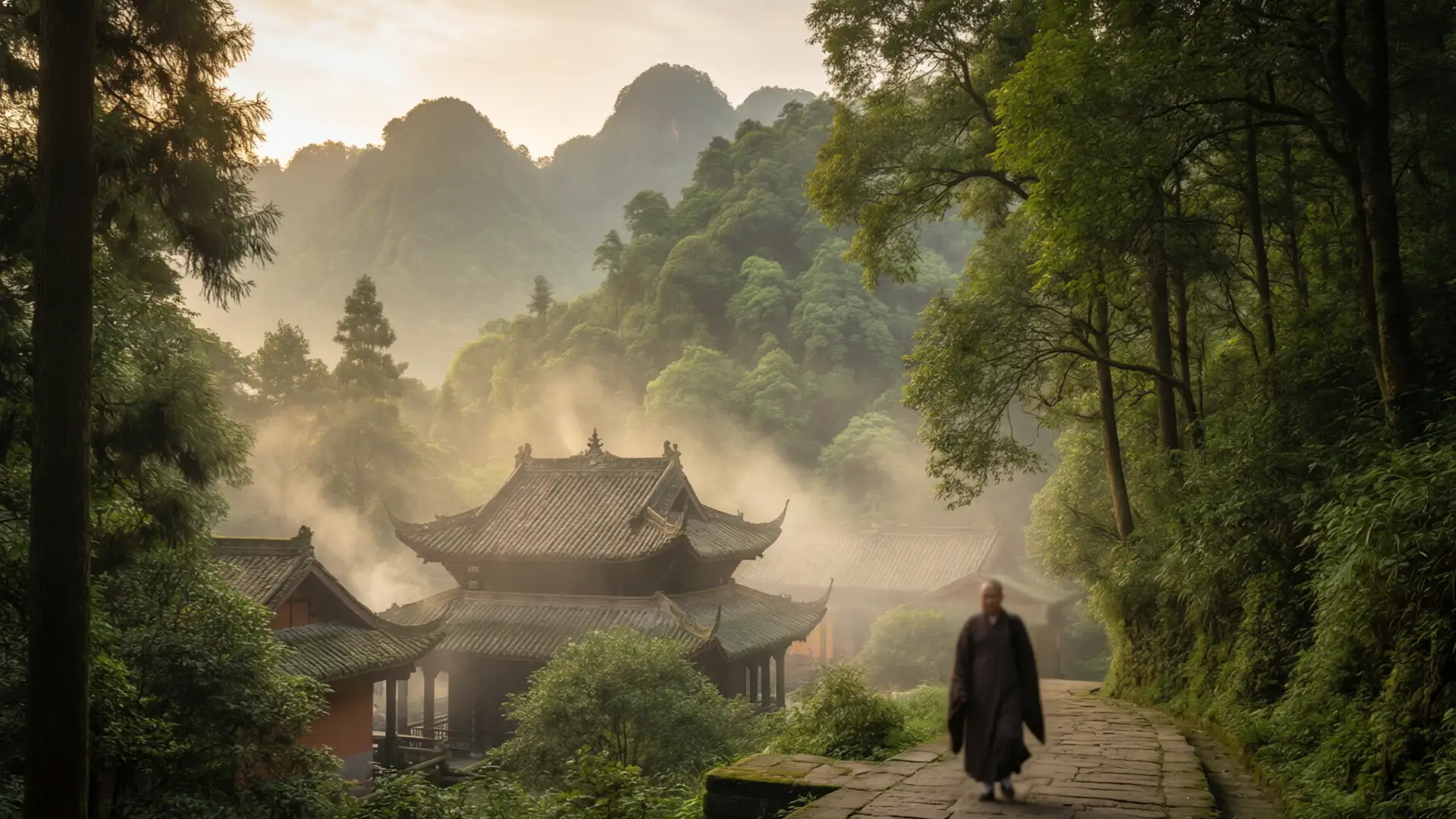
n the lush green foothills west of Chengdu, where ancient cypress trees shade stone paths worn smooth by centuries of pilgrims, Qingcheng Mountain has sheltered seekers for more than 1,800 years. Unlike the crowded panda bases or bustling food streets that dominate most Chengdu itineraries, this quiet Taoist sanctuary offers something increasingly rare in modern travel — silence, reflection, and a genuine connection to China's spiritual heritage.
This is not a standard sightseeing excursion. Qingcheng Mountain is one of the birthplaces of Taoism, a living center of Taoist culture, and home to centuries-old tea traditions that few visitors ever get to experience. Whether you join a blessing ceremony, a Taoist tea gathering, or a guided meditation session, the mountain invites you to slow down and reconnect with nature, philosophy, and inner calm.
1. Why Qingcheng Mountain Stands Apart as a Spiritual Destination
Qingcheng Mountain is widely regarded as one of the most important Taoist mountains in China. According to historical records, Taoism was formally founded here more than 1,800 years ago by Zhang Daoling, the Celestial Master, who received a divine revelation in one of the mountain's caves. Today, the mountain remains an active center of Taoist practice rather than a museum piece.
Visitors who arrive expecting a typical tourist attraction are often surprised by what they find instead: ancient Taoist temples nestled into forested ravines, traditional incense rituals performed by resident priests, mountain tea culture that predates most commercial tea houses, and quiet spaces where meditation is not a performance but a daily practice. Unlike many heavily commercialized attractions in China, Qingcheng Mountain retains a genuinely spiritual atmosphere.
For travelers seeking something deeper than sightseeing, the mountain offers a rare opportunity. It is one of the most peaceful day-trip experiences available from Chengdu, and it can be combined with other cultural activities for a richer itinerary.
2. Understanding Taoism: The Philosophy Behind Your Retreat
Before joining a Taoist retreat at Qingcheng Mountain, it helps to understand several key Taoist ideas that shape every aspect of the experience. These principles are not abstract theory — they are lived practices that you will encounter throughout your visit.
Harmony with Nature. Taoism teaches that human beings should live in balance with the natural world. The mountain itself is a classroom: ancient trees, flowing streams, and mist-shrouded peaks all illustrate the Taoist ideal of flowing with nature rather than resisting it.
Simplicity. Rather than constantly striving for more, Taoist wisdom emphasizes simplicity and contentment. This principle is reflected in the architecture of the mountain's temples, the preparation of tea, and the conduct of blessing ceremonies — all of which favor understated elegance over ostentation.
Inner Stillness. Through meditation, reflection, and tea culture, Taoism encourages a calm and clear mind. Many visitors describe their Qingcheng Mountain experience as a refreshing escape from modern stress, and some find that the clarity they gain on the mountain stays with them long after they return home.
3. Choosing Your Spiritual Experience at Qingcheng Mountain
Qingcheng Mountain offers several distinct spiritual experiences, each suited to different interests and schedules. The table below summarizes the main options so you can choose the one that fits your travel style.
Experience | Duration | Best For | Highlights |
Taoist Blessing Ceremony | 30–60 mins | First-time visitors | Traditional blessings for health, happiness, and prosperity |
Taoist Tea Gathering | 1–1.5 hours | Culture lovers | Tea tasting, Taoist philosophy, mindfulness |
Guided Meditation Session | 1–2 hours | Wellness travelers | Breathing exercises and inner reflection |
Temple Cultural Tour | 2–3 hours | History enthusiasts | Taoist heritage, architecture, and traditions |
Half-Day Spiritual Retreat | 4–5 hours | Slow travelers | Ceremony, tea, meditation, and temple visits |
All experiences can be arranged privately with advance notice. A local cultural guide provides translation and context throughout, ensuring that every ritual and custom is explained in a way that feels meaningful rather than exotic.
4. Taoist Blessing Ceremony: A Meaningful Cultural Ritual
The Taoist Blessing Ceremony is one of the most meaningful cultural experiences available at Qingcheng Mountain. It is not a performance for tourists — it is a genuine ritual conducted by resident Taoist priests in the mountain's temples.
During the ceremony, visitors may offer incense, receive blessings for health and happiness, learn about symbolic Taoist rituals, and gain insight into traditional Chinese spiritual customs. Many travelers choose to participate before major life events, family gatherings, or new beginnings, as the blessing is believed to bring positive energy and good fortune.
The ceremony typically takes place in one of the mountain's historic temples, surrounded by ancient wood carvings and the scent of sandalwood incense. Even visitors who do not identify as religious often find the experience deeply moving, as it offers a window into a living tradition that has endured for nearly two millennia.
5. The Immortal Tea Gathering: Taoist Tea Culture
Known locally as a "Shenxian Tea Gathering" (神仙茶会), this experience combines tea, philosophy, and mindfulness in a setting that could not be more fitting. The tea is prepared using traditional methods, and the gathering follows Taoist-inspired tea etiquette that emphasizes respect, presence, and appreciation.
Highlights include traditional Chinese tea preparation, conversations about Taoist wisdom and its relevance to daily life, and quiet appreciation of the mountain surroundings. Unlike commercial tea performances that prioritize entertainment, the focus here is reflection and genuine cultural exchange.
The tea gathering typically lasts one to one and a half hours, though it can be extended as part of a half-day retreat. It is an ideal experience for culture lovers who want to go beyond surface-level tourism and engage with a tradition that has shaped Chinese life for centuries.
6. Guided Meditation and Mindfulness at Qingcheng Mountain
Several temples and retreat spaces on Qingcheng Mountain offer guided meditation sessions that draw on Taoist wellness practices. These sessions typically include breathing exercises, quiet sitting meditation, and forest mindfulness walks along the mountain's ancient trails.
For many visitors, the meditation session is the most memorable part of the retreat experience. The combination of fresh mountain air, ancient forest surroundings, and expert guidance creates conditions for a level of calm and clarity that is difficult to achieve in everyday life.
Sessions can be arranged for individuals or small groups, and no prior meditation experience is necessary. The guides are accustomed to working with international visitors and can provide instructions in English through a local translator.
7. The Best Taoist Temples to Visit on Qingcheng Mountain
Qingcheng Mountain is home to dozens of temples, but three stand out as essential stops on any spiritual retreat:
Tianshi Cave (Celestial Master Cave) is one of the most important Taoist sites on the mountain. This is where Zhang Daoling, the founder of Taoism, is said to have received his divine revelation. The cave is surrounded by ancient architecture and retains a deep spiritual atmosphere that visitors can feel even without prior knowledge of Taoism.
Shangqing Palace is located higher on the mountain and offers panoramic views of the surrounding forested peaks. It is known for its mountain meditation environment, rich Taoist heritage, and spectacular scenery. The hike to Shangqing Palace is moderate and can be adjusted to your fitness level.
Jianfu Palace is often the first major temple encountered on the way up the mountain. It serves as a peaceful introduction to Qingcheng Mountain's spiritual world, with beautiful gardens and a tranquil atmosphere that sets the tone for the rest of your visit.
8. A Typical Half-Day Retreat Itinerary
For travelers who want to experience the full range of spiritual activities without committing to an entire day, a half-day retreat is the ideal option. Here is an example schedule:
Time | Activity |
09:00 | Meet local cultural guide at Qingcheng Mountain entrance |
09:30 | Enter Qingcheng Mountain, begin forest walk |
10:00 | Temple visit and introduction to Taoist culture |
11:00 | Taoist Blessing Ceremony |
14:00 | Taoist Tea Gathering (Shenxian Tea) |
15:00 | Guided Meditation and reflection |
16:00 | Return to Chengdu |
This itinerary is fully customizable. Activities can be rearranged, extended, or shortened based on your interests and energy level. The pace is deliberately unhurried — this is a retreat, not a tour.
9. Wellness Benefits of a Taoist Retreat
Visitors who complete a Taoist retreat at Qingcheng Mountain often report lasting benefits that extend well beyond the visit itself. These include reduced stress and anxiety, improved mental clarity and focus, a stronger connection with nature, greater appreciation for Chinese culture and philosophy, and a memorable break from the fast-paced travel that characterizes so many modern trips.
Some visitors describe the experience as a reset button for their mental wellbeing. The combination of physical activity (gentle hiking), mindfulness practice (meditation), cultural immersion (tea ceremony and blessing rituals), and natural surroundings (ancient forest and mountain air) creates a holistic wellness experience that is difficult to replicate elsewhere.
10. Practical Tips for Your Qingcheng Mountain Visit
To make the most of your spiritual retreat, keep these practical tips in mind. Wear comfortable walking shoes, as the mountain paths can be uneven in places. Dress respectfully when entering temples — covering shoulders and knees is appreciated. Speak quietly inside religious spaces to maintain the contemplative atmosphere. Photography may be restricted in some temple interiors, so always ask permission before taking photos.
Most importantly, advance reservations are recommended for private ceremonies. The Taoist Blessing Ceremony and Tea Gathering require coordination with resident priests, and availability can be limited during peak seasons. Your cultural guide can handle all arrangements in advance so that everything is ready when you arrive.
11. Frequently Asked Questions About Qingcheng Mountain Retreats
Is the Taoist retreat a religious experience?
No. While the retreat takes place in a Taoist setting and includes traditional rituals, it is primarily a cultural and wellness-focused experience. Visitors of all faiths and backgrounds are welcome, and the emphasis is on cultural understanding rather than religious conversion.
Can non-religious visitors participate in the blessing ceremony?
Absolutely. The blessing ceremony is open to everyone regardless of personal beliefs. Many visitors who do not identify as religious find the ceremony to be a beautiful and meaningful cultural experience.
Do the Taoist priests speak English?
Usually not, but your local cultural guide provides full translation and context throughout the experience. The guide explains each ritual and custom in English so that you understand the significance of everything you witness and participate in.
Is the tea ceremony authentic or staged for tourists?
The tea gathering is authentic, especially when arranged through local cultural practitioners rather than commercial tour operators. The focus is on genuine cultural exchange, not entertainment.
Is Qingcheng Mountain suitable for seniors or travelers with limited mobility?
Yes. Many retreat experiences require only light walking on well-maintained paths. The mountain can be enjoyed at a comfortable pace, and rest stops are available along the way.
12. Why This Is One of Chengdu's Most Unique Experiences
Many visitors to Chengdu see the pandas. Many explore the food streets. Few discover the spiritual side of Sichuan. A Taoist retreat at Qingcheng Mountain offers something that is increasingly rare in modern travel: silence, reflection, and meaningful cultural connection.
Whether you are seeking a break from the pace of city life, a deeper understanding of Chinese philosophy, or simply a beautiful day in the mountains, Qingcheng Mountain delivers an experience that stays with you long after you return home. It is not just a destination — it is an invitation to slow down and listen.
Traveler Discussions
Questions from travelers