
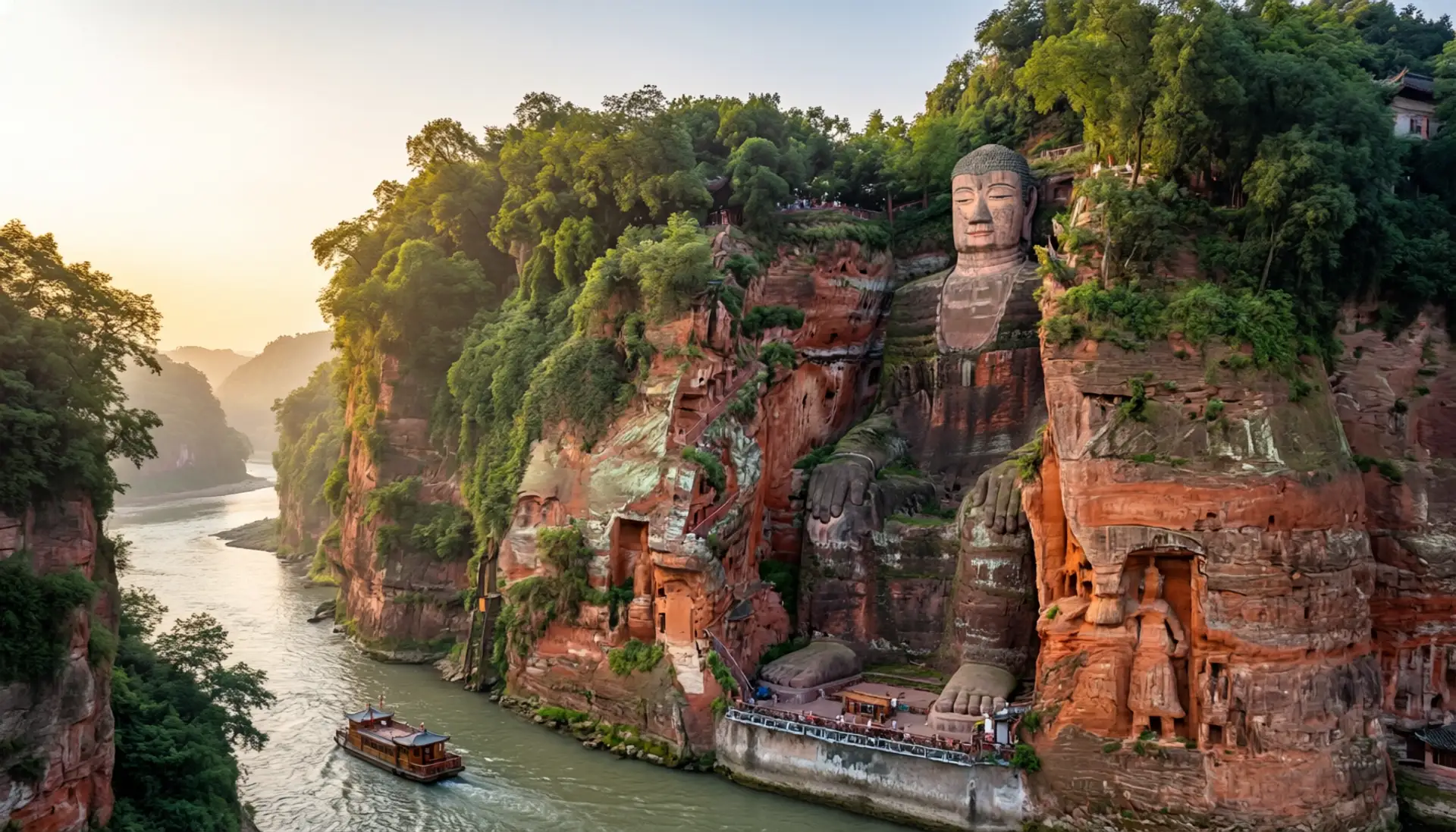
In the heart of southern Sichuan, where three mighty rivers converge beneath a sandstone cliff, sits a statue so vast it took 90 years to carve and has watched over the waterways for over 1,300 years. The Leshan Giant Buddha is not just the largest stone Buddha in the world — it is a monument to devotion, engineering, and the sheer audacity of human ambition. This comprehensive guide covers everything you need to plan your visit, from getting there to what to eat.
Trip Overview: Leshan Giant Buddha at a Glance
Item | Details |
|---|---|
Distance from Chengdu | 150 km (93 miles) |
Travel time (high-speed rail) | 1 hour |
Recommended time on-site | 5-7 hours |
Entrance ticket (peak season) | 160 RMB ($22) |
Entrance ticket (off season) | 80 RMB ($11) |
River cruise (optional) | 70 RMB ($10) |
Best months | April, October, November |
Worst time | June-August, October 1-7 |
Total budget (solo, budget) | 350 RMB ($49) |
Total budget (solo, comfortable) | 580 RMB ($81) |
Main attraction | 71m stone Buddha, cliff-carved |
UNESCO status | World Heritage Site (1996) |
Best photo spot | Feet platform (up) + river cruise (full) |
Must-try food | Qiaojiao Beef, Sweet Skin Duck |
Nearby extension | Mount Emei (UNESCO, 30 km away) |
Pro tip: If you only have one day, take the first high-speed train from Chengdu (departing around 7:00 AM), arrive by 8:15 AM, and enter the park before tour groups arrive. Do the cliff-stair descent first (the longest queue), then Lingyun Temple, then the river cruise. You will be back in Chengdu by 7 PM.
What Is the Leshan Giant Buddha? — The World's Largest Stone Buddha
The Leshan Giant Buddha (leshan dafo) is a 71-meter-tall statue of Maitreya — the future Buddha — carved directly into the red sandstone cliff face at Lingyun Mountain, where the Minjiang, Dadu, and Qingyi rivers converge in what is today Leshan City, Sichuan Province. It is the largest stone Buddha statue in the world and one of the most ambitious Buddhist sculpture projects in human history.
To put the scale in perspective: the Buddha is taller than a 20-story building. Its head alone is 14.7 meters high and 10 meters wide — large enough to fit a small bus inside. Each ear is 7 meters long. Each foot is 8.5 meters wide — you could fit 100 people standing on a single foot. The statue's shoulders span 28 meters across. The 1,021 twisted hair buns on the Buddha's head are each the size of a large watermelon.
Key Statistics at a Glance
Dimension | Measurement |
|---|---|
Total Height | 71 meters (233 feet) |
Head Height | 14.7 meters (48 feet) |
Head Width | 10 meters (33 feet) |
Shoulder Width | 28 meters (92 feet) |
Ear Length | 7 meters (23 feet) |
Foot Length | 8.5 meters (28 feet) |
Foot Width | 8.5 meters (28 feet) |
Hair Buns | 1,021 individually carved spirals |
Nose Length | 5.6 meters (18 feet) |
Finger Length | 8.3 meters (27 feet) |
Construction Period | 713-803 AD (90 years) |
Dynasty | Tang Dynasty (618-907 AD) |
Material | Red sandstone, carved in situ |
UNESCO Status | World Heritage Site since 1996 |
Elevation Above River | Approximately 71 meters at head level |
The History Behind the Leshan Giant Buddha: Monk Haitong's Vision
The Monk Haitong and the River Monster
In the early 8th century, the confluence of the Minjiang, Dadu, and Qingyi rivers was one of the most dangerous waterways in Sichuan. The three rivers collided at the base of Lingyun Mountain, creating massive whirlpools and turbulent currents that regularly capsized boats and drowned merchants, fishermen, and pilgrims. Local people believed a water monster lived beneath the surface.
A Buddhist monk named Haitong (also known as Monk Tong) conceived an audacious plan: to carve a massive Buddha statue into the cliff face so that the rubble from the carving would fill the riverbed, calming the waters and making the confluence safe for navigation. Whether the engineering logic was intentional or spiritual, the rubble from the carving did indeed alter the riverbed, and the waters became calmer over the centuries that followed.
Haitong began fundraising by traveling across Sichuan, collecting donations from commoners and officials alike. When a local official demanded the donated funds for himself, Haitong reportedly gouged out his own eyes and presented them, declaring: "I would rather give my eyes than the money meant for the Buddha." The official fled in terror. This story is carved into a stone tablet near the Buddha and remains one of the most dramatic episodes in Chinese Buddhist history.
"I would rather give my eyes than the money meant for the Buddha." — Monk Haitong, 8th century. This declaration is carved into a stone tablet near the Giant Buddha and remains one of the most dramatic episodes in Chinese Buddhist history.
Construction Timeline
Period | Event |
|---|---|
713 AD | Monk Haitong begins the project, carving the Buddha's head first |
713-739 AD | Haitong oversees initial carving; he dies before completion |
739-763 AD | Work stalls due to lack of funding and political instability |
763-781 AD | Regional governor Wei Gao resumes construction using government funds |
781-803 AD | Wei Gao completes the statue and adds the wooden pavilion (later destroyed) |
803 AD | The Leshan Giant Buddha is officially completed after 90 years |
Tang Dynasty | A seven-story wooden pavilion protects the statue (later destroyed by war) |
Song-Yuan | Buddha falls into disrepair; vegetation covers the statue |
Ming Dynasty | Restoration efforts repair cracks and rebuild protective structures |
1982 | Designated a National Key Cultural Relic Protection Unit by China |
1996 | Inscribed as UNESCO World Heritage Site (with Mount Emei) |
2001 | Major restoration: repairs head, face, and drainage system |
2018-2019 | Latest large-scale restoration of the Buddha's chest and abdomen |
2024 | Ongoing monitoring and maintenance; drone inspections implemented |
Engineering Secrets: The Hidden Drainage System
The original builders also applied a protective plaster and paint coating. Historical records suggest the Buddha was originally painted in vivid colors — golden skin, red robes, and blue hair. Today, only traces of pigment remain, and the statue has the natural sandstone color that most visitors recognize.
The Buddha features a cleverly designed hidden drainage system carved into the hair buns, collar, chest, and back. These channels direct rainwater away from the statue's surface, preventing erosion and water damage. This engineering solution is a major reason the statue has survived for 1,300 years despite constant exposure to rain, humidity, and river moisture.
Why the Leshan Buddha Matters: UNESCO World Heritage Significance
The Leshan Giant Buddha was inscribed as a UNESCO World Heritage Site in 1996, as part of the "Mount Emei Scenic Area, including Leshan Giant Buddha Scenic Area." The designation recognizes both the cultural and natural significance of the site.
Comparison: Leshan Buddha vs Other Giant Buddha Statues
Statue | Location | Height | Material | Era | Status |
|---|---|---|---|---|---|
Leshan Giant Buddha | Sichuan, China | 71 m | Stone, carved in situ | Tang (803 AD) | Largest stone Buddha |
Bingling Temple Buddha | Gansu, China | 27 m | Stone, carved in cliff | Tang (7th c.) | Cave temple complex |
Yungang Big Buddha | Shanxi, China | 17 m | Stone, cave carving | Northern Wei (5th c.) | UNESCO site |
Longmen Vairocana | Henan, China | 17.14 m | Stone, cave carving | Tang (672 AD) | UNESCO site |
Todai-ji Great Buddha | Nara, Japan | 14.98 m | Bronze, cast | Nara (752 AD) | National Treasure |
Kamakura Great Buddha | Kanagawa, Japan | 13.35 m | Bronze, cast | 1252 AD | National Treasure |
Spring Temple Buddha | Henan, China | 128 m | Bronze, modern | 2002 (completed 2008) | Tallest Buddha statue (modern) |
Laykyun Sekkya | Monywa, Myanmar | 116 m | Concrete, modern | 1996-2008 | Tallest standing Buddha |
Key distinction: The Leshan Buddha is the largest pre-modern stone Buddha carved directly into a cliff face. Modern concrete-and-bronze statues like the Spring Temple Buddha (128m) are taller but were built using modern construction techniques. Leshan's significance lies in its 1,300-year-old engineering, not just its size.
How to Get to Leshan from Chengdu — 4 Transportation Options
Leshan is approximately 150 kilometers (93 miles) south of Chengdu. There are four main ways to get there, each with different trade-offs in cost, speed, and convenience.
Transportation Comparison
Method | Duration | Cost (one-way) | Frequency | Best For |
|---|---|---|---|---|
High-speed rail | 1 hour | 54 RMB ($7.50) | Every 20-30 min | Fastest, most reliable |
Direct tourist bus | 2-2.5 hours | 55-65 RMB ($7.60-9) | Hourly | Budget travelers, no transfers |
Private car/driver | 1.5-2 hours | 400-600 RMB ($55-85) | On demand | Families, groups, flexibility |
River cruise (Chengdu-Leshan) | Varies | Not regular | Seasonal | Scenic route enthusiasts |
Option A: High-Speed Rail (Recommended)
The Chengdu-Leshan high-speed rail is the fastest and most popular option. Trains depart from Chengdu East Railway Station (Chengdudong) and arrive at Leshan Railway Station (Leshanzhan) in approximately 1 hour.
Departure station: Chengdu East Railway Station (accessible by Metro Line 2 or 7)
Arrival station: Leshan Railway Station
Travel time: 50-70 minutes depending on train type
Cost: 54 RMB second class, 86 RMB first class
Frequency: Trains every 20-30 minutes from 6:30 AM to 9:00 PM
Booking: Use the 12306.cn website or app, or buy at the station with passport
Tip: Book 1-3 days in advance, especially for weekend and holiday travel
From Leshan Station to the Buddha
Leshan Railway Station is about 10 kilometers from the Leshan Giant Buddha scenic area. Three options:
Taxi: 20 minutes, 25-35 RMB ($3.50-5). Most convenient.
Public bus: Bus K1 or Route 3 from the station, 30-40 minutes, 2 RMB. Drops you at the North Gate.
Didi (ride-hailing): Similar to taxi, slightly cheaper at 20-28 RMB
Option B: Direct Tourist Bus
Direct buses run from Chengdu Xinnanmen Bus Station (also called Tourism Bus Station) to the Leshan Giant Buddha bus parking area. This is the simplest option for those who want to avoid railway station transfers.
Departure: Chengdu Xinnanmen Bus Station (Metro Line 1, Xinnanmen Station)
Arrival: Leshan Giant Buddha tourist bus parking (walking distance to North Gate)
Travel time: 2-2.5 hours depending on traffic
Cost: 55-65 RMB ($7.60-9) one-way
Frequency: Every 30-60 minutes from 7:30 AM to 4:30 PM
Advantage: No transfer needed — the bus drops you at the scenic area entrance
Option C: Private Car or Driver
For families, groups of 3+, or travelers who want maximum flexibility, hiring a private car with a driver is cost-effective and convenient. The driver can wait for you at the scenic area and take you to lunch and nearby attractions.
Cost: 800-1300 RMB ($119-194) for a full-day round trip from Chengdu
Vehicle: Sedan for 1-3 passengers, van for 4-7 passengers
Booking: Arrange through your hotel or travel agencies, or use Didi/CTrip car service
Advantage: Door-to-door service, flexible schedule, can visit Mount Emei on the same trip
Option D: Organized Day Tour
Many travel agencies in Chengdu offer organized day tours to the Leshan Buddha, sometimes combined with Mount Emei or a river cruise. Prices range from 180-350 RMB per person including transport, guide, and tickets.
Pros: No planning needed, guide explains history, group discount on tickets
Cons: Fixed schedule, limited time at the Buddha (usually 2-3 hours), forced shopping stops on some tours
Recommendation: Only book tours that explicitly state "no shopping stops" (bu gou wu). Read reviews carefully.
Warning: Some budget tours (under 150 RMB) compensate for low prices by taking you to jade, silk, or tea shops for 1-2 hours. If a tour price seems too good to be true, it probably includes mandatory shopping stops. Always confirm the itinerary before booking.
Leshan Giant Buddha Tickets: Complete Pricing & Buying Guide
Ticket Prices
Ticket Type | Peak Season (Apr-Oct) | Off Season (Nov-Mar) | Includes |
|---|---|---|---|
Standard entrance | 160 RMB ($22) | 80 RMB ($11) | Buddha + Lingyun Temple + Wuyou Temple |
Student ticket | 80 RMB ($11) | 40 RMB ($5.50) | Same (with valid student ID) |
Senior (65+) | Free | Free | Same (with ID showing age) |
Children (under 1.2m) | Free | Free | Same |
Children (1.2m-1.5m) | Half price | Half price | Same |
River cruise (optional) | 70 RMB ($10) | 70 RMB ($10) | Boat tour to view Buddha from river |
Audio guide rental | 20 RMB ($2.80) | 20 RMB ($2.80) | Available in Chinese, English, Japanese |
How to Buy Tickets
Online: Book through the official WeChat mini-program "leshan dafo" (scan the QR code at the entrance), or through CTrip, Meituan, or Fliggy. Online booking is required during peak season and holidays.
On-site: Ticket counters at the North Gate and East Gate. Bring your passport (foreign visitors) or ID card (Chinese citizens). During peak season, expect 20-40 minute queues at ticket windows.
Passport required: All foreign visitors must present a valid passport to enter. No photocopies or photos accepted. This is a strict policy.
Advance booking: During Chinese National Day (October 1-7), Spring Festival, and summer weekends (July-August), online advance booking is mandatory and daily visitor caps may apply.
Money-saving tip: The standard entrance ticket includes Lingyun Temple, the Buddha cliff descent, and Wuyou Temple across the river. There is no separate ticket needed for these. The river cruise is optional and costs extra. If you want the full experience, budget 230 RMB total (160 entrance + 70 cruise) during peak season.
When Is the Best Time to Visit the Leshan Giant Buddha?
Season-by-Season Guide
Season | Months | Weather | Crowds | Pros | Cons |
|---|---|---|---|---|---|
Spring | Mar-May | 15-25C, mild | Moderate | Green scenery, comfortable | Spring rain in April-May |
Summer | Jun-Aug | 25-35C, humid | Very heavy | Longest daylight hours | Heat, crowds, thunderstorms |
Autumn | Sep-Nov | 15-28C, clear | Moderate to heavy | Best weather, clear photos | National Day rush (Oct 1-7) |
Winter | Dec-Feb | 5-12C, cold | Light | No queues, cheaper tickets | Cold, shorter daylight, grey sky |
Detailed Monthly Recommendations
Best Months: April, October, November
April offers mild temperatures, blooming flowers along the cliff paths, and moderate crowds before the summer rush. October and November bring crisp autumn air, clear blue skies ideal for photography, and the sandstone cliff glows warm amber in the afternoon light. The only exception is October 1-7 (National Day holiday), when crowds are at peak levels — avoid this week entirely.
Acceptable Months: March, May, September
March is early spring — still cool but warming, with fewer tourists. May is pleasant but can be rainy. September is the start of the autumn high season, with good weather but increasing crowds as schools resume.
Avoid: June-August, October 1-7
Summer months (June-August) bring extreme heat (35C+), high humidity, and massive domestic tourist crowds. The cliff stair queue can exceed 3 hours. The October National Day holiday (October 1-7) is the single busiest week of the year — the park may implement crowd control measures and cap daily entries. If you must visit during these periods, arrive before 8 AM and bring water, sunscreen, and patience.
Hidden Gem: December-February
Winter is the secret best time for independent travelers who do not mind the cold. Tickets drop to 80 RMB, there are almost no queues, and the Buddha takes on a solemn, misty atmosphere when fog rolls in from the rivers. The temperature ranges 5-12C, so bring warm layers. Photography is challenging due to overcast skies, but the experience is peaceful and meditative.
Best time of day: Arrive at 8:00 AM (park opening) to beat the tour groups. The morning light (8-10 AM) illuminates the Buddha's face perfectly for photography. If you want to see the Buddha from the river cruise, the best light is 3-5 PM when the sun is lower and the cliff face glows warm.
Exploring the Leshan Giant Buddha: Nine-Bend Plank Road, Feet Platform & More
The Main Buddha Statue
The main attraction is, of course, the Buddha itself. You will see it from multiple angles as you move through the park. Your first glimpse is from the top of the cliff, looking down at the Buddha's massive head and shoulders. From here, you join the queue for the Nine-Bend Plank Road (jiuqu zhan dao), the narrow stairway carved into the cliff face that descends to the Buddha's feet.
At the head level, you can see the 1,021 individually carved hair buns (luoji), each a tightly wound spiral of sandstone. The ears, originally carved from wood and later replaced with stone, measure 7 meters each. The eyes are half-closed in meditation, and the lips bear a faint, enigmatic smile. The face is 14.7 meters tall — the size of a four-story building.
The Nine-Bend Plank Road (Jiuqu Plank Road)
The Nine-Bend Plank Road is the most thrilling — and most physically demanding — part of the Leshan Buddha experience. This narrow stone stairway zigzags down the cliff face alongside the Buddha, descending from the head (top of the cliff) to the feet (river level). The path is approximately 500 meters long but drops 71 meters in elevation through a series of switchbacks, some only 1-1.5 meters wide with a sheer cliff wall on one side and a stone railing on the other.
The plank road was originally carved during the Tang Dynasty as part of the construction process, allowing workers to access different parts of the statue. Today, it is the only way to reach the Buddha's feet viewing platform. Along the way, you pass shoulder-level, arm-level, and hand-level viewpoints, each offering a unique perspective on the statue's massive scale.
Width: 1-1.5 meters at most points
Steps: Approximately 300+ stone steps
Direction: One-way only — you descend, then exit through a different path. You cannot go back up.
Time needed: 30-45 minutes (plus queue time, which can be 1-3 hours in peak season)
Difficulty: Moderate. The steps are uneven and steep. Not suitable for those with mobility issues, heart conditions, or severe fear of heights (acrophobia).
What to bring: Comfortable walking shoes with grip. No heels, no slippery sandals. Bring water — there is no vendor on the stairs.
Safety note: The plank road is one-way (downhill only). Once you start descending, you must continue to the bottom. If you have knee problems, use the handrails and descend slowly. Do not stop on the stairs to take photos — there are designated viewing platforms where you can pause. The stairway can be congested; be patient and do not push.
The Buddha's Feet Viewing Platform
At the bottom of the plank road, you arrive at the Buddha's feet viewing platform. This is the single most awe-inspiring viewpoint in the entire park. Standing at the feet and looking up, you see the full 71-meter height of the statue towering above you. Each foot is 8.5 meters long and 8.5 meters wide — you can stand on the platform next to a single toe that is taller than most people.
This is where the scale truly hits you. Photos do not convey the experience of standing at the base and craning your neck to see the Buddha's face 60 meters above. Take time here — it is the emotional climax of the visit. The platform can get crowded, but people move through in 10-15 minutes.
Photography tip: At the feet platform, use a wide-angle lens (16-24mm full-frame equivalent) to capture the full height of the Buddha. For scale, include a person standing near the toes. The best angle is from the far left corner of the platform, looking up and to the right, which frames the Buddha against the sky.
The Three-River Confluence
The Leshan Giant Buddha sits at one of the most geographically significant points in Sichuan — the confluence of three major rivers. Understanding this geography helps you appreciate why the Buddha was built here and why it was such an engineering achievement.
River | Origin | Length | Character | Direction at Leshan |
|---|---|---|---|---|
Minjiang (Min River) | Min Mountain, Songpan | 735 km | Largest tributary of the upper Yangtze | Flows south to Leshan |
Dadu River | Daxue Mountains, Sichuan | 1,155 km | Fast-flowing, mountain river | Flows east to Leshan |
Qingyi River | Qionglai Mountains | 279 km | Smaller, calmer tributary | Flows southeast to Leshan |
After confluence | Leshan | — | Combined flow south to Yangtze at Yibin | Flows south toward Yibin |
Before the Buddha was carved, these three rivers crashed together at the base of Lingyun Mountain, creating whirlpools that sank countless boats. The rubble from the carving project filled in the most dangerous sections of the riverbed, gradually calming the waters. Today, the confluence is still visually dramatic — you can see the different-colored waters of each river mixing as they merge, especially from the Lingyun Temple terrace or the river cruise.
Geography note: The three rivers you see at Leshan eventually merge into the Yangtze River system. The Minjiang (after receiving the Dadu and Qingyi) flows south to Yibin, where it joins the Yangtze. So the Buddha sits at a crossroads of Chinese waterways — a fact that made Leshan a wealthy trading port in ancient times.
Lingyun Temple and Wuyou Temple: Ancient Monasteries Above the Buddha
Lingyun Temple (Lingyun Si)
Lingyun Temple (also called Lingyun Monastery) is a Buddhist temple complex located on the cliff top directly above the Giant Buddha. Founded during the Tang Dynasty, it predates the Buddha itself — the temple was already established when Monk Haitong chose the cliff below it for his carving project. The temple is included in your entrance ticket and is worth 45-60 minutes of exploration.
What to See at Lingyun Temple
Main Hall (Daxiong Baodian): Houses three large golden Buddha statues representing the past, present, and future Buddhas. The central figure is Maitreya — the same Buddha depicted in the giant cliff carving below.
Haitong Memorial Hall: A small shrine dedicated to the monk who began the project. Contains a statue of Haitong and stone tablets recounting the story of his self-blinding to protect the donation funds.
Cliff inscriptions: Along the temple walls and cliff face, you will find carved calligraphy and poems by Tang and Song Dynasty scholars, including works by Su Shi (Su Dongpo), the famous Song Dynasty poet who lived in Leshan.
Lingyun Cliff (Lingyun Si Cliff): The terrace behind the temple offers panoramic views of the three-river confluence and the city of Leshan. On clear days, you can see for miles downriver.
Incense burner courtyard: The temple courtyard has a large bronze incense burner where pilgrims light incense. You can buy incense from vendors outside the temple for 10-20 RMB.
Wuyou Temple & Wuyou Hill
Wuyou Temple is located on a separate hill across the river from the Giant Buddha. Many visitors miss it because they do not realize it is included in the ticket. This is a mistake — Wuyou Temple is one of the oldest and most atmospheric Buddhist sites in Sichuan, and the hilltop offers the best land-based view of the Buddha from across the river.
How to Reach Wuyou Temple
After exiting the Buddha area (at the river-level gate), cross the bridge over the river. The walk to Wuyou Temple takes about 15-20 minutes along a riverside path. Alternatively, you can take a small ferry boat (included with your ticket) across the river — a 3-minute crossing that saves the walk.
What to See at Wuyou Temple
Luohan Hall: Contains 500 individually carved wooden arhat (luohan) statues, each with a unique facial expression and posture. This is one of the finest collections of arhat sculptures in China. Allow 20-30 minutes to walk through.
Bamboo forest path: A stone path winds through a dense bamboo grove leading to the temple entrance. The bamboo creates a green canopy that filters the light beautifully — ideal for photography.
River viewpoint: From the hillside above the temple, you get the best land-based view of the Giant Buddha from across the river. The distance gives you a sense of the Buddha's full proportions that you cannot get up close.
Stone buddha gallery: A collection of Tang Dynasty stone buddha fragments and stele, some predating the Giant Buddha itself.
Insider tip: Most tour groups skip Wuyou Temple to save time, which means it is usually quiet and uncrowded. If you want a peaceful temple experience away from the crowds, spend an hour here. The arhat hall alone is worth the visit.
The Leshan River Cruise: The Only Way to Photograph the Full Buddha
The river cruise is an optional add-on (70 RMB) that takes you by boat to the middle of the river confluence, where you can see the full Giant Buddha from a distance that is impossible to achieve from land. From the river, you can appreciate the entire cliff face and the Buddha in its full context — a tiny figure carved into a massive mountain, yet dominating the landscape.
River Cruise Details
Aspect | Details |
|---|---|
Duration | 30-40 minutes total (including boarding) |
Cost | 70 RMB ($10) — not included in standard entrance ticket |
Boarding point | Pier near the Buddha feet exit gate |
Boat type | Covered motorized boat with open-air viewing deck |
Best light | 3:00-5:00 PM (afternoon sun illuminates the cliff face) |
What you see | Full front view of the Buddha from river level, cliff face, river confluence |
Photography | Excellent — the only way to capture the full Buddha in one frame |
Seasickness | River is calm; not an issue for most passengers |
River Cruise vs. Land View: Which Is Better?
Factor | River Cruise | Land View (Cliff + Feet) |
|---|---|---|
Full-body view | Yes — only way to see entire Buddha at once | No — too close to see full statue |
Scale appreciation | Good — shows Buddha in landscape context | Excellent — standing at feet is overwhelming |
Detail visibility | Limited — 100+ meters away | Excellent — can see hair buns, fingers, toenails |
Photography | Best for wide-angle full-Buddha shot | Best for detail and scale shots |
Physical effort | Minimal — sit on boat | Moderate — descend 300+ cliff stairs |
Time needed | 40 minutes | 2-3 hours (including queue) |
Cost | Extra 70 RMB | Included in entrance ticket |
Crowd level | Moderate | Heavy (very heavy in peak season) |
Recommendation: Do both. The land view gives you the emotional impact of scale (standing at the feet); the river cruise gives you the only photograph that captures the entire Buddha in one frame. If you are short on time and must choose, take the land view — the cliff descent and feet platform are the core experience.
A Perfect One-Day Leshan Itinerary from Chengdu
This itinerary is designed for a single day trip, maximizing your experience while minimizing queue time. It assumes you start from Chengdu and return the same evening.
The Perfect One-Day Schedule
Time | Activity | Location | Duration | Notes |
|---|---|---|---|---|
6:30 AM | Depart hotel for Chengdu East Station | Chengdu | 30 min | Take Metro Line 2 or 7 |
7:00 AM | High-speed train to Leshan | Chengdu East | 1 hour | First trains are less crowded |
8:15 AM | Arrive Leshan Station, taxi to Buddha | Leshan | 20 min | Taxi or Didi, 25-35 RMB |
8:45 AM | Enter North Gate, buy tickets | Buddha scenic area | 15 min | Have passport ready |
9:00 AM | Lingyun Temple (quick visit) | Cliff top | 45 min | See Haitong Hall, cliff inscriptions |
9:45 AM | Join queue for Nine-Bend Plank Road | Buddha head level | 1-2 hr | Queue is shortest in morning |
10:45 AM | Descend cliff stairs to feet | Cliff face | 30-45 min | One-way, downhill only |
11:30 AM | Photos at Buddha feet platform | River level | 15 min | Best scale experience |
11:45 AM | Exit feet area, walk to river | Riverside | 10 min | Follow signs to pier |
12:00 PM | Lunch at nearby restaurant | Near East Gate | 1 hr | Try Qiaojiao Beef, Sweet Skin Duck |
1:00 PM | River cruise for full Buddha view | River pier | 40 min | Best afternoon light for photos |
1:45 PM | Cross to Wuyou Temple | Across river | 15 min | Walk or ferry (included) |
2:00 PM | Explore Wuyou Temple | Wuyou Hill | 1 hr | 500 Arhats, bamboo path, viewpoint |
3:00 PM | Return to main area, rest/snacks | Scenic area | 30 min | Tea, souvenirs, rest |
3:30 PM | Free time: cliff walk, calligraphy | Lingyun area | 1 hr | Optional: revisit temple for evening light |
4:30 PM | Depart scenic area | Leshan | 15 min | Taxi or bus to station |
5:00 PM | Train back to Chengdu | Leshan Station | 1 hour | Book return ticket in advance |
6:15 PM | Arrive Chengdu | Chengdu East | — | Metro back to hotel |
This schedule assumes a moderate pace. If you are traveling with children or seniors, skip Wuyou Temple and add the time to the river cruise and temple. If you are an avid photographer, spend more time at the feet platform and the river cruise, and skip the free-time block at the end.
Two-Day Extended Itinerary
If you have two days, combine the Leshan Buddha with Mount Emei (Emeishan), another UNESCO World Heritage Site located 30 km from Leshan. Day 1 covers the Leshan Buddha as described above. Stay overnight in Leshan (200-500 RMB/night) or at the foot of Mount Emei. Day 2: take the early shuttle to Mount Emei, ride the cable car to the Golden Summit (Jinding) at 3,079 meters, visit the Huazang Temple, and return to Chengdu by evening.
Mount Emei entry ticket: 160 RMB (peak) / 90 RMB (off-peak)
Cable car (round trip): 120 RMB to Golden Summit
Sightseeing bus (round trip): 90 RMB from base to Leidongping
Total add-on cost for Day 2: Approximately 370 RMB ($52) per person
Nearby Attractions Worth Considering
If you have extra time in Leshan, these attractions are within 30 minutes of the Giant Buddha and can be combined with your day trip.
Mount Emei (Emeishan): A UNESCO World Heritage Site (combined with the Leshan Buddha in the same inscription). One of the Four Sacred Buddhist Mountains of China, with temples dating back to the 1st century AD. The Golden Summit at 3,079 meters offers spectacular views and a massive golden statue of Samantabhadra. Distance: 30 km (40 minutes by bus). Ticket: 160 RMB (peak season).
Jiazhou Old Street (Jiazhou Gucheng): A historic neighborhood in downtown Leshan with preserved Qing Dynasty architecture, teahouses, and artisan shops. Good for an afternoon stroll. Free to enter. 10 minutes from the Buddha by taxi.
Leshan Sleeping Buddha: A natural rock formation visible from across the river that resembles a reclining Buddha, with the Giant Buddha sitting on its chest. Best viewed from the Wuyou Temple hillside.
Mahao Cave Tombs: Han Dynasty (206 BC-220 AD) cliff-side burial caves located near the Buddha scenic area. These predate the Buddha by 800+ years. Entry is free with your Buddha ticket. 15-minute walk from the Buddha feet exit.
Pingqiang Xiaozhou (Rafting): A scenic rafting route on the Qingyi River upstream from Leshan, passing through gorges and countryside. Available April-October. Costs 150-200 RMB per person.
Photography Guide: Best Spots and Settings for the Leshan Buddha
The Leshan Giant Buddha presents unique photography challenges and opportunities. The statue is so large that no single land-based vantage point can capture it in its entirety. Here is a comprehensive guide to getting the best photos.
Key Photo Spots
Location | What to Shoot | Lens Recommendation | Best Light | Difficulty |
|---|---|---|---|---|
Buddha head level (top of cliff) | Head and hair buns in detail | 24-70mm | 8-10 AM | Easy |
Plank Road switchbacks | Buddha body parts from different angles | 16-35mm wide | Morning | Moderate (narrow path) |
Feet platform (looking up) | Full height with people for scale | 16-24mm ultra-wide | Any time | Easy (but crowded) |
River cruise (mid-river) | Entire Buddha in one frame | 70-200mm telephoto | 3-5 PM | Easy (boat may rock) |
Lingyun Temple terrace | River confluence panorama | 24-70mm | Afternoon | Easy |
Wuyou Hill viewpoint | Buddha across the river | 70-200mm telephoto | Morning | Moderate (hike up) |
Bridge crossing to Wuyou | Buddha with river foreground | 24-70mm | Afternoon | Easy |
Photography Tips
Include people for scale: The Buddha is so large that without a human reference, photos look like an abstract rock face. Position a person near the feet, hands, or on the plank road.
Shoot in RAW: The sandstone has a wide dynamic range. RAW gives you recovery latitude for highlights and shadows.
Use a polarizing filter: Cuts glare on the sandstone and deepens the blue sky, making the warm sandstone pop.
Shoot vertically (portrait orientation): For the feet-platform upward shot, vertical framing captures the full height of the Buddha.
Shoot the river cruise from the right side: The boat approaches the Buddha from the right side. Sit on the right for the best angle.
Avoid midday sun: Between 11 AM and 2 PM, the harsh overhead light flattens the Buddha's features. Morning and late afternoon are best.
Drone photography: Drone flights are prohibited in the scenic area. Do not attempt to fly a drone — park rangers will confiscate it.
Camera settings cheat sheet: For the feet platform looking up — 16mm, f/8, ISO 100-400 (depending on light), shutter 1/125 or faster. For the river cruise — 70-200mm, f/5.6-8, ISO 200-400, shutter 1/250 or faster (to counteract boat movement). For detail shots (hair buns, fingers) — 70-200mm close focus, f/4-5.6.
Leshan Food Guide: Qiaojiao Beef, Sweet Skin Duck and Local Specialties
Leshan has a distinctive food culture that differs from Chengdu's Sichuan cuisine. The city sits at the river confluence, so freshwater fish and river ingredients feature prominently. Leshan is also known for its street food culture — the night markets here rival those of Chengdu but with unique local specialties.
Must-Try Leshan Specialties
Qiaojiao Beef (Qiaojiao Niu Rou)
Leshan's most famous dish. Beef (including offal, tendon, and bone marrow) is slow-cooked for hours in a clear herbal broth with dozens of Chinese medicinal herbs and spices. The name "qiaojiao" (crossing legs) comes from the tradition of customers sitting with crossed legs at low street-side tables. The broth is rich, savory, and slightly herbal; the beef is fall-apart tender.
Where to eat: Su Ji Qiaojiao Beef (Su Restaurant) on Yutian Street — the most famous, operating since 1888. Also available at most restaurants near the scenic area.
Price: 40-80 RMB per person
Must-try variant: Ask for the mixed platter (banpen) which includes brisket, tendon, tripe, and marrow.
Leshan Sweet Skin Duck (Tianpi Ya)
A Leshan specialty distinct from Chengdu's spicy duck. The duck is marinated in soy sauce, sugar, and spices, then roasted until the skin becomes glossy, amber-colored, and candied-crisp. The meat underneath is tender and fragrant. The contrast between the sweet, crunchy skin and the savory meat is addictive.
Where to buy: Zhao Duck (Zhao Ya) on Yutian Street, or any stall displaying hanging ducks with glossy skin. Buy half a duck for 30-40 RMB.
Best eaten: Warm, within an hour of purchase. The skin loses its crunch after refrigeration.
Bobo Chicken (Bobo Ji)
Not actually chicken — a street-food style where skewers of various ingredients (chicken, beef, offal, vegetables, tofu) are dunked in a spicy, sesame-oil-rich sauce served in a ceramic bowl (bobo). You pay per skewer (usually 1-3 RMB each). Leshan claims to be the origin of this dish, though Chengdu also claims it.
Where: Bobo Chicken stalls along Yutian Street and Zhanggongqiao Food Street.
Leshan Tofu Nao (Soft Tofu Pudding)
A breakfast favorite: silken soft tofu served in a bowl with spicy sauce, soy sauce, sesame oil, crushed peanuts, and pickled vegetables. Unlike the sweet version found in northern China, Leshan tofu nao is savory and spicy. Costs 5-8 RMB per bowl.
River Fish (He Yu)
Freshwater fish from the Minjiang River, typically cooked in a spicy Sichuan broth or braised with doubanjiang (fermented bean paste). The most common variety is Jiang Tuan (a type of catfish). Expect to pay 80-150 RMB per fish at restaurants near the scenic area.
Best Food Streets & Restaurants
Location | Specialty | Price Range | Atmosphere | Recommended Dishes |
|---|---|---|---|---|
Zhanggongqiao Food Street | Street food, night market | 10-50 RMB/person | Bustling, outdoor seating, red lanterns | Bobo chicken, skewers, sweet duck |
Yutian Street | Old restaurants, traditional | 40-100 RMB/person | Low tables, crossed-leg seating | Qiaojiao beef, sweet skin duck |
Near East Gate | Tourist restaurants | 50-120 RMB/person | Convenient but pricier | River fish, Sichuan stir-fries |
Jiazhou Old Street | Snacks, tea houses | 5-30 RMB/person | Historic, atmospheric | Tofu nao, sweet potatoes, tea |
Lunch strategy: Eat at Zhanggongqiao Food Street (15-minute walk from the East Gate) instead of the restaurants inside the scenic area, which charge 2-3x normal prices for mediocre food. A full meal at the food street costs 30-60 RMB per person; inside the park, the same costs 80-150 RMB.
Cultural Etiquette and Buddhist Customs at the Leshan Buddha
The Leshan Giant Buddha is not just a tourist attraction — it is an active Buddhist pilgrimage site. Monks live and worship at Lingyun Temple and Wuyou Temple. Understanding and respecting Buddhist customs will enhance your experience and show respect to local worshippers.
Dress Code
Cover shoulders and knees. Avoid tank tops, sleeveless shirts, shorts, and mini-skirts.
Wear comfortable, closed-toe shoes (you will be descending cliff stairs).
Remove hats and sunglasses when entering temple halls.
Avoid clothing with Buddhist symbols worn in a casual or ironic way.
Behavior in Temple Areas
Speak softly. Loud conversation, shouting, or playing music is disrespectful.
Do not touch Buddha statues, offering tables, or ritual objects.
Do not point at Buddha statues with your finger — use an open palm gesture.
Do not take photos inside main halls (look for "no photography" signs).
If monks are chanting, stand quietly and observe. Do not interrupt or walk in front of them.
Do not step on door thresholds when entering halls — step over them (a traditional Chinese custom).
If You Wish to Pray or Make an Offering
Lighting incense: Use 3 sticks (representing Buddha, Dharma, and Sangha). Hold with both hands at forehead level, bow 3 times, then place in the incense burner.
Do not blow on incense to extinguish — wave it gently instead.
Offering money: There are donation boxes in temples. Any amount is accepted. Do not put money directly on altars or statues.
Prayer posture: Kneel on the cushion, bow 3 times with forehead touching the ground, then kneel upright with hands pressed together (gassho mudra).
Interacting with Monks
Do not touch a monk's head (the head is sacred in Buddhist tradition).
Do not take photos of monks without permission.
If a monk offers you a blessing or a string bracelet, it is polite to accept it. A small donation (10-20 RMB) to the temple is appropriate but not mandatory.
Use both hands when giving or receiving anything from a monk.
Remember: You are visiting a place where people come to worship. Treat it with the same respect you would any place of worship in your home country, regardless of your own religious beliefs.
Budget Breakdown: What a Leshan Day Trip Really Costs
Solo Traveler — Budget Option
Item | Cost (RMB) | Cost (USD) |
|---|---|---|
High-speed train (round trip) | 108 | $15 |
Public bus station to Buddha (round trip) | 4 | $0.60 |
Entrance ticket (off-peak) | 80 | $11 |
River cruise | 70 | $10 |
Food (street food, 2 meals) | 50 | $7 |
Water & snacks | 15 | $2 |
Miscellaneous | 20 | $3 |
Total | 347 RMB | $48.60 |
Solo Traveler — Comfortable Option
Item | Cost (RMB) | Cost (USD) |
|---|---|---|
High-speed train (round trip) | 108 | $15 |
Taxi station to Buddha (round trip) | 60 | $8.50 |
Entrance ticket (peak season) | 160 | $22 |
River cruise | 70 | $10 |
Lunch at restaurant | 80 | $11 |
Snacks & drinks | 30 | $4 |
Audio guide | 20 | $3 |
Souvenirs | 50 | $7 |
Total | 578 RMB | $81 |
Family of 4 — Comfortable Option
Item | Cost (RMB) | Cost (USD) |
|---|---|---|
High-speed train (round trip x4) | 432 | $60 |
Taxi/van (round trip) | 120 | $17 |
Entrance tickets (2 adults + 2 children) | 400 | $56 |
River cruise x4 | 280 | $39 |
Lunch at restaurant | 300 | $42 |
Snacks & drinks | 60 | $8.50 |
Audio guide x2 | 40 | $5.60 |
Miscellaneous | 50 | $7 |
Total | 1,682 RMB | $236 |
Private Car with Driver — Full Day
Item | Cost (RMB) | Cost (USD) |
|---|---|---|
Private car with driver (full day) | 1100 | $162 |
High-speed train (not needed) | 0 | $0 |
Entrance ticket (peak) | 160 | $22 |
River cruise | 70 | $10 |
Lunch at restaurant | 80 | $11 |
Fuel & tolls (included) | 0 | $0 |
Snacks & drinks | 30 | $4 |
Total | 1440 RMB | $209 |
Budget tip: The biggest variable cost is transportation. If you are traveling solo, the high-speed rail is the most economical option. For groups of 3-4, splitting a private car costs about the same per person and offers much more flexibility — you can visit Mount Emei or stop at scenic viewpoints along the highway.
Final Tips: 10 Rules for Visiting the Leshan Giant Buddha
Arrive early. Be at the North Gate at 8:00 AM. The cliff stair queue grows exponentially after 10 AM.
Book train tickets in advance. The Chengdu-Leshan high-speed rail sells out on weekends and holidays.
Bring your passport. Foreign visitors cannot enter without a physical passport — no copies, no photos.
Wear grip shoes. The cliff stairs are uneven stone, sometimes damp. No heels, no flip-flops.
Do the cliff descent first. It has the longest queue. Do Lingyun Temple and river cruise afterward.
Eat outside the park. Zhanggongqiao Food Street is 15 minutes away and costs one-third of park food.
Take the river cruise. It is the only way to photograph the entire Buddha in one frame.
Visit Wuyou Temple. Most tour groups skip it, so it is quiet. The 500 arhats are extraordinary.
Avoid October 1-7. This is the busiest week of the year. Visit in April, November, or winter instead.
Respect the site. This is a Buddhist pilgrimage site. Dress modestly, speak quietly, and observe customs.
Practical Tips for International Visitors
English availability: Limited. Signs in the scenic area are in Chinese and English, but staff at ticket counters and restaurants rarely speak English.
Translation apps: Download Google Translate (with offline Chinese pack) or Baidu Translate. Photo-translation feature is very useful for menus and signs.
Key phrases: "Piao" = ticket. "Weisheng jian" = restroom. "Qu Leshan dafo zenme zou?" = How to get to the Leshan Buddha?
Emergency numbers: Police 110, Ambulance 120, Tourist complaint 12301
Currency: Chinese Yuan (RMB). Bring cash — some small food stalls and taxi drivers do not accept foreign cards.
Mobile payment: WeChat Pay and Alipay are accepted everywhere. Set up these apps before your trip. Some versions now accept foreign credit cards.
ATMs: Available at Leshan Railway Station and near the scenic area, but may not accept all international cards. Withdraw cash in Chengdu before departing.
What to Bring
Item | Why | Essential? |
|---|---|---|
Passport | Required for entry (foreign visitors) | Yes |
Comfortable walking shoes | Cliff stairs require grip | Yes |
Water bottle | Long walk, limited vendors on stairs | Yes |
Sunscreen & hat | Exposed cliff top, strong sun | Yes (summer) |
Light jacket | Morning chill, river breeze | Yes (spring/autumn) |
Snacks | Park food is expensive | Recommended |
Power bank | Long day, GPS, photos drain battery | Recommended |
Umbrella/rain jacket | Sichuan weather is unpredictable | Recommended (summer) |
Hand sanitizer | Restrooms may not have soap | Recommended |
Small backpack | Carry essentials hands-free | Recommended |
Connectivity
Wi-Fi: Limited free Wi-Fi at the scenic area. Do not rely on it.
Cellular data: China Mobile, China Unicom, and China Telecom all have good coverage at the site. 4G/5G is available throughout.
VPN: Google, Instagram, Facebook, and WhatsApp are blocked in China. Install a VPN before arriving, or use Chinese alternatives (WeChat, Baidu Maps).
Navigation: Apple Maps works in China. Google Maps is inaccurate and outdated for China. Use Baidu Maps (in Chinese) or Apple Maps.
Accessibility Assessment
The Leshan Giant Buddha scenic area presents significant challenges for visitors with mobility limitations. The terrain is inherently mountainous, with steep cliff stairs, narrow paths, and multiple elevation changes. However, parts of the site are accessible, and with careful planning, visitors with limited mobility can still experience the Buddha.
Area | Wheelchair Access | Mobility Aid Friendly | Notes |
|---|---|---|---|
North Gate entrance | Yes — paved ramp | Yes | Flat plaza, ticket counters accessible |
Lingyun Temple (cliff top) | Partial — some ramps | Yes, with difficulty | Some steps; main courtyard accessible |
Nine-Bend Plank Road | No | No | Narrow stairs, cliff edge, one-way only |
Buddha feet platform | No (only via plank road) | No | Only accessible by descending cliff stairs |
River cruise pier | Partial — steps to board | With assistance | Boat has steps; staff can assist |
Wuyou Temple | Partial | With difficulty | Hill path; some steps to arhat hall |
Restrooms | Yes — designated accessible restrooms | Yes | Available at North Gate and East Gate |
Parking | Yes — designated accessible spaces | Yes | Near North Gate entrance |
Best option for limited mobility: Take the river cruise. It is the only way to see the full Buddha without descending cliff stairs. The cruise is accessible with staff assistance for boarding. Visit Lingyun Temple at the cliff top for views of the Buddha's head and shoulders without the plank road.
The Leshan Giant Buddha is one of those rare sights that exceeds photographs. No image prepares you for standing at the feet of a 71-meter statue carved into a cliff by hand 1,300 years ago. Go early, be patient with the crowds, take the river cruise, eat the local food, and you will have one of the most memorable days of your China trip.

Traveler Discussions
Questions from travelers