
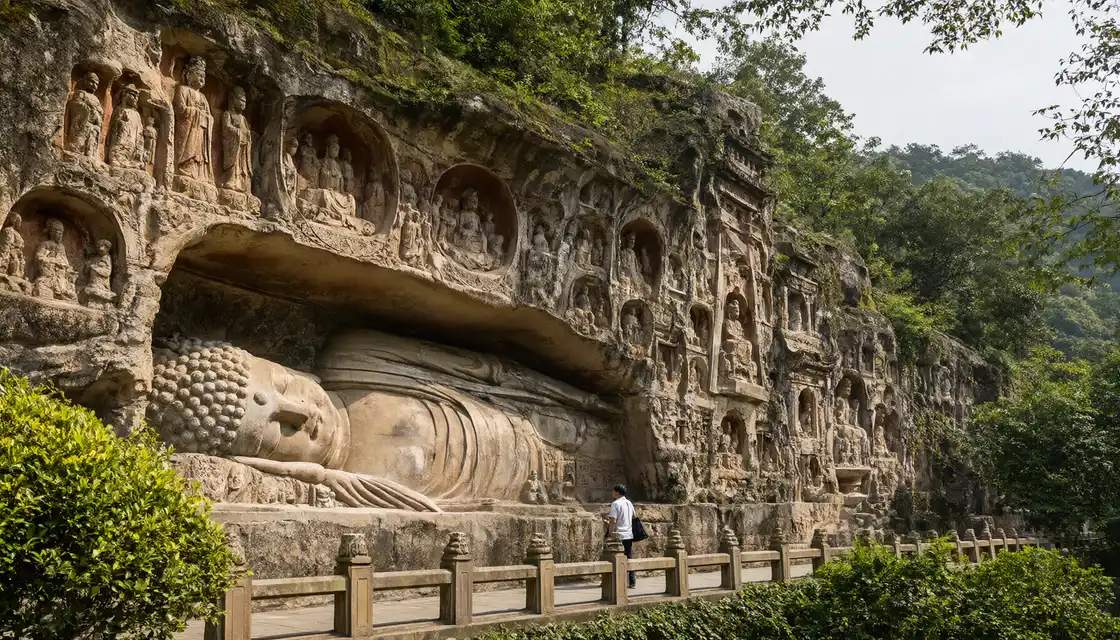
Quick facts: Dazu Rock Carvings at a glance
UNESCO | Statues | Best Site | Ticket | Hours | From Chongqing |
|---|---|---|---|---|---|
Inscribed 1999 | 50,000+ | Baodingshan | ~CNY 110-160 | 8:30–18:00 | 1.5–2 hrs |
Is Dazu Rock Carvings Worth Visiting?
Yes — absolutely.
The Dazu Rock Carvings are one of China's most remarkable yet underrated UNESCO World Heritage Sites. With over 50,000 Buddhist, Confucian, and Daoist statues carved into cliff faces over a period of more than 600 years, they represent the pinnacle of Chinese late-period grotto art. What makes them special is not just their scale and artistry, but also their remarkable state of preservation — many carvings still retain their original colors and intricate details.
Unlike the more famous Longmen and Yungang Grottoes in northern China, Dazu is in the south, far from the historical centers of Chinese power. It is less crowded, better preserved, and feels more intimate. For anyone interested in Buddhist art, Chinese history, or simply seeing something truly awe-inspiring, Dazu is absolutely worth the trip from Chongqing.
Reason | Why It Matters |
|---|---|
UNESCO World Heritage Site (1999) | Officially recognized as one of humanity's great cultural treasures |
50,000+ statues across 75 sites | One of the largest and most diverse grotto complexes in China |
Remarkable preservation | Many carvings still retain original paint and detail — better condition than Longmen in many areas |
Unique blend of 3 traditions | Buddhism, Confucianism, and Daoism depicted together — rare in Chinese grotto art |
Masterpiece of Song Dynasty art | Represents the apex of Chinese grotto art in the late imperial period |
Day trip from Chongqing | Only 1.5-2 hours from downtown Chongqing — easily doable in a day |
Less crowded | Far fewer visitors than Longmen or Mogao — you can take your time viewing |
If you are visiting Chongqing and enjoy history, art, or archaeology, Dazu should be at the top of your day trip list. It is the only UNESCO World Heritage Site in the Chongqing municipality and one of the finest grotto sites in China.
Dazu Rock Carvings History
The Dazu Rock Carvings are not a single site built at one time — they are a collection of 75 grotto sites scattered across Dazu District, carved over a period of more than 600 years from the early Tang Dynasty through the Southern Song Dynasty.
Timeline
Period | What Happened | Key Sites |
|---|---|---|
Early Tang Dynasty (650 AD) | First carvings created at Jianfo Rock (尖佛山) — the earliest known Dazu grottoes | Jianfo Rock |
Late Tang & Five Dynasties (9th–10th c.) | Initial development at Beishan (North Mountain); carvings begun by local officials and patrons | Beishan (early phase) |
Northern Song (10th–11th c.) | Beishan carvings expanded; more sites opened; style becomes more refined and secularized | Beishan (main phase) |
Southern Song (12th–13th c.) | Golden age — Baodingshan built under monk Zhao Zhifeng; most spectacular carvings created | Baodingshan (1179–1249 AD) |
Ming & Qing (14th–19th c.) | Some additions and restorations; no major new grotto creation | Various minor sites |
1945–present | Scholarly rediscovery; restoration; UNESCO inscription (1999); tourism development | All major sites |
Zhao Zhifeng — The Monk Behind Baodingshan
The most spectacular site at Dazu, Baodingshan, is largely the vision of one man: a Song Dynasty Buddhist monk named Zhao Zhifeng (赵智凤, 1159-1249). Born in Dazu, Zhao became a monk at a young age and dedicated his life to building a Buddhist grotto complex at Baoding Mountain.
Under his leadership, the main carvings at Baodingshan were created over a roughly 60-year period (1179-1249 AD). What makes Baodingshan unique is that it was conceived and built as a unified, planned complex — unlike most Chinese grotto sites which grew organically over centuries with many different patrons. This gives Baodingshan a coherent narrative and artistic vision that is rare in Chinese Buddhist art.
Zhao Zhifeng assembled a team of master sculptors led by Wen Shengyun to execute the carvings. The result is widely considered the masterpiece of Song Dynasty grotto art.
UNESCO World Heritage Listing
The Dazu Rock Carvings were inscribed on the UNESCO World Heritage List in 1999. UNESCO recognizes them for their:
Exceptional artistic quality and aesthetic significance
Unique synthesis of Buddhism, Confucianism, and Daoism
Insight into Song Dynasty society, beliefs, and daily life
Remarkable state of preservation
Role in the spread and evolution of Buddhist art in China
Source: Historical information: UNESCO World Heritage Centre — Dazu Rock Carvings inscription (1999). Also from Chinese official cultural heritage sources and academic publications on Song Dynasty grotto art.
The Five Major Sites
Dazu has 75 grotto sites in total, but five are considered the most important and are open to visitors:
Site | Chinese | Best Known For | Era | Visited |
|---|---|---|---|---|
Baodingshan | 宝顶山 | Most spectacular overall; reclining Buddha; 1,000-armed Guanyin; Wheel of Life | Southern Song (1179–1249) | ⭐ Most popular — 90% of visitors start here |
Beishan (North Mountain) | 北山 | Fine, delicate carvings; earliest major site; 300+ grotto niches | Late Tang → Song | ⭐ Second most popular — 2-3 hrs |
Nanshan (South Mountain) | 南山 | Daoist and Buddhist carvings; Song Dynasty grottoes | Song | Less visited — 1-2 hrs |
Shizhuanshan | 石篆山 | Rare blend of all 3 religions: Buddhism, Confucianism, Daoism | Song | Very few visitors — 1-2 hrs |
Shimenshan | 石门山 | Buddhist and Daoist carvings; impressive Song sculpture | Song | Least visited — 1-2 hrs |
Baodingshan — The Star Attraction
Baodingshan (宝顶山, "Precious Summit Mountain") is the most famous and most visited site at Dazu, and for good reason. It contains the largest, most spectacular, and best-preserved carvings in the entire complex.
Unlike most Chinese grotto sites that developed organically over centuries, Baodingshan was built as a single planned project in just 60 years (1179-1249 AD) under the direction of monk Zhao Zhifeng. The carvings follow a coherent narrative sequence, designed to teach Buddhist doctrine through visual storytelling.
Key highlights of Baodingshan:
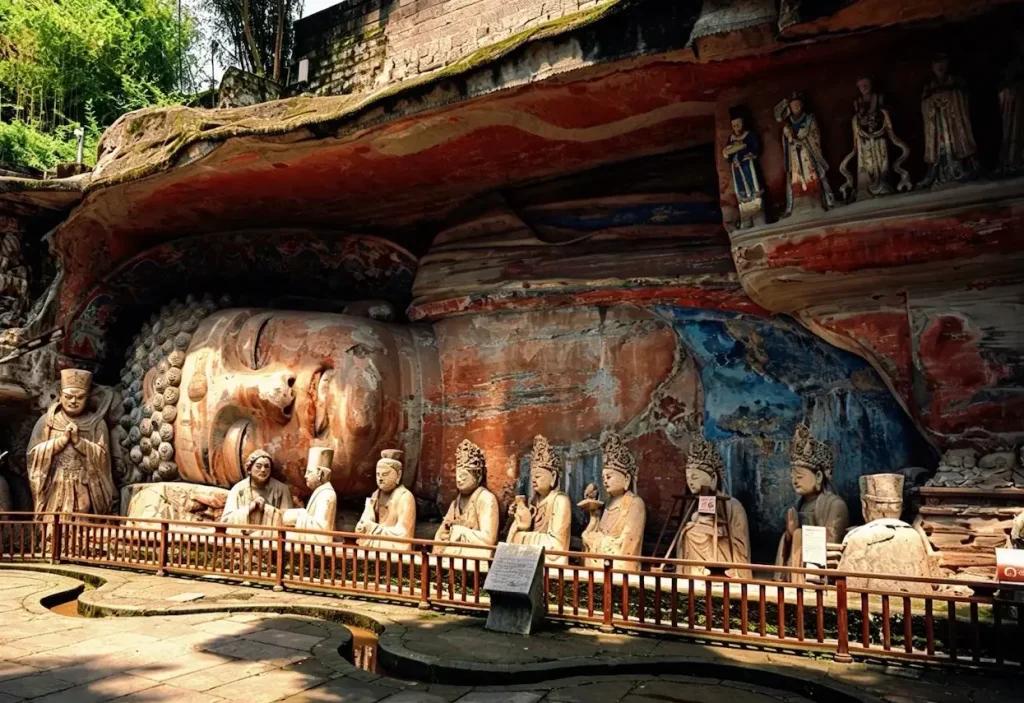
The Reclining Buddha (卧佛): The largest single carving at Baodingshan — a 31-meter-long statue of the Buddha entering parinirvana (final nirvana). The head alone is 5 meters tall, and the body extends into the cliff (the "feet" are deliberately left unfinished, disappearing into the rock face). It is one of the most iconic images at Dazu.
Thousand-Armed Guanyin (千手观音): A gilded statue of Avalokiteshvara with 1,007 arms, each with an eye in the palm. One of the most famous and beloved carvings at Dazu. It underwent a massive 8-year restoration project (2008-2016) — one of the largest cultural heritage restoration projects in modern Chinese history.
Wheel of Life (六道轮回图): A massive circular carving depicting the Buddhist cycle of rebirth — hell, hungry ghosts, animals, humans, gods, and asuras. A masterpiece of narrative art.
Parinirvana scene: Surrounding the reclining Buddha are figures of disciples, kings, and bodhisattvas reacting to the Buddha's passing — each with a different expression of grief, acceptance, or devotion.
Filial piety carvings: Unusual for Buddhist grottoes, Baodingshan includes carvings illustrating Buddhist stories of filial piety — reflecting the Song Dynasty blending of Buddhist and Confucian values.
Hell scenes (地狱变): Vivid, detailed depictions of the Buddhist hells and the punishments for various sins. Some of the most dramatic and gruesome carvings at Dazu.
Beishan — The "Other" Must-See Site
Beishan (北山, "North Mountain") is the second most important site at Dazu and the oldest major grotto site, begun in the late Tang Dynasty. It has more than 300 grotto niches with thousands of statues.
Beishan carvings are known for their delicate, refined style — especially the Song Dynasty works. Because Beishan was carved over a longer period (from late Tang through Song), it shows the evolution of Chinese grotto art from Tang grandeur to Song refinement. Many visitors say Beishan feels more intimate and less touristy than Baodingshan.
Key highlights of Beishan:
Grotto 136 (转轮经藏窟): Often called the "cave of carved pillars" — considered the masterpiece of Song Dynasty grotto art at Beishan. Exquisitely detailed bodhisattva statues with flowing robes and delicate features.
Grotto 245: A magnificent Tang Dynasty grotto with dense, elaborate carvings showing the Western Paradise of Amitabha Buddha.
Guanyin of the South Sea (南海观音): A graceful, famous Song Dynasty statue of Guanyin in a relaxed, contemplative pose.
The long corridor: Beishan has a covered walkway along the cliff face with hundreds of niches — great for a leisurely stroll
The Other Three Sites
Nanshan, Shizhuanshan, and Shimenshan are much less visited than Baodingshan and Beishan, but they have their own charms for dedicated grotto enthusiasts:
Nanshan (南山): Known for its Daoist carvings — relatively rare among major Chinese grotto sites. Also has some Buddhist carvings. Located on a hill with nice views.
Shizhuanshan (石篆山): Unique among Dazu sites because it contains carvings of all three major Chinese religious traditions — Buddhism, Confucianism, and Daoism — side by side. A testament to the religious pluralism of the Song Dynasty.
Shimenshan (石门山): A smaller site with Buddhist and Daoist carvings. Known for its guardian figures and the quality of its Song Dynasty sculpture. Very quiet — you may have the site almost to yourself.
First-time visitors with limited time: Focus on Baodingshan (2-3 hours). If you have a full day and love grotto art, add Beishan (2 hours). The other three sites are for serious enthusiasts or repeat visitors.
The Reclining Buddha of Baodingshan
The 31-meter-long reclining Buddha at Baodingshan is the single most famous and iconic carving at Dazu. It depicts the historical Buddha Sakyamuni entering parinirvana — his final passing into complete nirvana.
What Makes It Special
Size: 31 meters long, with the head alone measuring 5 meters in height. One of the largest reclining Buddha carvings in China.
Incomplete by design: The Buddha's lower body and feet disappear into the cliff face — they were deliberately left unfinished. This is an artistic choice that makes the Buddha feel larger than the mountain itself, extending beyond what the eye can see.
Detail: The carving is incredibly detailed, from the folds of the Buddha's robe to his serene expression. The face is remarkably well-preserved.
Surrounding figures: Around the reclining Buddha are carvings of his disciples, bodhisattvas, and worldly figures — each with a different expression, from grief to serene acceptance. It is a dramatic, emotional scene.
Symbolism: The reclining pose represents the Buddha's death and final enlightenment. In Buddhist art, the reclining Buddha always lies on his right side with his head propped on his right hand — the classic parinirvana pose.
Where to Find It
The reclining Buddha is located in the main cliff face at Baodingshan, near the end of the main viewing path. It is one of the last major carvings you encounter when walking through the site from the main entrance. You cannot miss it — it dominates the entire cliff face at that point.
Best Time to View
Morning light hits the reclining Buddha best, bringing out the details of the face and robes
Late afternoon also has nice warm light
Midday light can be a bit flat — good for detail photos but less dramatic
Allow 15-30 minutes to really take it in — there is a lot of detail in the surrounding figures
Tickets and Opening Hours
Ticket Prices
Ticket Type | Price (approx.) | Includes |
|---|---|---|
Baodingshan only | CNY 110-115 | Baodingshan scenic area + Baodingshan temple |
Beishan only | CNY 70-80 | Beishan grottoes |
Baodingshan + Beishan combo | CNY 140-160 | Both major sites (saves money vs buying separately) |
All five sites | CNY 170-200 | Baodingshan + Beishan + Nanshan + Shizhuanshan + Shimenshan |
Sightseeing bus (Baodingshan) | CNY 15-20 | Shuttle from entrance to the grotto area (optional but recommended) |
Note: Ticket prices can vary by season and may change. Prices may also differ between online booking platforms and on-site purchase. Always check the latest prices before your trip. Prices above are approximate based on 2025-2026 data.
How to Buy Tickets
On-site at the ticket offices of each site
Online through travel platforms (Trip.com, Ctrip, Fliggy, etc.) — sometimes at slightly discounted prices
Official WeChat account of Dazu Rock Carvings
Book in advance if visiting during Chinese holidays or peak season
Students with ID may get discounted tickets — check current policy
Opening Hours
Site | Opening Hours | Last Ticket Sale | Last Entry |
|---|---|---|---|
Baodingshan | 8:30 – 18:00 | 16:00 | 16:10 |
Beishan | 8:30 – 18:00 | 17:00 | 17:30 |
Nanshan / Shizhuanshan / Shimenshan | 8:30 – 17:30 | 16:00 | 16:30 |
Source: Opening hours and ticket information: Official Dazu Rock Carvings scenic area announcements and verified travel platforms. Hours are subject to seasonal adjustment.
Pro tip: Buy the Baodingshan + Beishan combo ticket if you plan to visit both. It saves money compared with buying separate tickets, and both are worth seeing for a full Dazu experience.
Plan around last entry, not closing time: Baodingshan stops selling tickets around 4:00 PM and shuts the gate near 4:10 PM even though signage says 6:00 PM. Arriving after 2:00 PM leaves you rushed through the best afternoon light on the reclining Buddha.
How Long to Visit Dazu Rock Carvings
Visit Style | Time Needed | What You Can See | Best For |
|---|---|---|---|
Express visit | 2–3 hours | Baodingshan only (the main highlight) | Short on time; first visit; casual travelers |
Standard day trip | 4–5 hours | Baodingshan + Beishan (the two major sites) | Most first-time visitors; culture lovers |
Full day | 6–8 hours | Baodingshan + Beishan + lunch + one more site (Nanshan or Shizhuanshan) | Grotto enthusiasts; art history buffs |
All-sites deep dive | Full day (8+ hrs) | All five major sites | Serious grotto art fans; repeat visitors |
Recommended Time Allocation
Baodingshan: 2-3 hours minimum. This is the largest and most impressive site. You could easily spend 3-4 hours here if you read all the descriptions and take your time.
Beishan: 1.5-2 hours. Smaller and easier to cover thoroughly. The covered walkway makes for a pleasant, leisurely visit.
Nanshan: 1-1.5 hours. Smaller site with Daoist carvings. Also has a nice temple.
Shizhuanshan: 1-1.5 hours. Very quiet. Unique three-religion carvings.
Shimenshan: 1 hour. The smallest and least visited site.
Travel between sites: 10-30 minutes between sites by car/taxi. Baodingshan and Beishan are on opposite sides of Dazu town.
Pacing Yourself
Dazu involves a lot of walking and standing. There are many stairs and uneven paths. It is easy to get "grotto fatigue" after a few hours. To avoid it:
Start with Baodingshan (the best one) while you are fresh
Take a break for lunch between sites
Sit down occasionally — there are benches at various points
Bring water and snacks
You do not have to see everything — quality over quantity
If you only have energy for one site, make it Baodingshan
How to Get There from Chongqing
Dazu District is located approximately 120 kilometers northwest of Chongqing city center. There are several ways to get there:
Transport Option | Cost (approx.) | Duration | Best For |
|---|---|---|---|
High-speed train + taxi/bus | CNY 80-120 round trip | 1.5–2 hrs each way | Budget travelers; independent travelers |
Organized day tour | CNY 250-500 per person | Day trip | First-timers; convenience; guide included |
Private car / driver | CNY 400-800 per day | 1.5–2 hrs each way | Families; groups; comfort & flexibility |
Long-distance bus | CNY 50-80 round trip | 2–3 hrs each way | Budget travelers; those on a tight schedule |
By High-Speed Train (Recommended)
There are high-speed trains from Chongqing West Station (重庆西站) to Dazu South Station (大足南站). The journey takes about 50-70 minutes.
Trains run frequently throughout the day
One-way fare: approximately CNY 40-60
From Dazu South Station, you need to take a taxi or bus to the grotto sites (about 15-30 min, CNY 20-50)
Book train tickets in advance on Trip.com, 12306.cn, or at the station
Note: Dazu South Station is on the Chengdu-Chongqing high-speed line, so you can also visit Dazu between Chengdu and Chongqing
By Organized Day Tour
Many Chongqing hotels and travel agencies offer day tours to Dazu. This is the easiest option if you do not want to deal with logistics.
Typical price: CNY 250-500 per person (varies by inclusions)
Usually includes transport, guide, and tickets (check what is included)
Most tours visit Baodingshan, some also include Beishan
Pickup and drop-off at your hotel in Chongqing
Book through your hotel, a travel agency, or online platforms
Rather not arrange trains and taxis yourself? Our Dazu Rock Carvings day tour from Chongqing handles the transfers, entry tickets and a licensed guide in one booking.
By Private Car
Hiring a car and driver for the day gives you the most flexibility. Good for families, groups, or anyone who wants to visit multiple sites at their own pace.
Typical price: CNY 400-800 for a full day (8-10 hours)
Book through your hotel, a travel agency, or ride-hailing apps for day rental
Great if you want to visit both Baodingshan and Beishan, plus maybe another site
Door-to-door service from your hotel
From Chengdu
If you are visiting from Chengdu, Dazu is on the way to Chongqing (or vice versa). You can do Dazu as a stopover between the two cities:
Take the high-speed train from Chengdu East to Dazu South (~1-1.5 hours)
Store your luggage at the station (if available) or take it with you by taxi
Visit Baodingshan (and Beishan if you have time)
Continue to Chongqing by train in the evening (~50-70 min)
This is a great way to break up the Chengdu-Chongqing journey
Most visitors base themselves in Chongqing and day-trip west; if you are pairing Dazu with the city, our guide to the best luxury hotels in Chongqing covers where to stay close to the high-speed rail stations.
Dazu Rock Carvings vs. Longmen Grottoes
Many travelers wonder how Dazu compares with China's more famous grotto sites, especially Longmen Grottoes near Luoyang. Both are UNESCO World Heritage Sites with spectacular Buddhist carvings, but they are quite different.
Aspect | Dazu Rock Carvings | Longmen Grottoes |
|---|---|---|
Location | Dazu District, Chongqing (southwest China) | Luoyang, Henan (central China) |
Period | Mostly Song Dynasty (10th-13th c.) — late imperial grottoes | Northern Wei to Tang (5th-10th c.) — peak imperial grottoes |
Number of statues | 50,000+ across 75 sites | 100,000+ in one massive site |
Scale | Spread across many sites; individual sites are more intimate | One massive cliff face; grand and overwhelming |
Style | Refined, detailed, narrative, secularized | Grand, monumental, imperial, more "classical" |
Preservation | Generally better preserved; more original color | More weathering and damage; some restoration |
Religious themes | Buddhism + Confucianism + Daoism (3 traditions) | Primarily Buddhism (some Daoist later) |
Famous for | Reclining Buddha, 1,000-armed Guanyin, narrative scenes | Fengxian Temple, Vairocana Buddha, grand scale |
Crowds | Relatively few visitors | Very popular — can be crowded, especially on holidays |
UNESCO inscribed | 1999 | 2000 |
Difficulty of visit | Day trip from Chongqing; multiple sites spread out | Easily accessible from Luoyang; single large site |
Which Should You See?
If you can only see one:
It depends on what you are looking for. Longmen is more famous and more monumental — the Fengxian Temple giant Vairocana Buddha is one of the most iconic images in all of Chinese art. If you want the "classic" Chinese grotto experience and you are traveling in central China, Longmen is the obvious choice.
Dazu, on the other hand, is more refined, more narrative, and better preserved. The carvings tell stories and show everyday life in the Song Dynasty. If you are already visiting Chongqing or Chengdu, or if you have already seen Longmen and want to see something different, Dazu is absolutely worth it.
If you can see both:
The standard "China grotto tour" usually goes Dunhuang → Yungang → Longmen — the great northern sites. But Dazu deserves a place on that list. It is the masterpiece of the southern, late-period grotto tradition, and in some ways it is the most artistically sophisticated of them all.
Baodingshan: A Self-Guided Tour
Baodingshan is the main attraction at Dazu. Here is a suggested route through the site, with the highlights to look for. The main carvings are arranged along a U-shaped cliff face, making a single walking loop.
The Main Cliff — Left Side
1. Entrance and temple: You enter through Baodingshan Temple (圣寿寺), a working Buddhist temple at the top of the hill. Take a moment to look around before heading down to the carvings.
2. Wheel of Life (六道轮回图): A massive circular carving showing the six realms of rebirth in Buddhist cosmology. Look for the pig, bird, and snake at the center representing greed, attachment, and anger — the three poisons that keep beings trapped in the cycle.
3. Hell scenes (地狱变): Dramatic, sometimes gruesome depictions of the Buddhist hells. Each panel shows a different hell and the punishment for a specific sin. Remarkably detailed and vivid.
4. Filial piety scenes (父母恩重经变): A series of carvings showing the love and kindness of parents — unusual for a Buddhist site, and reflecting Song Dynasty Confucian influence. Very human and touching.
The Center — Reclining Buddha Area
5. The Reclining Buddha (卧佛): The 31-meter parinirvana Buddha is the centerpiece. Do not just look at the Buddha — look at the surrounding figures of disciples, kings, and bodhisattvas. Their expressions tell a story of grief, acceptance, and devotion.
6. 1,000-Armed Guanyin (千手观音): A short distance from the reclining Buddha is the famous gilded 1,007-armed Guanyin. Look closely — each hand has an eye in the palm, and each holds a different Buddhist symbol or implement. The recent restoration brought back much of the original gold leaf.
7. Huayan Three Saints (华严三圣): Three large standing statues — Sakyamuni Buddha and two bodhisattvas. Notice how the bodies are slightly tilted forward — the sculptors did this intentionally so that worshippers looking up from below would see the faces head-on.
The Right Side and Lower Section
8. Bamboo grove and pathway: The path winds through a bamboo grove between carving sections. Enjoy the walk and the sound of bamboo leaves in the wind.
9. Vimalakirti scene (维摩诘经变): A detailed narrative carving showing the lay Buddhist scholar Vimalakirti debating with bodhisattvas. Full of interesting details of daily life.
10. Other narrative scenes: Baodingshan has many more carved panels telling Buddhist stories. Take your time — the more you look, the more details you see.
11. Longevity Pavilion (万寿楼): At the end of the main path, climb up for views back over the site and the surrounding countryside.
Tips for Visiting Baodingshan
Start early — beat the heat and the crowds
Take the scenic bus from the entrance to the top of the hill (saves a steep uphill walk)
Walk slowly — there are details everywhere you look
Download an audio guide or bring a guidebook — the stories behind the carvings make them much more interesting
Allow 2-3 hours minimum; 3-4 hours if you really want to see everything
Bring water — there are limited shops inside the scenic area
Wear comfortable shoes with good grip — some paths are steep and can be slippery when wet
Worth the small extra cost: hire a guide (or rent an audio guide) at Baodingshan. Read with commentary, the carvings become a 900-year-old “stone scripture” weaving Buddhism, Confucianism and Daoism together; skimmed without it, most visitors only see a lot of pretty statues.
Essential Tips for Your Visit
Before You Go
Book tickets in advance if visiting during Chinese holidays (National Day, May Day, Spring Festival)
Check the weather — Dazu is best on clear days, but overcast weather is actually good for photographing carvings (no harsh shadows)
Wear comfortable walking shoes with good grip — there are stairs and uneven paths
Bring water and snacks — options are limited inside the scenic areas
Bring sun protection — hat, sunscreen, sunglasses (especially in summer)
Bring a small umbrella — both for rain and sun
Carry some cash — some smaller sites and shops may not accept foreign payment methods
Download a translation app with offline Chinese — many signs are only in Chinese
During Your Visit
Do not touch the carvings — the oils from your hands damage the stone
Do not use flash photography — it damages the pigments (though many sites do not enforce this well)
Stay on designated paths — do not climb on the carvings or walk in restricted areas
Be careful on stairs and walkways — they can be slippery when wet
Take your time — grotto art rewards close looking. The more you look, the more details you notice
Hire a local guide if you can — the stories and context make the carvings much more meaningful. Audio guides are also available at some sites.
If you are visiting multiple sites, start with Baodingshan (the best one) while you are fresh and energized
Take breaks — it is easy to get "grotto fatigue" after a few hours
Photography Tips
Overcast days are actually best for photographing carvings — soft, even light brings out detail without harsh shadows
Use a wide-angle lens for large scenes like the reclining Buddha; use a zoom lens for details
Tripods may or may not be allowed — check at the entrance. They are usually forbidden at the most popular sites.
The reclining Buddha is best photographed in morning or late-afternoon light
Try to shoot at eye level with the carvings when possible
Include people in some shots for a sense of scale — these carvings are huge!
Shoot both wide shots (showing the whole scene) and close-ups (showing the detail)
Food and Drink Nearby
There are restaurants and snack shops near the entrance of Baodingshan — expect tourist prices and average quality
For better food, go into Dazu town proper. There are many local Sichuan restaurants
Dazu is known for its local noodles and Sichuan home-style cooking
Bring water and snacks for the sites themselves — options are limited inside
There are tea houses and snack stalls near Beishan as well
The most important tip: Do not try to see everything. It is better to spend quality time at Baodingshan and Beishan than to rush through all five sites. You will remember more and enjoy it more.
Suggested Day Trip Itineraries
Classic Day Trip (Baodingshan Only)
For first-time visitors with limited time
7:00-8:00 AM: Depart Chongqing (by train, tour bus, or private car)
9:30-10:00 AM: Arrive at Baodingshan; buy tickets; take scenic bus up to the temple
10:00 AM – 12:30 PM: Explore Baodingshan at a leisurely pace; start with the left cliff, then the reclining Buddha area, then the right side
12:30-1:30 PM: Lunch at a restaurant near the entrance or in Dazu town
1:30-2:30 PM: Optional: Visit Dazu Museum or stroll through Dazu old town
2:30-4:00 PM: Return to Chongqing
5:00-6:00 PM: Arrive back in Chongqing; rest before dinner
Full-Day Grottle Enthusiast (Baodingshan + Beishan)
For anyone who loves art, history, or archaeology
7:00 AM: Depart Chongqing
9:00 AM: Arrive at Baodingshan (go first while you are fresh)
9:00 AM – 12:00 PM: Baodingshan — take your time; get an audio guide or hire a guide
12:00-1:00 PM: Lunch in Dazu town
1:00-2:00 PM: Travel to Beishan (on the other side of town)
2:00-4:00 PM: Explore Beishan — the covered walkway with 300+ niches; especially look for Grotto 136
4:00-5:00 PM: Optional: Quick visit to Nanshan if you still have energy
5:00-6:30 PM: Return to Chongqing
7:00 PM: Arrive back in Chongqing — reward yourself with a proper hot pot dinner!
Chengdu–Chongqing Stopover
Perfect for travelers going between Chengdu and Chongqing
Morning: Take early high-speed train from Chengdu to Dazu South (~1-1.5 hrs)
Late morning: Store luggage at the station or take it with you by taxi to Baodingshan
Late morning–early afternoon: Visit Baodingshan (2-3 hours)
Afternoon: Lunch; return to Dazu South Station
Late afternoon/evening: Take high-speed train onward to Chongqing (~50-70 min)
This way you break up the journey between Chengdu and Chongqing and see a UNESCO site in the process. Perfect use of a travel day!
Final Thoughts
The Dazu Rock Carvings are one of those places that stay with you long after you have left. There is something about standing in front of a 31-meter reclining Buddha carved into a cliff 800 years ago, or looking at a 1,007-armed Guanyin with each palm bearing an eye, that puts your own life into perspective.
What makes Dazu special is not just the scale or the artistry — it is the preservation. Unlike Longmen or Yungang, where many carvings have been damaged by time, weather, and human hands, much of Dazu remains remarkably intact. The colors are still vibrant in places, the details are still sharp, and you can see the carvings almost as their creators intended.
Dazu is also special because it tells stories. These are not just rows of identical Buddha statues — each panel has a narrative, a lesson, a glimpse into what people believed and how they lived 800 years ago. You can see scenes of childbirth, farming, cooking, punishment, devotion, and enlightenment, all captured in stone with remarkable skill and humanity.
If you are going to Chongqing, do not skip Dazu. It is a bit of a journey to get there, but it is one of the most rewarding day trips you can take from the city. You will come away with a deeper appreciation for Chinese art, history, and the sheer dedication of people who carved an entire mountain into a monument of faith.
Dazu is more than just another grotto site — it is a window into the soul of Song Dynasty China. The artistry, the storytelling, the preservation, and the sheer ambition of it all make it one of the most remarkable cultural sites in China. Go slow, look closely, and let the carvings reveal their secrets.
Last updated: November 2026. Ticket prices, opening hours, and transport schedules are subject to change. Always verify current information before your trip. Sources: UNESCO World Heritage Centre (Dazu Rock Carvings inscription), China National Tourism Administration, official Dazu Rock Carvings scenic area information, and multiple verified travel sources.

Traveler Discussions
Questions from travelers