
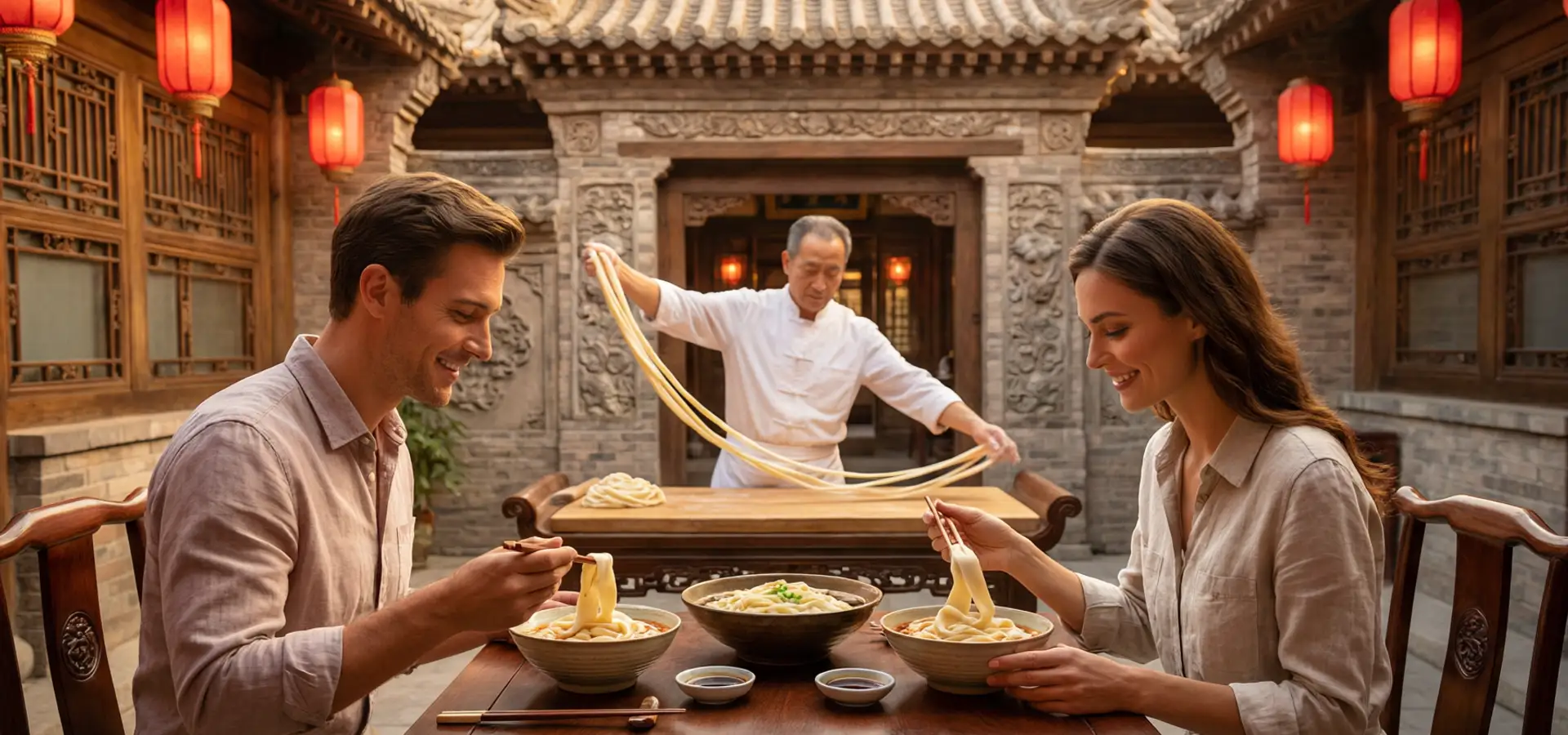
In the heart of China's Guanzhong Plain, centuries of wheat farming, harsh winters, and open landscapes gave rise to eight traditions that outsiders find delightfully strange — from noodles wider than a belt to opera that is not sung but roaring. For private travelers seeking authentic Xi'an experiences, these Eight Oddities offer a direct window into Shaanxi identity, revealing how geography, climate, and daily life shaped every aspect of food, architecture, customs, and performance.
What Are the Eight Oddities — An Overview for Private Xi'an Travelers
When you travel in Xi'an on a private cultural tour, you will encounter customs that may seem unusual at first: noodles as wide as belts, flatbreads the size of pot lids, and bowls as large as basins. These Eight Oddities of Guanzhong reflect how Shaanxi people adapted to their land, climate, and history through everyday food and traditional lifestyles.
Today, these traditions continue in Xi'an's food streets, villages, and cultural experiences, offering visitors a direct way to understand the stories and identity behind Shaanxi life. Each oddity tells a story of practical wisdom — how people turned simple wheat into extraordinary dishes, how architecture responded to a dry climate, and how folk arts preserved community spirit across generations.
Oddity | Category | What It Reveals |
|---|---|---|
Noodles as wide as belts | Food | Wheat-farming heritage and hearty appetite |
Guokui as large as pot lid | Food | Practical energy for long farm work |
Oil-splashed chili as a dish | Food | Bold flavors from simple ingredients |
Bowls as large as basins | Food | Generous hospitality and community dining |
Women wear headscarves | Folk custom | Adaptation to dust and sun on the plateau |
Single-sloped roofs | Architecture | Climate response to dry weather and cold winds |
Women rarely married outside | Folk custom | Tight-knit agricultural community bonds |
Qinqiang Opera is roaring | Performing arts | Voices adapted to open plains and fields |
Why Do Shaanxi People Call Their Own Traditions "Oddities" — A Private Cultural Insight
The word "odd" comes from a different perspective. A tradition often feels "strange" only when viewed from another region. The same is true for Guanzhong customs such as wide noodles, large flatbreads, and unique ways of living. For locals, these are simply the natural rhythm of daily life.
The Eight Oddities represent Shaanxi people's connection to their land, family memories, and regional culture. Today, these traditions are celebrated as symbols of Shaanxi's distinctive food, lifestyle, and history — not as curiosities, but as proud markers of identity. On a private tour, your guide can help you see each "oddity" not as something strange, but as something deeply meaningful.
How Did Geography Shape the Eight Oddities of Guanzhong?
The fertile Guanzhong Plain shaped a wheat-based food culture, creating dishes like biangbiang noodles, oil-splashed noodles, and guokui. Local homes such as courtyard houses and yaodong cave dwellings reflect adaptation to the environment and climate. Many Guanzhong customs developed from farming life and practical needs rather than being intentionally unusual.
Noodles as Wide as Belts — A Private Food Journey Through Shaanxi's Noodle Culture
Shaanxi's noodle culture grew from centuries of wheat farming. Wide, long noodles became one of the most iconic styles — often several centimeters across, stretched by hand into chewy, satisfying strands. On a private food tour, watching a master stretch dough into belt-like ribbons is one of Xi'an's most mesmerizing culinary experiences.
Why Are Shaanxi Noodles Made Wide and Long?
Feature | Reason Behind the Belt-Like Shape |
|---|---|
Easy to make | Wide noodles use simple hand-making techniques, suitable for traditional family cooking |
Filling and satisfying | The larger shape creates a chewy texture and a more satisfying meal |
Suitable for farm work | A hearty bowl of noodles offers lasting energy for a physically demanding lifestyle |
How Do Shaanxi Noodles Reflect Local Personality and Hospitality?
In Shaanxi, a bowl of noodles is often a reflection of how people treat others. The famous wide, long, and generous noodles represent the Guanzhong personality: straightforward, warm, and sincere. A host is more likely to place a large bowl of handmade noodles in front of you and say, "Eat more, there is plenty."
When family or friends visit, noodles are often prepared as a welcoming meal. More toppings, extra chili oil, and a fuller bowl are simple ways to tell guests: "You are welcome here." Just like Shaanxi noodles are bold and satisfying, the local character is often described as direct and sincere.
Types of Shaanxi Wide Noodles
Biangbiang noodles: Handmade, belt-like width with a chewy bite. Simple toppings — chili, vinegar, vegetables — highlight the natural taste of the noodle itself.
Oil-splashed noodles: Hot oil poured over chili powder and garlic on wide noodles. The sizzling sound and rich aroma make this one of Shaanxi's most iconic dishes.
Where to Experience Shaanxi Wide Noodles on a Private Tour?
Place | Experience | Location | Hours |
|---|---|---|---|
Old Li's Biangbiang Noodles (Bell Tower Flagship) | Classic biangbiang with belt-like noodles and traditional toppings | 30m south of East Street & Luomashi intersection, Xi'an | 09:00–22:00 |
Shangzhai Liaozalie Noodle Restaurant | Authentic Shaanxi wide noodles and bold local flavors | No.1 Luomashi, East Street, Beilin District | 11:30–21:30 |
Xinqiao Agricultural Market | Fresh handmade noodles, watch the noodle-making process | Xinqiao Market, Kunming Road, Yanta District | 04:00–18:00 |
Guokui as Large as a Pot Lid — The Taste of Guanzhong on a Private Food Tour
Guokui is a traditional baked flatbread from Guanzhong, known for its large size, thick texture, and firm bite. Unlike soft breads that are eaten immediately, guokui developed from the practical needs of daily life — feeding many people, supporting long working hours, and providing energy that lasts through a full day of farm work.
How Did Guokui's Giant Size Reflect Guanzhong Life?
In rural families, one large guokui could be shared among several people, making it suitable for family meals and farming communities. A thick, dense flatbread provided more energy than smaller snacks. Over time, guokui grew into a symbol of the Guanzhong way of life — its large size reflects the local values of generosity, practicality, and abundance.
How Do Shaanxi People Turn a Giant Flatbread into Everyday Meals?
Locals usually cut it into small wedge-shaped pieces called "yá yá" and enjoy it in simple but flavorful ways:
Guokui with Chili: Break it open and fill with oil-splashed chili or stir-fried green peppers — the crispy bread absorbs the spicy aroma while keeping its wheat flavor.
Guokui with Meat: Thick and firm, it holds rich fillings such as braised pork, beef, pickled vegetables, or cold dishes.
Guokui Soaked in Soup: Dense texture absorbs soup without becoming too soft — enjoyed with bean curd soup, lamb soup, or Qishan saozi soup.
Simple Farm-Style: In rural areas, enjoyed with garlic, green onions, vinegar, chili sauce, or sugar — straightforward ingredients, strong flavors.
Oil-Splashed Chili as a Dish — Bold Flavors of Shaanxi for Private Travelers
When chili first arrived in Shaanxi, it was only a seasoning. In Guanzhong, however, it gradually became "a dish of its own." The saying "Oil-splashed chili is a dish" reflects how Shaanxi people turned a simple condiment into an essential part of daily meals, pairing it with noodles, flatbreads, and other local foods.
Why Did Oil-Splashed Chili Become a "Dish" in Shaanxi?
Qin Pepper: Known for its bright color, rich aroma, and moderate heat, creating the unique flavor of Shaanxi oil-splashed chili. A Complete Experience: Combines chili flakes, sesame seeds, and spices, offering rich texture and layered flavors beyond simple spiciness. A Symbol of Daily Culture: Homemade oil-splashed chili is a common household staple, reflecting Shaanxi people's ability to create bold flavors from simple ingredients.
Eating Method | How Shaanxi People Enjoy It | Cultural Meaning |
|---|---|---|
Chili with Guokui | Spread chili inside guokui without meat fillings | Simple wheat foods create satisfying flavors |
Dipping Steamed Bread | Dip steamed bread into chili with porridge | Simple and practical home-style eating |
Noodles | Add chili flakes and hot oil to noodles | Turns ordinary noodles into a signature dish |
Xi'an Liangpi | Mix chili oil with liangpi, vinegar, seasonings | Essential part of Xi'an cold noodles |
Cold Dishes | Combine chili with vegetables, bean curd skin | Complete flavor enhancer |
Where Can You Experience Authentic Shaanxi Oil-Splashed Chili?
Place | Address | Notes |
|---|---|---|
Xinfeng Chili Seasoning Store | Huimin Farmers' Market, Hongzhuan South Road, Yanta District | Chili varieties, oil-splashed chili making experience |
Wei Jia Liangpi | No. 3 South Street, Nanyuanmen, Xi'an | Classic liangpi, 24 hours, Shaanxi chili flavor |
Bowls as Large as Basins — The Art of Generous Dining in Guanzhong
The tradition of serving food in large, deep bowls that look more like small basins is one of the most visible expressions of Shaanxi hospitality. On a private food tour, lifting one of these bowls and feeling its weight is a memorable sensory experience.
How Was the Traditional Guanzhong Large Bowl Designed for Local Life?
Wide mouth: Holds large amounts of food and makes it easy to mix noodles, toppings, and sauces. Deep body: Accommodates large portions of noodles, broth, and toppings — it can contain bread pieces, meat, soup, and chili in beef and lamb paomo while keeping the food warm. Thick ceramic: Durable and suitable for daily use; many rural families used the same bowls for years.
How Does the Big Bowl Reflect Shaanxi Hospitality?
Locals often welcome guests with large bowls of noodles, soup, and plenty of toppings, using abundant food to show respect and sincerity. Traditional Guanzhong meals were often shared around a table, where family members and neighbors gathered, ate together, and exchanged daily conversations. The oversized bowl reflects the Shaanxi spirit of being straightforward, warm, and practical.
How Can You Experience Guanzhong's Big Bowl Culture?
Order: Choose oil-splashed noodles, biangbiang noodles, or mixed-topping noodles to experience how a large bowl holds a complete Guanzhong meal.
Observe: Watch freshly pulled noodles, large chili containers, and local diners to feel the everyday atmosphere.
Feel: Lift the heavy bowl, compare its size, and notice how the extra space helps mix noodles and toppings.
Mix: Stir noodles from the bottom up, combining chili, sauce, and toppings evenly while the noodles are hot.
Eat: Enjoy with big bites, garlic, and the remaining sauce — the Guanzhong way called "die mian".
Women Wear Handkerchiefs on Their Heads — Guanzhong Folk Customs for Private Travelers
For generations, women in the Guanzhong region wore handkerchiefs or headscarves as an everyday essential while working outdoors. This tradition reflects the practical wisdom of life on the Loess Plateau — dust protection, sun protection, and convenience for daily labor.
How Did the Headscarf Become a Symbol of Guanzhong Women?
The headscarves not only shield women from wind and dust but also reflect their industrious and unpretentious way of life. In the fields, the sight of women with white headscarves creates a distinctive scene characteristic of the traditional Shaanxi countryside. The handkerchief was not a decorative item but an everyday tool — its value came from usefulness rather than appearance, reflecting the Guanzhong spirit of practicality, endurance, and simplicity.
How Did Guanzhong Women Turn Everyday Materials into Art?
In traditional rural society, women used simple materials to create handmade works that reflected their emotions, beliefs, and hopes. Paper-cutting, sachet making, and dough figurine making are three representative arts that preserve local stories and festive traditions.
Where Can You Experience Shaanxi Traditional Handicrafts?
Place | Hours | Experience |
|---|---|---|
Yongxingfang Intangible Cultural Heritage Workshop | Open all day; workshops 10:00–22:30 | Watch artisans demonstrate dough figurine making; hands-on sessions (~50–100 RMB) |
Qin Yuan Intangible Cultural Heritage Museum | Tue–Sun 10:00–18:00 | Learn paper-cutting techniques through hands-on workshops |
Chang'an Academy He Xiang Hall | Tue–Sun 09:00–19:00 | Mix natural spices and create a personalized sachet |
Houses with Single-Sloped Roofs — Traditional Guanzhong Architecture on a Private Tour
The "half-covered house" is one of the most recognizable features of traditional Guanzhong architecture. Unlike the symmetrical double-sloped roofs commonly seen in other parts of northern China, these houses have a roof that slopes in only one direction — a design shaped by climate, landscape, and materials.
Why Did Guanzhong People Build Half-Covered Houses?
Climate: The Guanzhong Plain has a relatively dry climate with limited rainfall. Single-sloped roofs provided basic rain protection while reducing construction difficulty. Landscape: Houses face south to receive sunlight; the single slope helps bring light into the courtyard while blocking cold northern winds. Materials: Local loess bricks, tiles, and timber required simpler construction than double-sloped roofs. Courtyard Space: The open courtyard provided space for drying crops, family activities, and better ventilation.
How Are Guanzhong Houses Different from Other Traditional Chinese Homes?
Region | Roof Features | Why It Developed |
|---|---|---|
Guanzhong | Single-sloped roof | Dry climate, south-facing sunlight |
Beijing | Symmetrical double-sloped | Formal layout reflecting family hierarchy |
Fujian | Large circular earth buildings | Built for clan living and defense |
Where Can You Experience Guanzhong Half-Covered Houses?
Place | Experience | Location | Hours |
|---|---|---|---|
Guanzhong Folk Art Museum | Restored Ming–Qing houses with single-sloped roofs | No.1 Nantaishan Road, Wutai Town, Chang'an District | Tue–Sun 09:00–17:00 |
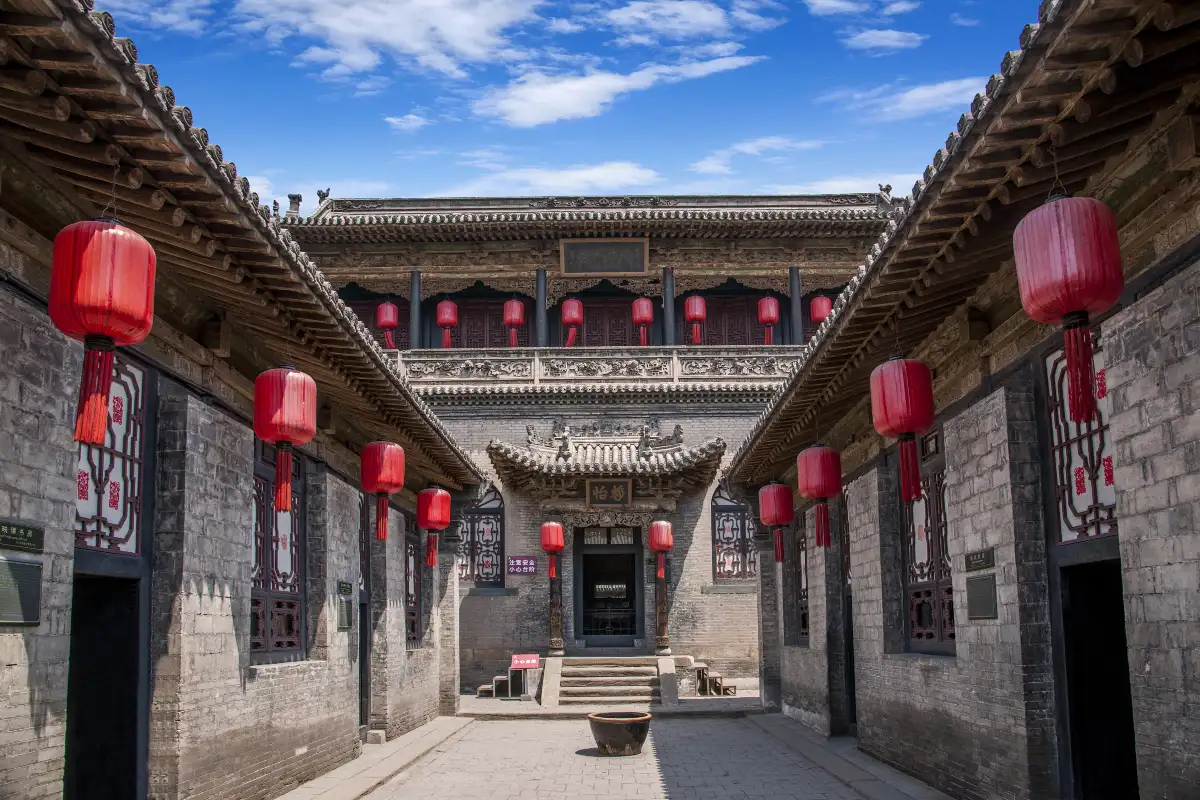
Gao Family Courtyard | Traditional courtyard with shadow puppetry | No.144 Beiyuanmen Street, Lianhu District | Tue–Sun 10:00–18:00 |
Yuanjia Village | Half-covered houses, folk workshops, local food | Yanxia Town, Liquan County (~50 km from Xi'an) | Open all day |
Guanzhong Girls Rarely Married Outside — Marriage Traditions and Social Identity
In traditional Guanzhong villages, marriages were closely connected with family ties and local communities. The agricultural lifestyle meant families relied on relatives and neighbors for farming, so nearby marriages helped maintain social networks. Women often stayed close to their parents and in-laws, supporting household and agricultural work.
Today, the tradition has gradually changed. Urbanization, education, and employment opportunities have allowed more women from Shaanxi to study, work, and live outside their hometowns. This shift shows how marriage choices were once closely connected with local communities, while modern Guanzhong women have more freedom to choose their own paths. On a private cultural tour, visiting traditional villages offers a window into how these social patterns shaped daily life for centuries.
Qinqiang Opera Is Not Sung, It Is Roared — The Sound of Guanzhong for Private Travelers
The Guanzhong region has wide plains, dry weather, and open rural landscapes. In the past, people lived and worked in villages surrounded by farmland, where communication across distance depended on strong voices. The famous "roaring" style of Qinqiang is not simply a performance technique — it reflects how people adapted their voices to the land they lived on.
How Did the Guanzhong Landscape Shape the Sound of Qinqiang?
High-pitched singing, strong vocal projection, and dramatic emotional expression characterize Qinqiang Opera. After a long day of farm work, villagers gathered around a temporary stage at a temple fair, watching actors perform stories of loyalty, family, love, and justice. The strong voice of Qinqiang matches the personality of Guanzhong people: direct, passionate, and straightforward.
What Stories Does Qinqiang Tell About Guanzhong Life?
Qinqiang Feature | Cultural Meaning |
|---|---|
High-pitched and powerful | Reflects the straightforward and bold personality |
Strong emotional expression | Shows passionate and open way of expressing feelings |
Tragic and heroic atmosphere | Represents resilience through historical hardships |
Simple and sincere style | Reflects loyalty, family, and human relationships |
Where to Experience Qinqiang on a Private Xi'an Tour?
Venue | Duration | Style | Show Times |
|---|---|---|---|
Xi'an Intangible Cultural Heritage Grand Theatre | 60–70 mins | Classic Qinqiang excerpts | Tue–Fri: 13:00, 15:00, 17:00, 19:30; Weekends: +11:00 |
Shaanxi Provincial Song and Dance Theatre | ~40 mins | Qinqiang melodies + folk performance | Daily 13:00 and 17:00 |
Gao Family Courtyard | ~15 mins | Short performances in authentic courtyard | 11:30, 12:30, 16:30, 18:30, 20:30, 21:40 |
How Modern Xi'an Transformed These "Strange Customs" — A Private Cultural Experience
Modern Xi'an does not simply preserve the Eight Oddities as historical customs. Instead, it turns them into experiences that people can participate in, allowing these traditions to continue as a living part of local culture.
Through Taste: Food traditions have become a direct way to experience Guanzhong culture. Visitors can understand local values of practicality, generosity, and hospitality through traditional dishes at local restaurants and food streets.
Through Space: Traditional architecture has been transformed into cultural spaces where visitors experience how local people adapted to the climate, resources, and family structure of the Loess Plateau.
Through Sound: Qinqiang has developed from village entertainment into a symbol of Guanzhong identity. Through modern performances, visitors experience the powerful voice and emotions that represent the spirit of Shaanxi.
Plan Your Private Guanzhong Culture Tour — What to Taste, See & Do in Xi'an
The Eight Oddities of Guanzhong are not just unusual customs but reflections of Shaanxi people's lifestyle, wisdom, and values. To truly understand them, go beyond tourist areas and observe everyday life in local markets, neighborhoods, and traditional streets with a private guide who knows the stories behind each tradition.
What to Taste on Your Private Food Tour
Experience | Where | Best Time |
|---|---|---|
Biangbiang noodles | Old Li's (Bell Tower) or local markets | Lunch |
Guokui with chili | Yuanjia Village or Muslim Quarter | Morning or afternoon |
Oil-splashed chili making | Xinfeng Chili Store, Huimin Market | Morning market hours |
Beef & lamb paomo | Xingshenglou (Bell Tower Store) | Dinner (open until 02:30) |
What to See on Your Private Architecture Tour
Experience | Where | Duration |
|---|---|---|
Single-sloped roof courtyards | Guanzhong Folk Art Museum | 2–3 hours |
Brick and wood carvings | Gao Family Courtyard | 1–2 hours |
Traditional village life | Yuanjia Village | Half day |
What to Do on Your Private Cultural Experience
Experience | Where | Cost |
|---|---|---|
Paper-cutting workshop | Qin Yuan Museum | Varies by activity |
Sachet making | Chang'an Academy He Xiang Hall | Varies by workshop |
Qinqiang Opera performance | Intangible Heritage Grand Theatre | Ticket required |
Dough figurine making | Yongxingfang Workshop | ~50–100 RMB |
For a more authentic experience, go beyond tourist areas and observe everyday life in local markets, neighborhoods, and traditional streets. The "strangeness" of the Eight Oddities is actually the charm of a culture that continues to live today — and a private tour is the best way to unlock its deeper meaning.


Traveler Discussions
Questions from travelers