
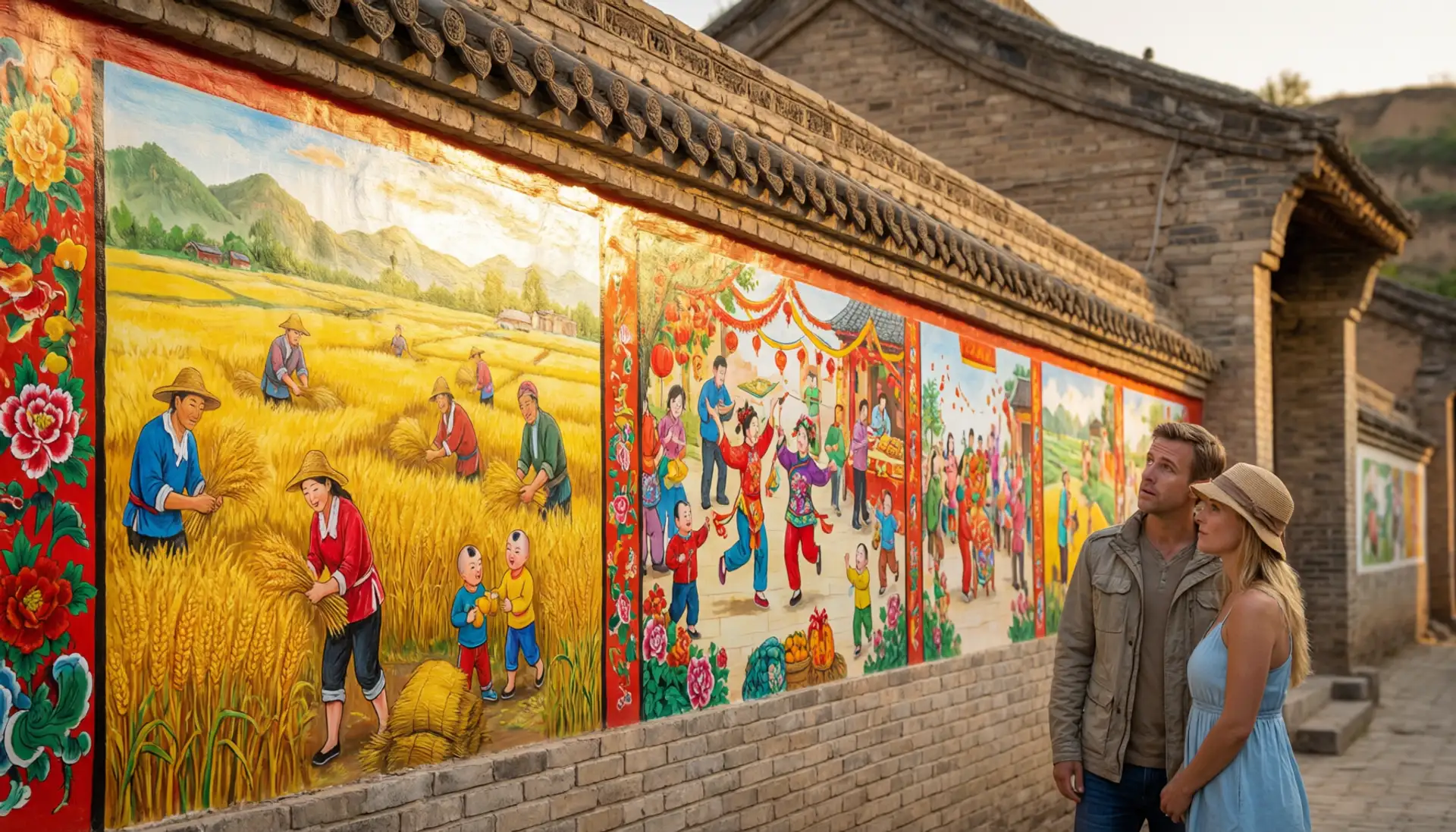
In the villages of Shaanxi province, rural artists have been transforming everyday life into colorful artworks for generations. Their paintings — created not in studios but in courtyards, fields, and village workshops — capture harvests, festivals, family gatherings, and folk beliefs through bold colors, exaggerated figures, and ancient symbols. This is the world of Shaanxi Farmers' Paintings, one of China's most vivid folk art traditions.
This article explores Shaanxi Farmers' Paintings from both artistic and cultural perspectives. It begins by tracing the historical origins of this folk art form and explaining how diverse geographical environments — the Guanzhong Plain, the Loess Plateau, and the Qinling Mountains — have shaped distinct artistic styles. It then delves into the cultural significance embedded in the works, highlighting symbolic color palettes, exaggerated figure styling, folk beliefs, and the tradition of female artistry. Finally, it examines the contemporary transformation and evolution of Shaanxi Farmers' Paintings through tourism and modern design.
Ancient Symbols & Folk Art: The Roots of Shaanxi's Private Cultural Tours
Shaanxi Farmers' Paintings inherit early Chinese art traditions that stretch back thousands of years. Yangshao-culture pottery offers symbolic motifs and bold colours. Qin-Han stone carvings tell daily-life stories via simple shapes. Tang-dynasty murals provide rich colours and vivid compositions.
Beyond these ancient roots, local folk crafts serve as the most direct source of inspiration. New Year paintings, paper-cutting and embroidery bring bright tones, decorative patterns and symbolic images: flowers for joy, fish for prosperity, animals for protection. These crafts have been passed down through generations of rural families, forming the visual vocabulary that farmers later transferred onto canvas.
Over time, artists switched creation materials from walls and textiles to paper and canvas. Yet the goal remains the same: depict daily life, folk beliefs and people's hopes through visuals. This continuity is what gives Shaanxi Farmers' Paintings their distinctive authenticity — they are not academic interpretations of folk culture, but folk culture itself, expressed through paint and color.
Why Shaanxi Farmers' Paintings Are a Must-See Xi'an Luxury Experience
The name "Farmers' Paintings" does not mean paintings about farmers or rural areas. It refers to the creators — the farmers themselves. These artists paint from their own experiences, transforming farming, festivals, family life, and village memories into artworks.
In the 20th century, farmers in places like Huxian and Ansai began creating paintings alongside their daily work. Many were inspired by traditional skills such as paper-cutting and embroidery, using folk colors and symbols to express their own view of life. The result is an art form that differs fundamentally from academic painting in both technique and purpose.
Academic Art | Farmers' Paintings | |
|---|---|---|
Creators | Professional artists | Rural creators |
Display | Museums and galleries | Villages and communities |
Foundation | Artistic techniques | Life experience |
Huxian Farmers' Paintings: A Private Day Trip from Xi'an
Located in today's Huyi District of Xi'an, Huxian Farmers' Paintings developed from the farming traditions of the Guanzhong Plain. Surrounded by wheat fields and village communities, local artists found inspiration in harvests, festivals, family life, and everyday rural scenes.
How Do Huxian Farmers' Paintings Express Rural Life?
Happy Rural Imagination: Wheat farming has long shaped life in Guanzhong. Scenes of planting, harvesting, festivals, and family gatherings became the main inspiration for Huxian Farmers' Paintings. These works do not simply record rural life but express people's happiness, hopes, and gratitude for the land.
Strong Visual Impact: The bold color contrasts and clear outlines make the paintings instantly eye-catching. The bright style reflects the optimistic spirit and joyful imagination of rural life.
Influence of Folk Arts: The decorative style is closely connected with traditional folk arts such as Chinese New Year paintings and paper-cutting. Like these crafts, Huxian Farmers' Paintings emphasize simple forms, symbolic patterns, and a full, colorful composition.
What Do the Colors Symbolize in Huxian Farmers' Paintings?
Color | Meaning |
|---|---|
Red | Happiness, celebration, and good fortune |
Yellow | Land, wheat, and harvest |
Blue | Sky, hope, and a better future |
Green | Nature, growth, and vitality |
Why Do Huxian Farmers' Paintings Love to Show Happiness?
The paintings often transform ordinary village scenes into images full of energy and optimism. Scenes such as busy harvest fields, courtyards filled with crops, festival celebrations, and family gatherings reflect traditional rural hopes for a successful harvest, a prosperous family, and a peaceful community.
This connection with everyday experience is what makes Huxian Farmers' Paintings different from many forms of professional art. They do not depict the world as it is — they depict the world as people wish it to be.
Where Can You Experience Huxian Farmers' Paintings Today?
Location | Type | Contact | Opening Hours | Experience | Price |
|---|---|---|---|---|---|
Huxian Farmers' Paintings Exhibition Hall | Official exhibition hall | 029-84812871 | 9:00–12:00; 14:00–18:00 (15:00–18:00 in Jul–Aug); Closed Mondays (except holidays) | View classic Huxian works; learn about Guanzhong harvest themes, bright colors, and rural traditions; painting and coloring workshops | Free entry; hands-on: ~RMB 30–60/person; workshop courses: ~RMB 80–120/person (booking required) |
Donghan Village Farmers' Painting Village | Traditional art village | N/A | Open all day | Visit local artists' studios; private one-on-one painting sessions available | Free village visit; workshops arranged directly with artists |
Ansai Farmers' Paintings: Exclusive Folk Art Journey on the Loess Plateau
Located in northern Shaanxi, Ansai lies in the heart of the Loess Plateau, a landscape shaped by deep valleys, rolling hills, and relatively isolated villages. For generations, people here lived closely with nature, developing a unique way of understanding and expressing the world through folk art.
How Did the Loess Plateau Shape Ansai's Artistic Language?
Different Landscape: The Guanzhong Plain features fertile farmland, whereas Ansai is defined by mountains, gullies and arid plateaus. This rugged landscape fostered locals' deep bond with nature, wildlife and folk beliefs. As a result, Ansai Farmers' Paintings strongly reflect vitality, spiritual protection and hopes for the future.
Paper-cutting: Northern Shaanxi paper-cutting is the closest artistic source. Many Ansai painters were originally skilled in paper-cutting and embroidery. They brought its characteristics into painting: exaggerated shapes, strong outlines, decorative patterns, and symbolic images.
Waist Drum Culture: Ansai waist drum performances influenced the dynamic feeling of these paintings. The paintings capture the excitement of festivals and village celebrations. Figures often appear with large movements, strong gestures, and rhythmic compositions.
Folk Songs: Northern Shaanxi folk songs such as Xintianyou are known for strong emotions and direct expression. Similar qualities appear in Ansai Farmers' Paintings through bold compositions and energetic figures.
What Do the Symbols in Ansai Farmers' Paintings Mean?
Symbol | Common Meaning |
|---|---|
Grasping-Hair Doll | Protection, family wishes, and hopes for children |
Fish and Lotus | Harmony, happiness, and prosperity |
Snake and Rabbit | Traditional northern Shaanxi symbols associated with good fortune |
Animals and Birds | Connection between people, nature, and wishes for protection |
Life Tree | A symbol of growth, connection, and the cycle of life |
Why Do Ansai Farmers' Paintings Look Like a Dream?
Ansai Farmers' Paintings are not simple copies of rural life. Instead, they create "a symbolic universe created by rural imagination." Artists combine different moments in one picture — cave dwellings, farming scenes, festivals, animals, and plants — into a single composite image.
Shapes follow meaning rather than realism. Important figures are often enlarged or decorated with patterns. Children may appear with larger heads to express vitality and hope, while animals may include decorative elements. These artistic choices focus on expressing feelings and meanings rather than realistic appearance.
The Influence of Paper-cutting: A Creative Process of Cutting First, Painting Later
Most Ansai Farmers' Painters follow a creative approach rooted in paper-cutting: they first create paper-cut patterns and then transfer these shapes onto paper with colors. In this sense, their paintings can be seen as "colorful paper-cuttings." Paper-cutting itself is not restricted by realistic forms. It allows artists to freely combine different images and symbols. When this visual language is transformed into painting, it preserves the imaginative and unrestricted creativity of paper-cutting.
Where Can You Experience Ansai Farmers' Paintings?
Location | Type | Contact | Opening Hours | Experience | Price |
|---|---|---|---|---|---|
Ansai Cultural Relics Museum (Ansai Cultural Arts Center) | Official exhibition hall | 0911-6216219 | Tue–Sun: 8:30–12:00; 14:30–17:30; Closed Mondays (except holidays) | See Grasping-Hair Dolls, Snake Coiling Around Rabbit, and the Life Tree; painting and paper-cutting workshops by reservation | Free entry; materials: ~RMB 40–70/person; guided workshop: ~RMB 80–130/person (booking required) |
Fengjiaying Folk Culture Village | Folk village | N/A | Open all day | Experience cave dwelling culture, paper-cutting, farmers' painting, and waist drum performances | Prices vary by activity; advance consultation required |
Hanyin Farmers' Paintings: Off-the-Beaten-Path Shaanxi Culture Tour
Southern Shaanxi, including Hanzhong, Ankang, and Shangluo, is located between the Qinling and Daba Mountains, with the Han River flowing through the valleys. Unlike the plains of Guanzhong and the Loess Plateau of northern Shaanxi, it is shaped by mountains, forests, tea gardens, and rivers, creating a softer artistic style centered on nature and village life.
How Did Mountains and Rivers Shape Hanyin's Artistic Style?
A Softer Color Style: Influenced by the humid mountain environment, Southern Shaanxi art avoids strong color contrasts and favors a more peaceful palette.
Color | Inspiration | Visual Feeling |
|---|---|---|
Green | Forests, tea gardens, and mountain vegetation | Fresh, lively, and connected with nature |
Blue-gray | Mountains, rivers, and misty valleys | Quiet, soft, and poetic |
Light brown | Villages, farmland, and earth tones | Warm, simple, and rustic |
Inspired by Mountain Landscapes: The natural environment of Southern Shaanxi influences the themes and atmosphere of Hanyin Farmers' Paintings. Common subjects include layered mountains and misty valleys, Han River landscapes and streams, terraced fields and tea gardens, mountain villages and traditional houses, and farming, fishing, boat travel, and forest activities.
A Composition Shaped by Mountains: The mountainous landscape shapes a unique composition style. Artists often use layered vertical compositions to show mountains, forests, and villages step by step, with gentle empty spaces creating a sense of peace and distance. Unlike Guanzhong's busy farming scenes or Ansai's symbolic dreamlike style, Hanyin emphasizes balance and harmony between humans and nature.
Why Is Hanyin Less Known Than Huxian and Ansai?
Compared with Huxian and Ansai Farmers' Paintings, Hanyin's artistic expressions are often quieter and more closely connected with ordinary mountain life. Huxian highlights harvests, festivals, and the joyful atmosphere of Guanzhong villages. Ansai is known for bold symbols, paper-cutting influences, and strong visual expressions. Hanyin focuses more on mountains, rivers, villages, and daily activities. Its appeal comes less from dramatic symbols and more from the peaceful memories of local landscapes.
Where Can You Experience Hanyin Farmers' Paintings?
Location | Type | Contact | Opening Hours | Experience |
|---|---|---|---|---|
Hanyin County Cultural Center | Local cultural exhibition venue | 0915-8219051 | Weekdays: 9:00–12:00; 14:00–17:00 | View local Hanyin works featuring mountains, terraces, tea gardens, and rural life |
Fengyan Ancient Terraced Fields | Natural and cultural landscape | N/A | Open all day | Explore the real landscapes shown in Hanyin paintings; ideal for photography and cultural exploration |
Understanding the Unique Artistic Style of Shaanxi Folk Paintings
Shaanxi Farmers' Paintings do not aim to copy people exactly. Instead, artists use exaggerated shapes, bright colors, and symbolic images to express emotions, memories, and hopes.
Size Shows Importance: In folk art, the size of an object does not depend on distance, but on its importance in the story. A child may be painted larger because it represents family hope and the continuation of life. Grain and crops may appear oversized because they symbolize harvest, prosperity, and a good year. Important characters, such as farmers, drummers, or festival performers, often have larger heads and stronger expressions to highlight their emotions.
Instead of asking "Does it look realistic?", folk artists ask: "What is the most important thing in this picture?"
Feature | Meaning |
|---|---|
Exaggerated shapes | Highlight important people and symbols |
Side-facing figures | Show movement in farming and festivals |
Front-facing faces | Keep important features visible |
Combined scenes | Bring together memories, stories, and wishes |
Translation from paper-cutting to painting: Many Ansai creators follow a workflow where they first make paper-cuts, then trace the paper-cut outlines onto paper and add colours. In essence, Ansai farmer paintings are coloured paper-cuts. Paper-cutting can hardly render complex human anatomical perspective. It favours flat, simplified and exaggerated forms without three-dimensional volume. When transferred directly into painting, the formal conventions of paper-cutting persist: large heads, short limbs and flat outlines that disregard anatomical proportions.
The Joyful World of Shaanxi Farmers' Paintings: A Cultural Insight
Shaanxi Farmers' Paintings often create a joyful rural world. The absence of suffering and conflict does not mean they ignore reality; instead, they express Folk Idealism — ordinary people's hopes for a better life.
Most early farmers' painters were ordinary villagers, not trained academic artists. Their paintings expressed simple hopes: good harvests and full granaries, healthy families and many children, prosperous homes and thriving animals.
Shaanxi Farmers' Paintings inherited the traditions of folk arts such as paper-cutting, New Year prints, and embroidery. These crafts were not created to show sadness, but to bring blessings and celebrate life. Bright colors, full compositions, and lively scenes reflect traditional wishes for abundance and joy.
Huxian Farmers' Paintings developed mainly in the 1950s–1970s, when rural development and a new countryside became important themes. Many works showed collective labor, agricultural production, and celebrations after harvest, reflecting people's confidence and hope for a better future. This "fullness" reflects a traditional rural belief: a complete and abundant life is the greatest happiness.
Women Artists & Shaanxi Folk Art: A Cultural Heritage Experience
Before Farmers' Paintings became recognized as folk art, rural women had already created a rich visual tradition through paper-cutting, embroidery, window decorations, and festival crafts. These traditions influenced Farmers' Paintings through flat decorative compositions, bright colors, strong outlines, and symbolic patterns.
Especially in Ansai, many paintings preserve the visual language of paper-cutting, turning traditional household crafts into colorful artworks. Women's perspectives also brought everyday village memories into paintings, including family gatherings, weddings and festivals, cooking and handicrafts, and children's lives.
Women Artists Who Helped Popularize Farmers' Paintings: Female artists played an important role in bringing Farmers' Paintings from village communities to wider audiences. Li Fenglan was one of the representative artists of Huxian Farmers' Paintings. Her works, including Spring Plowing, reflected rural labor and village life, helping introduce this local art style to a broader audience.
Shaanxi Farmers' Paintings Today: Living Heritage & Cultural Tourism
Like many traditional art forms, Shaanxi Farmers' Paintings face challenges in the modern era. As young people move to cities, fewer villagers continue learning the craft, creating a gap in traditional inheritance. Market demand brings new opportunities, but mass production may turn folk art into simple decoration and weaken its original meaning. Traditional Farmers' Paintings grew from farming, festivals, and village customs — as rural life changes, artists must find new ways to express modern village memories.
Yet there are also signs of revival.
Cultural Tourism: In places such as Huyi and Ansai, Farmers' Paintings have become part of cultural experiences. Visitors can explore exhibition halls, artist villages, and workshops to see how local life is transformed into colorful artworks.
Folk Art Experiences: In Ansai, Farmers' Paintings continue to connect with local traditions such as paper-cutting and waist drum culture. Visitors can discover symbolic images like the Grasping-Hair Doll and Life Tree while learning the stories behind these folk symbols.
Digital and Modern Design: Online exhibitions and digital collections allow more people to discover Shaanxi Farmers' Paintings. Traditional patterns are also used in modern products such as postcards, bags, notebooks, and home decorations, bringing folk art into everyday life.
Where to Buy Authentic Shaanxi Farmers' Paintings in Xi'an
Shaanxi Farmers' Paintings are meaningful souvenirs because they preserve rural memories, folk beliefs, and the hopes of local people. Visitors can choose between lightweight cultural products and original handmade artworks depending on their travel time and interests.
Location | What You Can Buy | Price | Best For |
|---|---|---|---|
Shuyuanmen Cultural Street | Postcards, printed paintings, framed prints, small folk-art products | RMB 10–200 | Travelers with limited time who want an easy souvenir in central Xi'an |
Tang Paradise Cultural Shops | Bags, bookmarks, notebooks, scarves, small decorative products | RMB 30–300 | Families and visitors looking for stylish gifts |
Huxian Farmers' Painting Exhibition Hall | Official cultural products, postcards, art books, framed works, hand-painted originals | Souvenirs: RMB 20–200; Originals: from several hundred RMB | First-time visitors, art lovers, and travelers seeking authenticity |
Donghan Village | Original paintings and handmade artworks from local artists' studios | Depends on artist and artwork size | Travelers who want a deeper village experience and direct contact with artists |
How to Read a Shaanxi Farmers' Painting: A Private Guide
Look For | What You May Notice | How to Understand It |
|---|---|---|
Main Story | What are people doing? Farming, celebrating, gathering? | Find the main activity first — it usually tells the story of village life |
People's Relationships | Families, couples, neighbors, villagers | Look at how people interact; the painting often shows family ties and community life |
Traditional Symbols | Fish, rooster, ox, lotus, children, flowers | These images often carry wishes for luck, prosperity, and a happy life |
Seasonal Clues | Crops, festivals, farm work, decorations | Details reveal the time of year and local customs |
Hidden Details | Small animals, patterns, objects, daily tools | Small elements often record folk memories and local traditions |
Regional Styles | Huxian and Ansai styles | Huxian = farming life and realistic scenes; Ansai = bold colors, symbols, and folk imagination |
Which Shaanxi Folk Art Experience Fits Your Private Tour?
Huxian: Ideal for first-time visitors to Shaanxi who want to quickly understand what Farmers' Paintings are and see the connection between art and everyday village life. Also great for families and casual travelers who prefer an easy cultural experience close to Xi'an.
Ansai: Perfect for culture enthusiasts and slow travelers who have more time to explore northern Shaanxi's folk traditions, including painting, paper-cutting, and waist drum culture. Also suited for travelers interested in traditional beliefs and local stories who want to discover the deeper meanings behind symbols, festivals, and rural memories.
Hanyin: Best for nature lovers and countryside explorers who enjoy mountains, terraces, tea gardens, and peaceful rural landscapes more than crowded attractions. Also ideal for travelers seeking an authentic local experience who want to see how folk art grows from the relationship between people, land, and daily life.
Final Thoughts: Shaanxi Farmers' Paintings as a Luxury Cultural Experience
Shaanxi Farmers' Paintings are more than colorful folk artworks; they are visual stories of village life, local beliefs, and people's hopes. For first-time visitors, Huxian offers the easiest introduction through farming scenes and everyday rural memories. Ansai reveals a deeper symbolic world shaped by paper-cutting, folk beliefs, and northern Shaanxi traditions. Hanyin provides a quieter experience where art is closely connected with mountains, nature, and countryside life.
When viewing these paintings, do not only look at the colors and shapes. Look for the stories, symbols, and emotions hidden behind each image — that is where the real charm of Shaanxi Farmers' Paintings lies.

Traveler Discussions
Questions from travelers