

Beijing and Harbin are barely four and a half hours apart by high-speed rail, yet choosing how to make the crossing - bullet train, overnight sleeper or flight - is exactly where first-timers lose time, money or warmth. Below is the honest, numbers-first comparison of every way to get from Beijing to Harbin: real schedules and fares, which station and which airport, the transfers that follow, and the winter-specific traps that catch people out around the Ice Festival.
Take the bullet train, fly only if the clock is against you
Three viable ways exist between Beijing and Harbin. For the overwhelming majority of leisure travellers the 4½-hour high-speed train is the better product — it leaves from the city, arrives in the city, and shrugs off snowstorms that ground aircraft.
Best overall — G-train · 4h33. Beijing Chaoyang → Harbin West. Roughly ¥584–633 in second class. Ten to twelve departures a day, first around 08:00.
Best value — Z-sleeper · 10h22. Leave Beijing Station at 21:18, wake up in Harbin at 07:40. Soft sleeper ¥409–427; saves a hotel night.
Fastest in the air — Flight · 2h. Daxing or Capital to Taiping. ~5½ hours door to door once transfers and check-in are counted.
How far is Beijing from Harbin, really?
About 1,050 km as the crow flies, 1,198 km along the rail corridor, and roughly 1,240 km by road. Same time zone, very different weather.
The straight-line distance is almost irrelevant to trip planning because the two cities sit at opposite ends of a single, extremely well-built corridor. The Beijing–Harbin high-speed line runs 1,198 km through Hebei, Liaoning, Jilin and Heilongjiang, and since July 2025 its Beijing–Shenyang section has run at the full 350 km/h design speed. That is why the journey collapsed from an overnight ordeal into a morning-to-lunch hop.
Measure | Figure | What it means for you |
|---|---|---|
Flight distance (PKX–HRB) | ~1,050 km / 655 mi | 1h55–2h20 in the air |
Rail distance | 1,198 km | 4h33 on the fastest G trains |
Road distance | ~1,240 km | 13–14 hours driving; not advised in winter |
Time difference | None | Both cities on UTC+8, no jet lag |
January temperature gap | Beijing ~0°C / Harbin ~−18°C | Pack for a different planet, not a different province |
Distances are rounded. Rail figure follows the published length of the Beijing–Harbin high-speed corridor; flight distance is the great-circle figure used by schedule databases.
Train vs plane vs sleeper: the honest comparison
Airline websites quote 1h55. Rail websites quote 4h33. Neither number is the one you actually experience. Compare door-to-door, and the ranking changes.
Option | Door to door | Typical cost (one way) | Snow reliability | Best for |
|---|---|---|---|---|
High-speed G train | 5h15–5h45 | ¥584–633 second class | Excellent | Almost everyone |
Overnight Z train | 10h22–11h40 (asleep) | ¥156.5 hard seat | Excellent | Budget travellers, anyone wanting to save a hotel night |
Flight | 5h30–6h30 | ¥350–600 low season | Delay-prone | Tight schedules, air connections, late departures |
Driving | 13–15h | Fuel + tolls ¥900–1,200 | Risky | Only for experienced winter drivers with a 4WD |
Why the train usually wins the arithmetic
By plane — the hidden hours: ≈ 5h30–6h30
Leave hotel 45 min + Airport check-in 90 min + Flight 2h + Baggage + bus/taxi 60–75 min
By high-speed train — the honest hours: ≈ 5h15–5h45
Leave hotel 40 min + Station security 40 min + Train 4h33 + Metro/taxi to hotel 25–40 min
They land within twenty minutes of each other, and the train does it without a security pat-down of your liquids, a baggage carousel, or a 45-minute ride into a suburban airport. Add the fact that Harbin West and Harbin Station are both on the metro, and the train is simply less work.
THE ONE CASE FOR FLYINGYou are arriving in Beijing on an international flight at Capital or Daxing and continuing straight to Harbin; or you need a departure after 19:00, when the last fast G trains have gone. In deep winter, also check that your flight is not the first casualty of a snow front.
Beijing to Harbin by high-speed train
Twenty-plus departures a day, a fastest journey of 4 hours 33 minutes, and seats that feel more like a plane's premium cabin than a Chinese train of ten years ago.
Figure 2. High-speed stock at a Chinese station platform. The corridor's flagship services use Fuxing CR400BF-GS sets rated for −40°C operation.
Sample schedule: what a normal day looks like
Trains are numbered in the G100–G120 block for the fastest "benchmark" services and G3500-series for the slower, more heavily stopped ones. Times below are representative of the current timetable — always reconfirm on 12306 the day you book, because China adjusts its diagram several times a year.
Train | Departs | Arrives | Duration | Type |
|---|---|---|---|---|
G101 | Beijing Chaoyang 08:00 | Harbin West 12:33 | 4h33 | Fastest |
G103 | Beijing Chaoyang 08:05 | Harbin West 12:40 | 4h35 | Non-stop-ish |
G3503 | Beijing Chaoyang 08:25 | Harbin West 14:13 | 5h48 | More stops, cheaper |
G105 | Beijing Chaoyang 08:55 | Harbin West 13:28 | 4h33 | Fastest |
G107 | Beijing West 08:56 | Harbin West 14:19 | 5h23 | Handy for the west side |
G3507 | Beijing Chaoyang 10:11 | Harbin West 16:06 | 5h55 | Cheaper seats |
G115 | Beijing Chaoyang 11:05 | Harbin West 15:38 | 4h33 | Fastest, civilised hour |
G3513 | Beijing Chaoyang 11:20 | Harbin 17:49 | 6h29 | Arrives at the central station |
Illustrative departures only, compiled November 2026. Exact times, train numbers and stopping patterns change with each timetable revision — check 12306 or Trip.com before booking.
Fares, seat classes and the dynamic-pricing trick
Chinese high-speed fares on this corridor are floating: the same seat can cost 81% of the base fare on a Tuesday and full price on the Friday before Chinese New Year. Base fares look like this:
Class | Typical fare (fast G) | What you get | Worth it? |
|---|---|---|---|
Second class | ¥584.5–633 | 3+2 seating, 1,020 mm pitch, fold-down table, USB/power at every pair | Yes — perfectly comfortable for 4½ hours |
First class | ~¥934.5 | 2+2 seating, wider armrests, more recline, quieter carriage | For tall travellers or anyone working |
Business class | ~¥1,838.5 | 1+2 pods that recline almost flat, meal service, lounge access at some stations | Splurge; rarely necessary |
Slower G trains | from ¥546 | Same comfort, 1–2 hours longer, more stops | Best value if your day is flexible |
Z sleeper | ¥409–441 soft berth | Four-berth compartment, bunk, bedding included | Best value per hour, if you can sleep |
Children under 1.2 m travel free without a seat; 1.2–1.5 m get a half-price child ticket. Foreign passports work fine — but the passport number, not a printout, is what opens the gate.
What the 4½ hours actually feel like
The benchmark trains are CR400BF-GS sets, a cold-weather variant engineered for −40°C: sealed doors, heated underfloor systems, coated braking components. Practically, that means no cancellations when the temperature drops to −30, and a cabin that stays at a sane 22°C while the steppe outside turns white somewhere past Shenyang.
Legroom is generous in second class — 4½ hours is genuinely comfortable, not a squeeze.
Power and Wi-Fi: every row has sockets; onboard Wi-Fi exists but is patchy and needs a Chinese phone number to activate, so download offline maps before boarding.
Food: a dining car and a trolley selling instant noodles, ham sausage and hot water. Harbin locals pack fruit and bread; you should too.
Luggage: overhead racks fit a 24-inch case; larger suitcases go on the racks at the carriage ends. No weight limit, no fee — a real advantage over the airlines.
Scenery: the last 90 minutes, from Changchun north, is the good part — frozen rivers, snow-covered corn stubble, villages with red rooftops.
Booking: the 15-day rule and how not to miss it
Tickets open 15 days before departure at 08:00 or 09:00 Beijing time depending on the station. Set an alarm; the 08:00 trains on the Friday before New Year sell out in minutes.
Book on 12306 (official, English interface, accepts passports) or through Trip.com / Ctrip for a small service fee and English support. Both issue e-tickets tied to your passport.
Choose your berth on sleepers if you care: lower berths sell first, upper berths are cheapest and quietest.
Book the return leg at the same time. Harbin → Beijing on a Sunday in January is the harder direction.
Beijing to Harbin by overnight train
Ten hours, one bunk, ¥409. You board in a lit-up Beijing evening and step out into a Harbin morning at −22°C. It is the most romantic option and, for many budgets, the smartest.
Train | Departs | Arrives | Duration | Notes |
|---|---|---|---|---|
Z15 | Beijing Station 21:18 | Harbin 07:40 | 10h22 | Soft sleeper only — the classic |
Z17 | Beijing Station 21:26 | Harbin 07:48 | 10h22 | Hard + soft sleeper |
Z203 | Beijing Station 20:37 | Harbin 07:02 | 10h25 | Arrives earliest |
Z83 | Beijing Station 18:19 | Harbin 05:34 | 11h15 | Too early to be useful in winter |
Z112 / Z156 | Beijing Fengtai 05:54 / 06:02 | Harbin West 17:28 / 17:42 | 11h34 | Daytime seated/sleeper service |
Cheapest, most local. Hard seat ¥156.5. Bench seating, overnight, no recline. Fine for students and the very hardy. Not recommended for a winter arrival.
Six-berth compartment. Hard sleeper ¥261–289. The workhorse. Bunk with mattress and duvet, charging point at the end of the carriage, washroom down the hall.
Four-berth compartment. Soft sleeper ¥409–441. Wider bunk, door that closes, quieter. The best night's sleep on rails in China at this price.
20:30 Board at Beijing Station
Settle into your bunk, fill your thermos at the water point, and set out tomorrow's clothes on top of the blanket.
21:30 Lights dim
The carriage goes quiet. Bring earplugs — sleeper trains are not silent, and the couple in berth 3 will discuss their itinerary at length.
06:30 Wake-up, Shenyang behind you
The landscape is white. Wash in the compartment's basin or the washroom; there are no showers on domestic sleepers.
07:40 Arrive Harbin
Central station, 1.5 km from Central Street. Metro Line 2 or a ¥12 taxi gets you to your hotel before the tour groups wake up.
Beijing to Harbin flights: airports, airlines, schedules and fares
About 17 nonstop departures a day, 1,050 km, 1 hour 55 minutes gate to gate. The route is one of the densest domestic city pairs in northern China — which keeps off-peak fares surprisingly low, peak fares surprisingly high, and the choice of airport genuinely important.
17+ daily nonstops · 1h55m shortest flight · 2 beijing airports · ¥350+ low-season fare
Step one: Capital or Daxing?
Beijing has two airports 60 km apart and both fly to Harbin. Choosing badly can add 90 minutes and ¥150 to a trip that is only two hours in the air.
Beijing Capital (PEK) | Beijing Daxing (PKX) | |
|---|---|---|
Location | Northeast, 25 km from the centre | Far south, 46 km from the centre |
Best if you stay | Sanlitun, Chaoyang, Wangjing, Gulou | South Beijing, or arriving on a Daxing international flight |
City transfer | Airport Express ¥25 from Dongzhimen (25 min) + metro; 45–60 min by car (¥90–120) | Daxing Express ¥35 from Caoqiao (about 20 min); 60–75 min by car (¥130–170) |
Terminals | T2 and T3 (Air China in T3) | One enormous terminal |
Carriers | Air China, Hainan, Sichuan, Xiamen, China Southern (some) | China Southern (hub), China Eastern, Air China, China United |
Frequency to HRB | Several daily | ~119 weekly departures — the busiest |
Walk-out factor | Long taxi to the gate; T3 is a 10-minute train ride internally | Huge but efficient; long walks between security and gates |
Who flies it, and what the aircraft are like
Airline | Airports | Aircraft | Frequency | Worth knowing |
|---|---|---|---|---|
China Southern (CZ) | PKX hub, some PEK | A320 / A321neo | ~49 per week — the most | Best choice of departure times; SkyTeam |
Air China (CA) | PEK T3 + PKX | 737-800, A320 | Daily, several | Star Alliance; strongest for onward international connections |
China Eastern (MU) | PKX + PEK T3 | A320 | Daily | Often the cheapest of the three big carriers |
Hainan (HU) | PEK | 737 | Daily | Good service reputation; strict cabin baggage weighing |
Sichuan (3U) | PEK / PKX | A320 / A321 | Several weekly | Often the lowest fare of the lot |
China United (KN) | PKX | 737 | Several weekly | Low-cost style: check what is included before booking |
Almost every aircraft on this route is a single-aisle A320 or 737. “First class” domestic means a 2+2 recliner with more legroom, not a flat bed — pleasant for two hours, rarely worth 2.5× the economy fare. There is no premium economy on domestic flights.
Sample schedule: the flights that actually work for a short trip
Below are representative departures from the current timetable. The 07:00–08:00 bank is what you want: it lands you in Harbin before 10:30, ahead of the ice-park crowds and with a full afternoon.
Flight | From | Departs | Arrives | Duration | Airline |
|---|---|---|---|---|---|
CZ6204 | Daxing | 07:00 | 09:10 | 2h10 | China Southern |
MU8446 | Daxing | 07:00 | 09:10 | 2h10 | China Eastern |
CA1639 | Daxing | 07:40 | 09:25 | 1h45 | Air China |
MU6235 | Daxing | 07:40 | 09:50 | 2h10 | China Eastern |
CZ6657 | Capital T3 | 07:55 | 10:15 | 2h20 | China Southern |
CZ6202 | Daxing | 08:00 | 09:55 | 1h55 | China Southern |
CA1689 | Capital T3 | 17:30 | 19:25 | 1h55 | Air China |
CA1643 | Capital T3 | 19:15 | 21:10 | 1h55 | Air China |
MU5197 | Capital T3 | 20:35 | 22:25 | 1h50 | China Eastern |
CA8383 | Daxing | 21:50 | 23:55 | 2h05 | Air China |
Flight numbers, times and aircraft change with each seasonal schedule — treat this as a pattern, not a booking reference. Verify on the airline app or Trip.com.
What a ticket costs, season by season
Fares swing more than almost any other domestic Chinese city pair, because half the traffic is business and the other half is ice-festival tourism.
Period | Typical one-way economy | What to expect |
|---|---|---|
November, April–June | ¥350–600 | Discount fares common; often cheaper than a first-class train seat |
Late December–February | ¥800–1,800 | Ice festival peak. Book 4–6 weeks out or pay double |
Chinese New Year week | ¥1,500–2,600 | The single worst week of the year; trains are also full |
Last-minute, any season | ¥1,200+ | Walk-up pricing on a trunk route is brutal |
Booking, check-in and the rules that catch people out
Where to book. Airline apps and Trip.com both work with a foreign passport; some airline sites still refuse overseas cards. Trip.com issues the ticket in English and is easier for refunds.
Name and passport must match exactly, including middle names. A typo means a new ticket, not a correction.
Check-in closes 45 minutes before departure (40 at some airports). Counters open about 2 hours before. Boarding starts 30 minutes out and the gate closes 20 minutes before — earlier than most travellers expect.
No visa, no customs. It is a domestic flight; your passport is just ID.
Tickets are refundable in tiers. Deep-discount fares may lose 30–50% on cancellation; flexible fares cost more but refund nearly everything.
Seat choice: A or F for a window; the front of the cabin for a fast exit. On a two-hour flight, the wing exit row is the only seat with real legroom unless you buy first class.
Baggage and security: what Chinese airports enforce
Item | Rule | Practical effect |
|---|---|---|
Checked baggage | 20 kg economy, 30 kg first class | One large case plus a boot bag is usually fine |
Cabin baggage | 5–7 kg, one bag, size-checked at the gate | Weighed more strictly than in Europe or the US |
Power banks | Carry-on only; must be labelled, ≤100 Wh | Unlabelled or oversized banks are confiscated at security |
Spare lithium batteries | Carry-on only, terminals taped | Never in checked bags |
Lighters and matches | Banned in cabin and checked | Leave them at the hotel |
Liquids | No 100 ml limit on domestic flights | Hot water and drinks are fine; still opened for screening |
Winter clothing | Coats go through the X-ray separately | Wear layers you can take off in 30 seconds |
The winter-flight problem nobody mentions
Harbin Taiping handles a lot of winter traffic on limited runway capacity. Freezing fog, de-icing queues and snow clearance can delay or cancel the first bank of morning flights — precisely the flights you want. Statistically, the high-speed train is the more reliable way to keep a three-day itinerary intact.
If your flight is cancelled: the recovery plan
Winter cancellations are common enough to plan for. Chinese airlines are required to rebook you free of charge, but at festival peak the next available seat can be two days away.
Get the cancellation certificate from the airline desk before leaving the airport. Insurance claims need it; the app screenshot is not enough.
Ask for rebooking or endorsement onto another carrier the same day. Do this at the desk, not by phone — the queue moves faster than the hotline.
If the wait exceeds four hours, switch to rail. Refund the ticket and check 12306 for a G train from Beijing Chaoyang; even a 17:00 departure beats a two-day airport wait.
Trigger your insurance. A four-hour delay commonly pays ¥300–500 on a ¥20–40 policy — worth buying for a winter trip.
The hybrid that actually works
You do not have to choose one mode for both legs. The strongest combination for a long weekend is fly out, train back: an early flight gets you into Harbin by 10:00 on day one, and a 17:00 train home gives you a full last day without a 06:00 airport start. Book the train first — it is the leg that sells out — then build the flight around it.
Harbin airport transfer: the ¥20 bus vs the ¥130 taxi
Taiping Airport (HRB) sits 35–40 km southwest of the city and — importantly — has no metro. Line 9 to the airport has never been approved for construction. Your options are bus, taxi, ride-hailing or a pre-booked car.
Option | Time | Cost | Verdict |
|---|---|---|---|
Airport shuttle bus | 50–70 min | ¥20 | Cheapest; leaves when full, so in −25°C you may wait outside |
Metered taxi | 45–60 min | ¥100–150 incl. toll | Best for two or more with luggage |
Didi / ride-hailing | 45–60 min | ¥90–140 | English app, overseas cards accepted, fixed pickup point |
Private transfer | 45–60 min | from ¥180 | Worth it for families, late-night landings, ski bags |
The airport bus, line by line
Buses leave from Gate 7, level 1 of Terminal 2 (international arrivals land at T1; walk across). Tickets are sold at the counter and self-service machines beside the gate, or via the WeChat mini-program. Fares ¥20, first departures around 07:30, last bus waits for the final arrival of the day.
Line | Goes to | Take it if… |
|---|---|---|
Line 1 | Harbin Railway Station → Civil Aviation Hotel | You are connecting to a train, or staying in Nangang |
Line 2 | Haxi → Harbin West Station → Convention Centre | Your hotel is on the west side or in Haxi |
Line 3 | Central Street → Daowai → Harbin East | You are staying in the old town — the classic choice |
Line 4 | Ice and Snow World → Harbin North → Hulan | You are going straight to the ice park or Songbei |
Express | Harbin Railway Station, nonstop | You have a tight train connection |
Taxi maths and the tout problem
The meter starts at ¥8 for 3 km, then ¥1.9/km by day and ¥2.5/km at night, plus a small airport surcharge and the expressway toll — roughly ¥130 to Central Street. That is fair. What is not fair is the man inside the arrivals hall offering "fixed price ¥300". Ignore him, walk to the official rank outside, and use the queue.
Harbin railway station transfer: West vs Central vs East
Where you alight determines your first 30 minutes in the city. Most G trains stop at Harbin West; a handful continue to Harbin Station in the city centre.
Station | Distance to Central Street | Metro | Taxi | Use it if… |
|---|---|---|---|---|
Harbin West | ~8 km | Line 3 | 20–30 min, ¥25–35 | Most high-speed arrivals; fastest exit from the platform |
Harbin Station | ~1.5 km, walkable | Line 2 (Central Street, Ice World) | 8–12 min, ¥10–12 | You want to walk to your hotel with a coffee in hand |
Harbin East | ~5 km | Line 1 | 15–20 min | Rare; some regional services and the airport Line 3 |
Two metro lines matter: Line 2 links Harbin Station, Central Street and Ice and Snow World across the Songhua River, and Line 3 serves Harbin West. Fares are ¥2–5; trains run to about 21:30. In January the metro is not just cheaper than a taxi, it is warmer than waiting for one.
What each station and airport is actually like
Beijing's stations are the size of airports, and Harbin's two main stations serve completely different parts of the city. Knowing what is inside each one saves you from wandering a concourse with two suitcases at −20°C.
Hub | Metro | What's inside | One thing to know |
|---|---|---|---|
Beijing Chaoyang | Line 3 | Opened 2021: wide waiting hall, food court, convenience stores, power-bank rental, staffed left luggage, heated waiting area | Where most Harbin G trains leave. 25–35 min from Sanlitun, 40–50 min from the historic centre. |
Beijing West | Lines 7 / 9 | Vast 1996 terminal, fast-food chains, VIP lounge, left luggage, taxi and bus ranks on both sides | Easy to get lost. Check whether your train boards from the north or south square. |
Beijing Station | Line 2 | Compact 1959 building, KFC and noodle shops, left luggage, one main waiting hall | Closest to the centre and the departure point for the Z sleepers. Gets crowded at 20:00. |
Beijing Fengtai | Lines 10 / 16 | Rebuilt 2022, the largest rail hub in Asia: soaring concourse, food court, lounges, left luggage | Far southwest. Allow 50–60 minutes from the centre. |
Harbin West | Line 3 | Modern high-speed terminal: taxi rank at exit level, city bus hub, left luggage, food court, heated waiting area | 8 km from Central Street — 20–30 min and ¥25–35 by taxi. Ignore drivers approaching you inside. |
Harbin Station | Line 2 | Rebuilt 2018 behind a European facade: compact, KFC, left luggage, taxi rank, direct metro to Central Street | 1.5 km from Central Street — walkable with a light bag, one metro stop with a heavy one. |
Taiping Airport | None | T1 for international, T2 for domestic; airline lounges, left luggage, free hot water, paid charging, bus counter at Gate 7 (T2, level 1) | 45–60 min from town and no metro. In winter, add 20 minutes for de-icing. |
Facilities listed are the ones travellers actually use, not an exhaustive inventory. Lounges and left-luggage counters can close or move during refurbishment.
Left luggage. Use it. Every hub above has a staffed counter, typically ¥10–30 per bag per day. The single most useful facility if you arrive before check-in.
Free hot water. Use it. Boiling-water points sit at the end of every platform and waiting hall. Bring a thermos; it is how China travels in winter.
Power-bank rental. Use it. Scan-and-go banks in the waiting halls, ¥2–5 per hour. Return them at the same brand's kiosk in the next station.
STATION ROUTINE, IN ORDER Security checkpoint at the entrance (passport or ID plus bag scan) → find your train on the departure board → waiting area for your gate → gate opens about 15 minutes before departure → boarding closes 5 minutes before. Arrive 40 minutes early for a Chinese high-speed train, 90 minutes for a flight. Business-class tickets usually include lounge access; second class does not, but the paid lounges are rarely worth it for a 4½-hour trip.
Which option fits your trip?
Overnight Z, hard sleeper. Solo, budget-first. ¥261 and a free night. Arrive 07:40, drop your bag, and be on Central Street before the shops open.
G101 out, G-reply back. Couple, 3-day weekend. 4h33 each way gives you two full days in Harbin with no red-eye penalty. Book both legs the day sales open.
Morning G, first class. Family with children. No airport queues, no baggage carousel, seats together, and a corridor to walk a restless six-year-old.
Early flight or G101. Business, one meeting. G101 puts you in Harbin at 12:33 for an afternoon meeting; the 07:00 flight does it an hour earlier at triple the stress.
Afternoon G, stay 3 nights. Photographer, ice festival. Arrive in daylight, shoot the blue hour at 16:00–17:00, and keep a night spare for weather.
G to Harbin West + transfer. Ski trip to Yabuli. Extra bags and ski tubes make the train's no-limit luggage rule decisive.
Beijing to Harbin winter travel: when to go, and what "cold" means
Deciding when to come is its own question - see the best time to visit Harbin and, for the headline event, the Harbin Ice Festival guide.
Harbin's season is short, spectacular and unforgiving. Getting the dates right is worth more than any transport upgrade.
The 2026–27 ice season
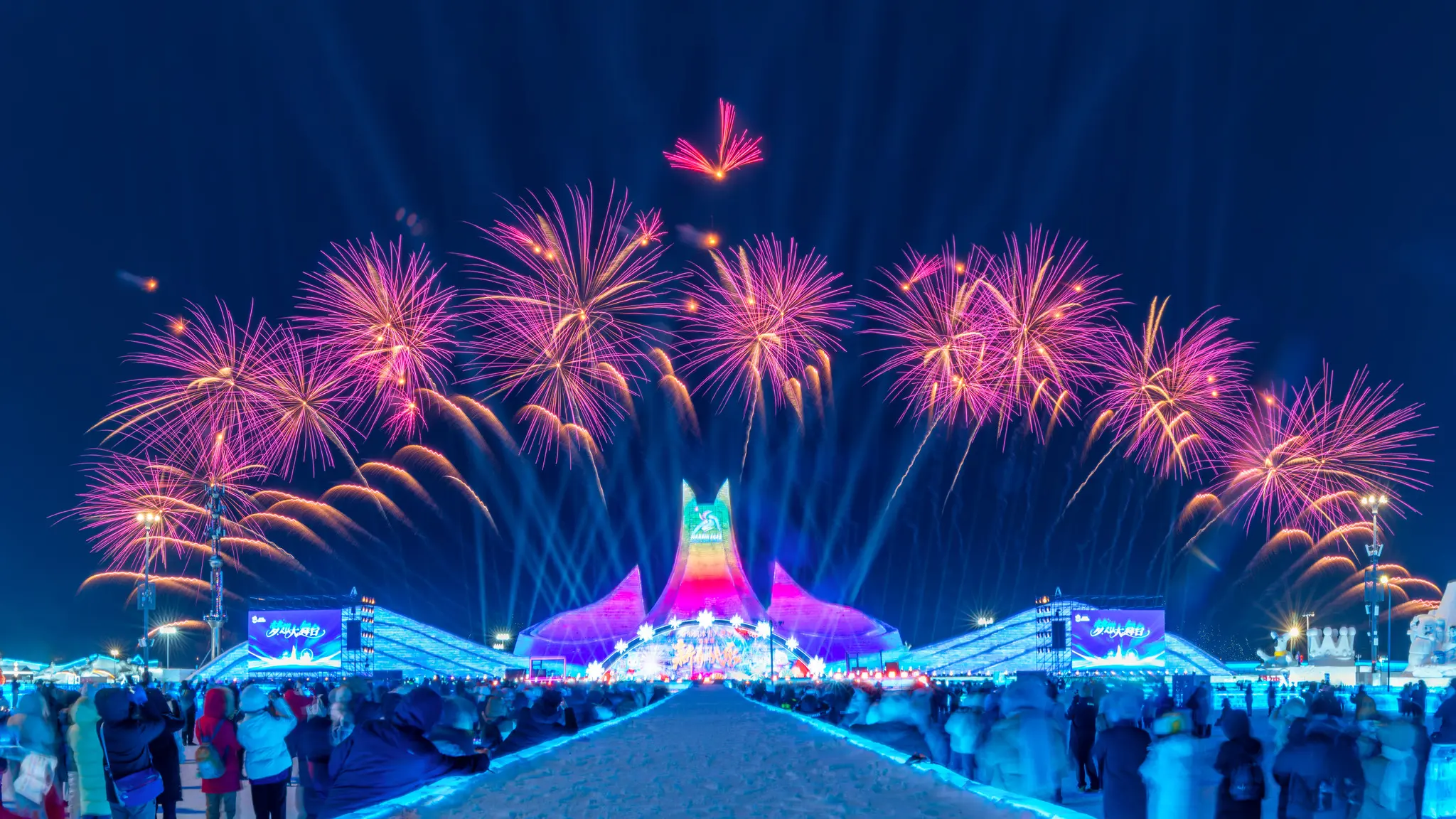
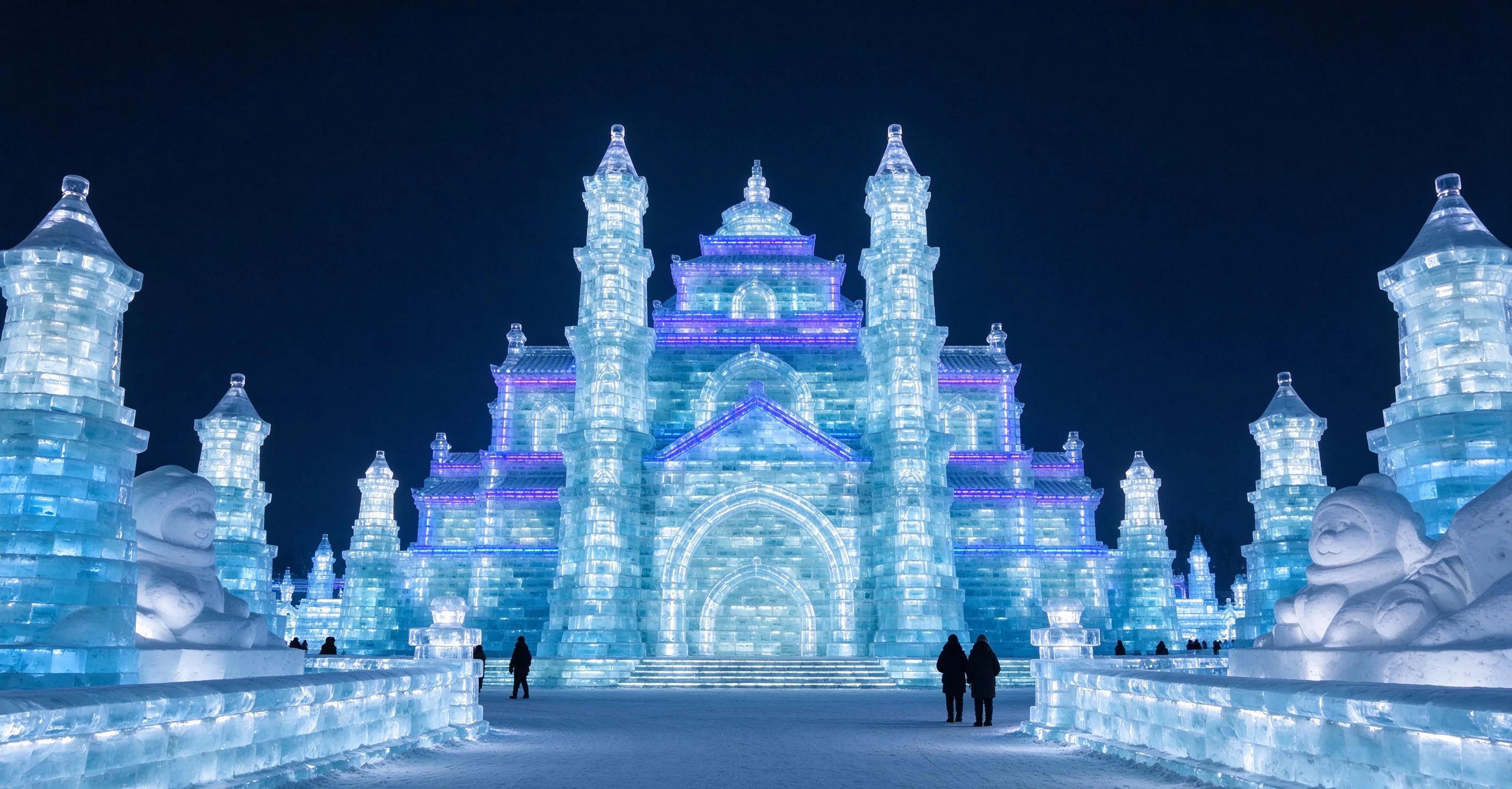
Soft opening: Ice and Snow World is expected to begin trial operation around 20 December 2026, with some sculptures still being finished.
Official festival opening: around 5 January 2027 — the 43rd edition of the city festival.
Best window:5 January – mid-February 2027. Everything is built, lit and running.
Closing: late February, weather-dependent. In 2026 the park closed early when temperatures rose above zero, which is normal — the art is made of river ice.
Avoid: Chinese New Year week (6 February 2027 and the days around it) unless you enjoy queueing for a slide in −25°C.
BOOKING RHYTHM For early-January dates: book train tickets the moment the 15-day window opens, and lock accommodation 4–8 weeks ahead. Ice and Snow World tickets release on a rolling one-to-seven-day window through the official mini-program — set a reminder, because the 15:00–17:00 entry slots go first.
What −20°C is actually like
Harbin in January runs roughly −13°C by day and −25°C at night, with a dry, continental cold and a wind off the Songhua River that makes the "feels like" number 5–8 degrees lower. It is survivable and even pleasant for two to three hours at a time, provided you dress in layers rather than one thick coat, and provided you know the two rules: never bare skin for more than a few minutes, and go indoors every 90 minutes.
Month | Daytime high | Night low | Verdict |
|---|---|---|---|
December | −10°C | −20°C | Soft-opening season; cheaper, some works unfinished |
January | −13°C | −25°C | Peak. Everything open, coldest, most crowded |
February | −8°C | −20°C | Still full festival; slightly gentler |
July | +28°C | +19°C | A completely different, green riverside city |
If ice is not your reason for going, June to September is genuinely lovely — the Central Street cafés spill onto the pavement, the river boats run, and train tickets cost half of what they do in January.
Three days in Harbin, built around the train timetable
For what to actually do once you arrive, start with our Harbin travel guide, pick a base with where to stay in Harbin, and add China Snow Town if you want the fairytale drifts.
A weekend is enough if you use the 08:00 departure and the 17:00 return. Here is how it actually fits together.
Day 1 · 06:45 Beijing Chaoyang, coffee and security
Metro Line 3 to the station, 40 minutes for security and boarding. Buy water and a pastry on the concourse.
Day 1 · 08:00 G101 departs
Window seat on the left for the snowy stretch after Changchun. Arrive Harbin West 12:33.
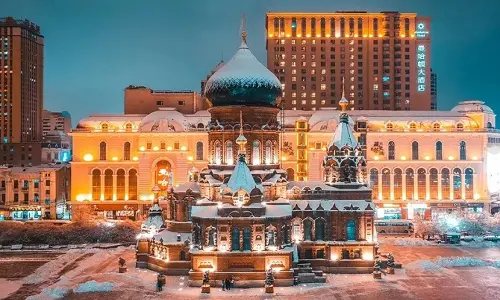
Day 1 · 13:15 Check in, then St Sophia Cathedral
Green onion domes, red brick, and the best first photograph of the trip. Twenty minutes' walk from Central Street.
Day 1 · 15:00 The 1.4 km of Central Street
Baroque façades, Russian bakeries, madier ice cream at −20°C, and the cobbles that have been there since 1900.
Day 1 · 18:30 Iron pot stew and an early night
You will be asleep by 21:30. So will the city.
Day 2 · 13:30 Metro Line 2 to Ice and Snow World
Enter around 14:30: you get daylight photographs, the 16:00–16:30 lighting switch, and the full neon show. Four to five hours is right.
Day 2 · 20:30 Back across the river
Hot pot or dumplings; the metro closes about 21:30, so do not linger at the exit gates.
Day 3 · 09:30 Sun Island snow sculptures
¥198, and the giant snow carvings are arguably more photogenic in daylight than the ice is at night.
Day 3 · 15:30 Train or airport
Allow 60 minutes from Central Street to Harbin West, 90 to the airport. A 17:00–18:00 departure gets you home before midnight.
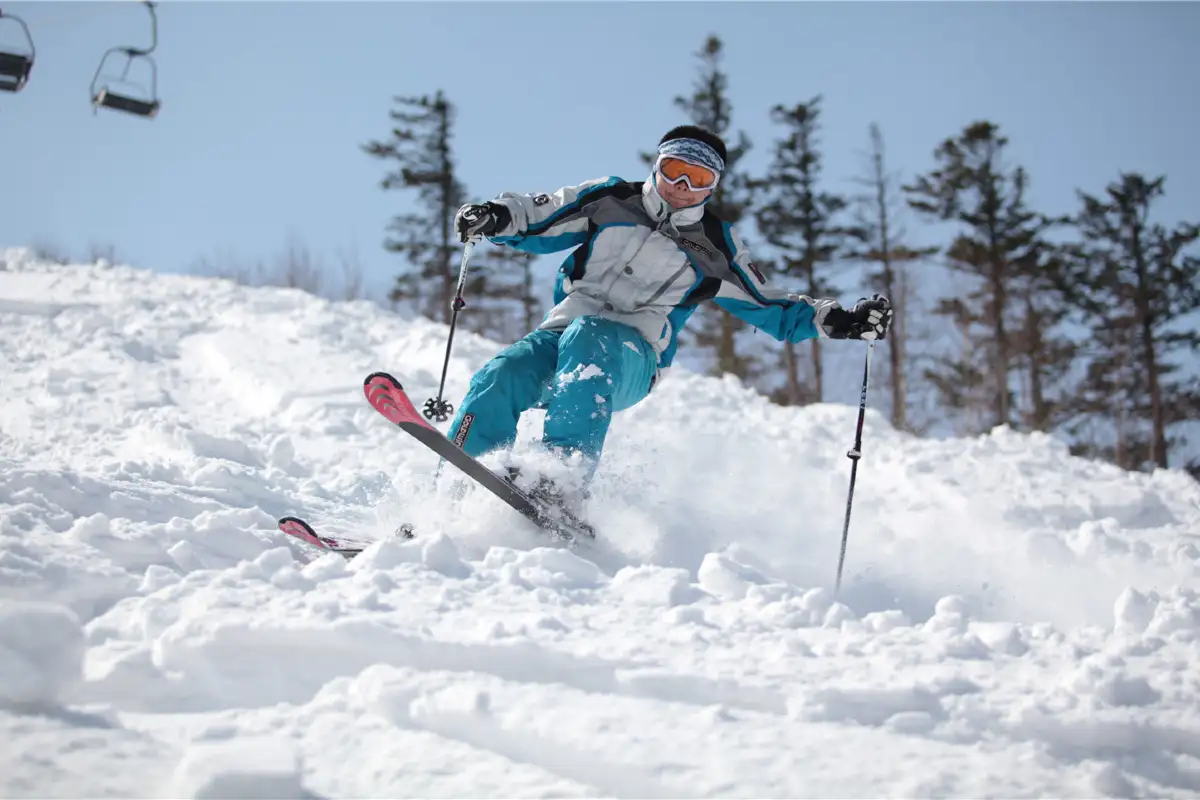
STRETCH IT TO FIVE DAYS Add Yabuli ski resort (90 minutes by high-speed train from Harbin, then a shuttle), or Volga Manor for the Russian-architecture day trip. China Snow Town in Hailin is a further 3 hours and best done as an overnight, not a day trip.
What to pack (and what to buy in Harbin instead)
The full layering system - what to wear at -20°C, hour by hour - is in our Harbin winter packing guide.
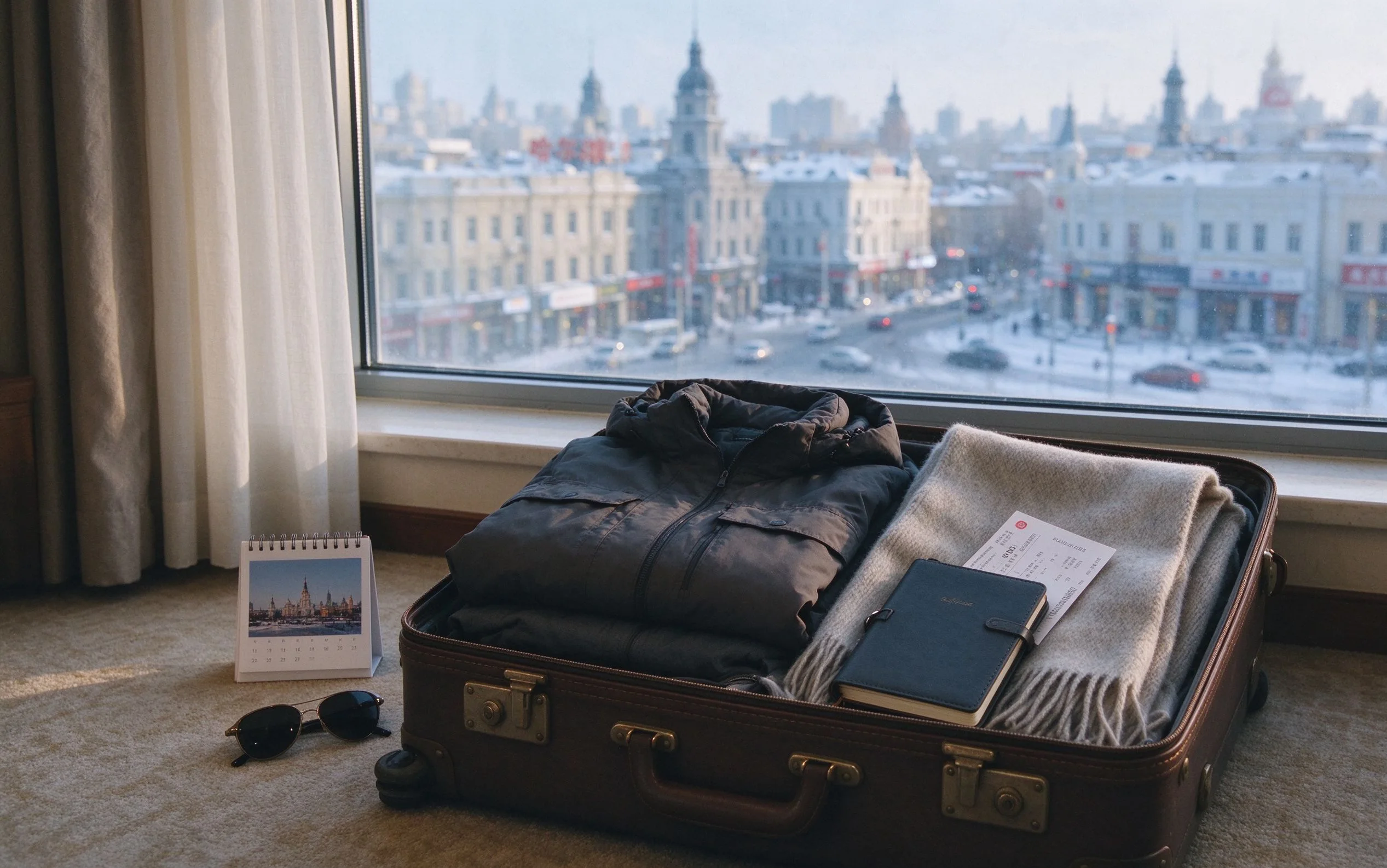
Beijing's −2°C is a mild autumn compared with Harbin's −22°C. Do not try to bridge that gap with one jacket.
Down coat rated to −25°C, hip-length or longer
Thermal base layer, top and bottom
Fleece or wool mid-layer
Waterproof, insulated boots with deep tread
Two pairs of wool socks
Insulated gloves plus thin liner gloves
Beanie that covers the ears
Neck gaiter or scarf, and a face mask
Thermos flask (hot water is free everywhere)
Hand warmers — a pack of ten costs ¥20 locally
Power bank kept inside your coat, not your bag
Lip balm and heavy moisturiser
Sunglasses for the glare off snow
Universal adapter and a long charging cable
Small backpack for the ice park
Yak trakts or slip-on grips if you plan long walks
PHONE KILLER Lithium batteries lose capacity fast below −15°C. Your phone will die at 30% if you keep it in an outside pocket. Keep it against your chest, and carry a power bank somewhere warm.
You can buy almost everything on Central Street or in the underground mall at the Harbin Station — padded trousers for ¥150, boots for ¥200, hats for ¥30. Locals shop there; so can you. It is often cheaper than buying expedition-grade gear at home for a three-day trip.
Apps, payments and the small friction points
Need | Use | Note |
|---|---|---|
Train tickets | 12306 or Trip.com | Passport number must match exactly |
Taxis | Didi (English UI) | Links to Alipay or an overseas card |
Payment | Alipay / WeChat Pay | Set up before arrival; cash is rarely used |
Metro | Line 2 & Line 3 | Scan the QR in Alipay at the gate |
Translation | Any offline-capable app | Download the Chinese pack before you fly |
Maps | Gaode / Amap | Google Maps is inaccurate for China |
Internet | Roaming eSIM or local SIM | Roaming keeps your usual apps reachable |
Harbin is a safe city by any standard, including at night, and the tourist core around Central Street is used to foreign visitors. The friction is linguistic, not criminal. Learn four phrases — nǐ hǎo (hello), xièxie (thanks), duōshao qián (how much), zhège (this one) — and you will be fine.
Ten mistakes first-timers make on this route
Booking the 08:00 train from the wrong Beijing station. Most G trains leave from Beijing Chaoyang in the northeast, not Beijing Station or Beijing West. Check the station name, not just "Beijing".
Arriving at Harbin West and expecting Central Street outside. It is 8 km away. Budget 25 minutes and ¥30, or take Metro Line 3.
Flying into Harbin and assuming a metro exists. It does not. The airport bus is ¥20 but leaves when full; in deep winter, pay for the taxi.
Treating the festival opening as the park opening. The city festival on 5 January and the park's soft opening in late December are different dates. Check the operator's mini-program.
Booking a 2-day trip in the last week of December. Sculptures may still be under construction, and the light is gone by 16:00.
Underdressing because "it's only China". Beijing and Harbin are 1,200 km and 15 degrees apart. Pack for the destination, not the departure city.
Buying Ice World tickets from a man outside the gate. Only the official mini-program, on-site ticket halls or reputable platforms are valid.
Leaving the return train to the last minute. Harbin → Beijing on a January Sunday sells out first. Book both legs together.
Planning a day trip. Nine hours of travel for five hours in the city is not a day trip, it is a punishment. Stay at least one night — ideally two.
Carrying cash only. Harbin is close to cashless. Set up Alipay with an overseas card before you arrive, or you will be asking strangers to pay for your noodles.
Beijing–Harbin tour packages: when they are worth it
We run this route ourselves: the Beijing to Harbin 4-day high-speed-train tour and the Harbin winter tour both bundle the train, the transfers and an English-speaking guide.
Two-day bullet-train packages from Beijing start around $500–800 per person, usually including return G-train tickets, a Harbin hotel, English-speaking guide, Ice and Snow World entry and city transfers. DIY, the same components cost roughly $380–600 — so you are paying $100–200 for someone else to hold the tickets.
Package | DIY | |
|---|---|---|
Train tickets | Booked for you | You, 15 days out, at 08:00 |
Ice World entry | Included, pre-reserved | Rolling 1–7 day window; you fight for slots |
Language | English guide throughout | Translation app and pointing |
Flexibility | Fixed itinerary, early starts | Total |
Cost | $500–800 pp | $380–600 pp |
Book a package if you are travelling with elderly parents, if your dates fall in the New Year crush and you cannot face the 12306 lottery, or if you have never navigated a Chinese station. Otherwise, this route is genuinely easy to do alone — the infrastructure is the product.
Prefer to hand the timetable, tickets, transfers and hotels to someone who runs this route every winter? Tell us your dates and how many nights you want in Harbin - Snow Town or the Tiger Park included if they are on your list - and we will build it around you via plan my trip.




Traveler Discussions
Questions from travelers