
The Short Answer: Where Chinese Tourists Are Heading in 2027
Wondering where Chinese tourists are traveling in 2027? This guide covers top destinations, emerging markets, spending patterns & traveler preferences by combining official China-wide totals, destination-country arrival data and industry surveys to show which countries are winning mainland China’s rebounding outbound market. It is the companion piece to our China Outbound Tourism Statistics 2027 data report — that article explains trip volumes and methodology, while this one focuses on the destinations themselves.
For 2027, the most defensible outlook is that nearby Asia-Pacific destinations will continue to capture the largest share of mainland China's outbound leisure market, while long-haul Europe, the Middle East, Africa and selected emerging destinations compete for experience-led trips. South Korea, Thailand, Vietnam, Malaysia, Singapore, Indonesia and Japan are important destinations to watch, but their relative performance can change quickly with visa rules, flight capacity, safety perceptions, prices and bilateral relations.
China's outbound travel market has fully recovered and entered a new phase of high-quality growth. The country recorded approximately 167.92 million outbound trips in 2025, up 16% year-on-year and approaching pre-pandemic levels. Projections for 2026 suggest further growth to 179.3 million trips with total spending reaching USD 257.6 billion. For 2027, the World Travel & Tourism Council (WTTC) forecasts China's tourism sector will maintain an average annual growth rate of around 7% over the next decade.
There is no single, comprehensive official 2027 ranking of destinations chosen by Chinese tourists. This article combines official China-wide totals, destination-country arrival data and industry surveys to present a multi-dimensional view rather than a single definitive league table.
Key Findings at a Glance
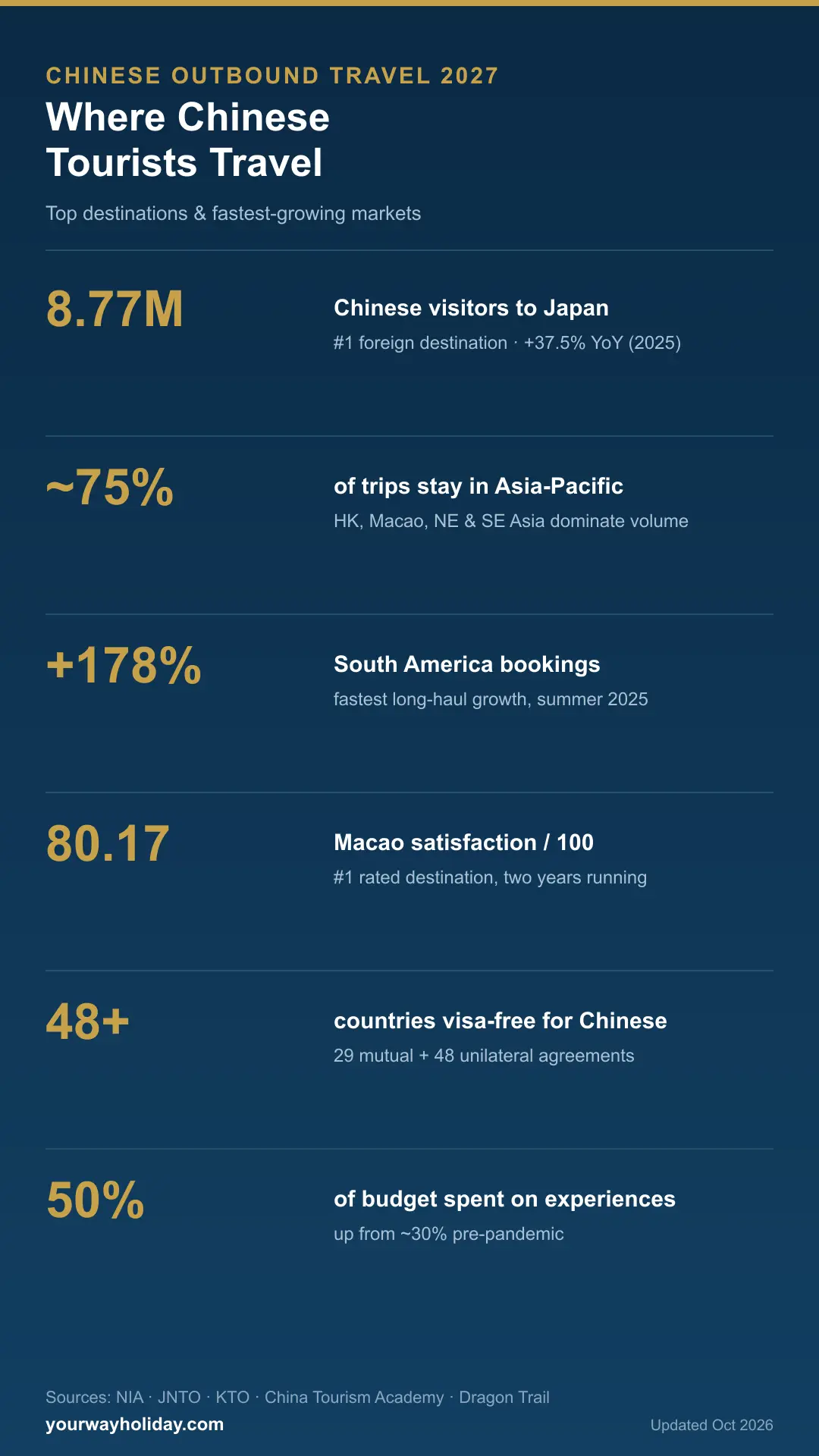
Save this snapshot — yourwayholiday.com
Market scale is fully recovered: 167.92 million outbound trips in 2025, projected 179.3 million in 2026, with total spending reaching USD 257.6 billion.
Asia dominates: ~75% of mainland outbound trips go to Asia-Pacific destinations (Hong Kong, Macao, Northeast and Southeast Asia).
Q3 2026 official top 10: Hong Kong, Macao, South Korea, Vietnam, Thailand, Japan, Singapore, Malaysia, Russia, Indonesia (China National Immigration Administration).
Experience over shopping: Experiential spending has risen from ~30% to ~50% of total travel budget; Z世代 local activity spending up nearly 20% YoY.
Free-travel is mainstream: Independent travel grows faster than group tours; small-group tours are the fastest-growing segment in organized travel.
Long-haul surging: Europe up ~76% in summer 2025; Middle East & Africa up 103%+; South America up 178%+ (from lower base).
Visa liberalization: 29 mutual visa-free countries, 48 unilateral visa-free countries for Chinese passport holders as of 2025.
Younger travelers driving growth: 18-35 year olds represent 47% of travel agency-reported growth; Z世代 group tour bookings up 52%.
Multi-destination trips up 84%: Average 2.8 countries per multi-country itinerary in 2026 Golden Week data.
Mobile payment goes global: WeChat Pay now supports direct QR code scanning in South Korea, Thailand, Malaysia, Singapore, Sri Lanka and Indonesia.
Market Size & Growth Trajectory
China is once again the world's largest outbound tourism spender, having reclaimed the title in 2024. (For the full trip-volume methodology and why official figures differ, see our companion China Outbound Tourism Statistics 2027.) The market has transitioned from policy-driven rebound to high-quality, normalized growth.
Metric | 2024 | 2025 | 2026E |
|---|---|---|---|
Outbound Trips (Mainland) | 146 million | 167.92 million | 179.3 million |
YoY Growth | -- | +16% | +6.8% |
Total Outbound Spending | -- | ~USD 160B | USD 257.6B |
Per Capita Spending | -- | ~RMB 4,100 | ~USD 1,437 |
Visa-Free Countries | -- | 29 mutual + 48 unilateral | Expanding |
Tourist Satisfaction | -- | 80.17 / 100 | -- |
Sources: China Tourism Academy, National Bureau of Statistics of China, TravelAndTourWorld, China Tourism News. Note: Different sources use slightly different definitions (trips vs. unique travelers; mainland residents vs. all Chinese jurisdictions).
Top Destinations for Chinese Tourists in 2027
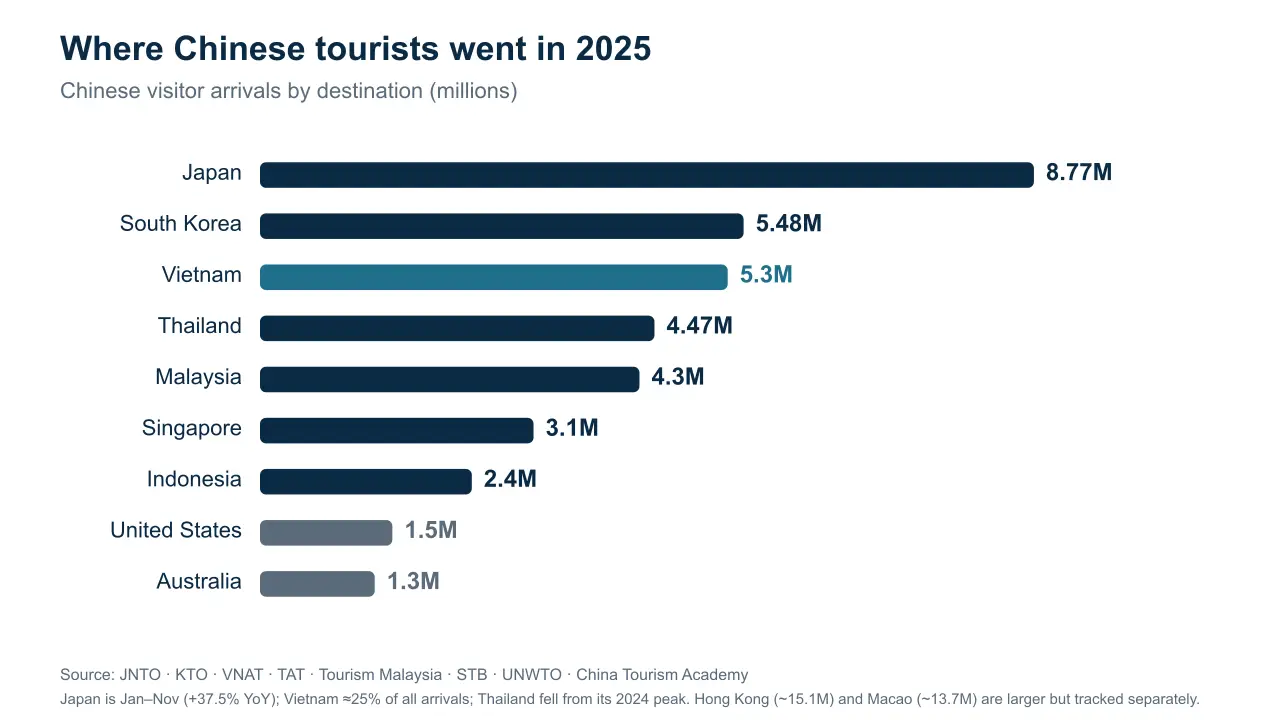
Chinese visitor arrivals by destination, 2025 (millions). Source: national tourism boards via China Tourism Academy.
The following ranking combines 2025 full-year destination-country arrival data, 2026 quarterly data, and industry forecasts. Rankings shift based on visa policy, flight capacity, safety perceptions and geopolitical factors. Hong Kong and Macao are listed separately from foreign countries as they represent a different travel category.
Rank | Destination | 2025 Arrivals | YoY Growth | Key Notes |
|---|---|---|---|---|
1 | Japan | 8.77M (Jan-Nov) | +37.5% | Japan's #1 foreign source market; 47.8% of foreign spending in Q3 2025 |
2 | South Korea | 5.48M | +19.1% | Group visa-free extension; K-culture, beauty, shopping draw |
3 | Vietnam | 5.3M+ | +41.3% | ~25% of Vietnam's international visitors; food, beaches, heritage |
4 | Thailand | 4.47M | -33.6% | Declined from 2024 peak; still 3rd largest foreign source for Thailand |
5 | Singapore | ~3.1M | Visa-free | Mutual visa-free since 2024; family-friendly, efficient transport |
6 | Malaysia | ~4.3M (est.) | +35.6% | Visa facilitation drove growth; H1 2025: 2.18M Chinese visitors |
7 | Indonesia | ~2.4M | Strong growth | Bali dominates; visa-free access; wellness and resort travel |
8 | Russia | Growing | +25%+ | 30-day visa-free since late 2025; border areas and Moscow/St. Pete |
9 | United States | ~1.5M (est.) | ~-1% | High-value market; VFR, students, leisure; visa processing backlog |
10 | Australia | ~1.3M | Stable | Top 10 satisfaction destination; nature, wildlife, family travel |
-- | Hong Kong SAR | ~15.1M | -- | Largest outbound destination by volume; day trips and short stays |
-- | Macao SAR | ~13.7M | -- | #1 satisfaction rating 2 years running; entertainment, food, events |
Sources: Japan National Tourism Organization, Korea Tourism Organization, Vietnam National Administration of Tourism, Ministry of Tourism & Sports Thailand, Singapore Tourism Board, Tourism Malaysia, Ministry of Tourism Indonesia, China Tourism Academy, National Immigration Administration Q3 2026 data.
Destination Deep Dives: What Travelers Need to Know
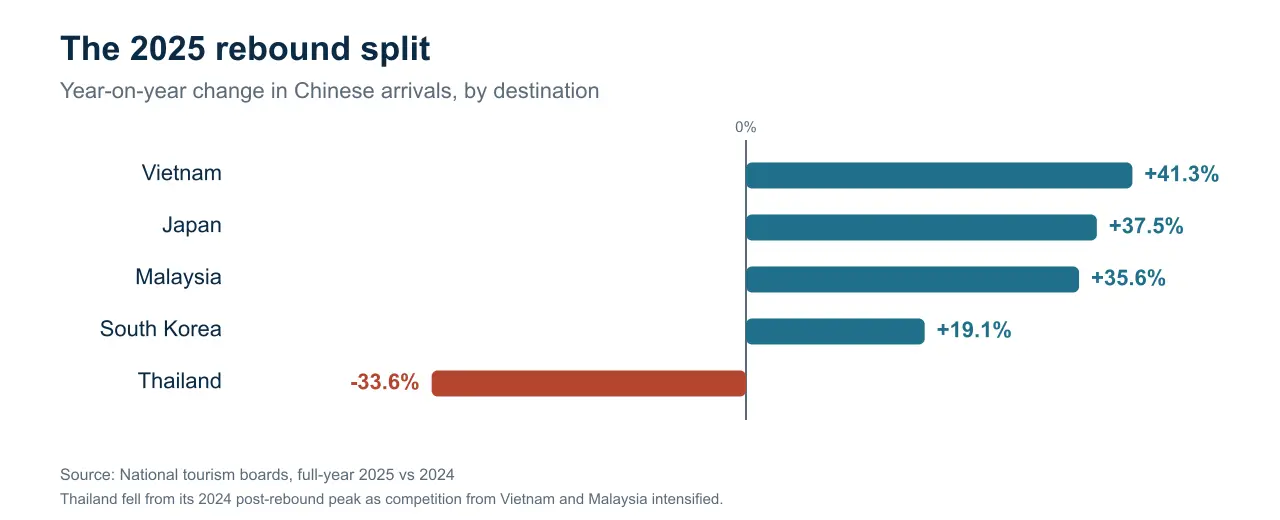
The 2025 rebound was uneven — Vietnam, Japan and Malaysia surged while Thailand fell from its 2024 peak.
1. Japan: Enduring Appeal with High Spending Power
Japan remains the top foreign destination by Chinese visitor volume. From January to November 2025, Japan received 8.77 million Chinese visitors, up 37.5% year-on-year, making China Japan's largest source market by a wide margin.
Spending power: Chinese tourists accounted for 47.8% of all foreign tourist spending in Japan during Q3 2025, despite comprising a smaller share of visitor numbers. This reflects higher per-capita spending on shopping, dining and experiences.
Best for: Food, shopping (cosmetics, electronics), pop culture, historic districts, hot springs, seasonal cherry blossoms and autumn foliage, ski trips.
Average stay: 5-7 days for first-time visitors; 3-4 days for repeat city-focused trips.
Peak seasons: March-April (cherry blossoms), July-August (summer), September-November (autumn foliage), December-February (ski).
Visa: Single-entry, multiple-entry, and transit visas available; e-visa system in place. Processing typically 5-10 business days.
Mobile payment: Alipay and WeChat Pay widely accepted at major retailers, department stores and tourist sites; UnionPay accepted at most chain stores.
2027 outlook: Japan faces volatility from diplomatic relations and official travel advisories. Monitor monthly arrival data and airline capacity before making firm plans.
2. South Korea: The Short-Haul Powerhouse
South Korea welcomed 5.48 million Chinese visitors in 2025, up 19.1% year-on-year. The extension of group tourist visa-free policies and abundant flight capacity from major Chinese cities keep South Korea highly accessible.
Traveler profile: Z世代 travelers (born 1995-2010) represent a fast-growing segment, drawn by K-pop, K-drama, K-beauty, and food culture. Short breaks of 3-5 days are common.
Best for: Beauty and skincare shopping, K-culture experiences, street food, Seoul city breaks, Jeju Island nature trips, Busan coastal getaways.
Average stay: 3-5 days for Seoul/Jeju; 5-7 days for multi-city.
Peak seasons: Spring (cherry blossoms), autumn (fall foliage), summer (Jeju), winter (ski).
Visa: Individual tourists require visa; group tour visa-free policy in effect (subject to renewal). Multiple-entry visas available for frequent travelers.
Mobile payment: WeChat Pay directly integrated with Korean local QR payment systems (April 2026); Alipay widely accepted at duty-free stores, major retailers and tourist attractions.
Spending note: Lotte Duty Free reported Chinese customer numbers grew 74% but spending per customer fell 19% in 2025-2026, reflecting a shift from heavy shopping to more experiential travel.
3. Vietnam: Fastest-Growing Major Destination
Vietnam received over 5.3 million Chinese tourists in 2025, surging 41.3% year-on-year. Chinese visitors now account for approximately one-quarter of Vietnam's total international arrivals.
Best for: Budget-friendly travel, street food, beaches (Da Nang, Nha Trang, Phu Quoc), heritage sites (Hoi An, Hue), Ha Long Bay cruises, mountain trekking (Sapa).
Average stay: 5-7 days for north or south alone; 10-14 days for full country itinerary.
Peak seasons: September-November (north), December-April (south beach destinations).
Visa: E-visa available for 90 days; visa-free for 15 days for Chinese passport holders (subject to policy updates).
Mobile payment: Alipay and WeChat Pay accepted at major hotels, restaurants and tourist shops in Hanoi, Ho Chi Minh City and tourist areas; cash still dominant outside major centers.
2027 outlook: Strong growth trajectory supported by increased flight routes, competitive pricing and growing awareness beyond just beach resorts.
4. Thailand: Familiar Favorite Adapting to Competition
Thailand recorded 4.47 million Chinese visitors in 2025, a 33.55% decline from 2024's post-rebound peak. Despite the drop, China remains Thailand's 3rd largest source market, and Thailand continues to offer the broadest range of products in Southeast Asia.
Best for: Beach resorts (Phuket, Krabi, Koh Samui), Bangkok city life, cultural heritage (Chiang Mai, Ayutthaya), wellness and spa, island hopping, family holidays.
Average stay: 5-7 days for Bangkok + beach; 7-10 days for multi-region.
Peak seasons: November-February (cool, dry season); July-October (green season, lower prices).
Visa: Visa-exempt entry for Chinese tourists (policy extended through 2026-2027; verify current status).
Mobile payment: Alipay and WeChat Pay widely accepted in tourist areas, shopping malls and at major attractions.
2027 outlook: Thailand is working to rebuild traveler confidence and compete with Vietnam, Malaysia and other rising Southeast Asian destinations. Expect continued focus on safety, quality experiences and niche segments like wellness and medical tourism.
5. Singapore & Malaysia: Convenient Multi-Stop Pairing
Singapore and Malaysia are often combined in multi-destination itineraries. Singapore offers efficient transport, family-friendly attractions and a highly organized travel experience, while Malaysia provides diverse culture, food, nature escapes and better value for money.
Singapore highlights: Gardens by the Bay, Sentosa, Universal Studios, Orchard Road shopping, hawker center food, family-friendly infrastructure. ~3.1M Chinese visitors in 2025.
Malaysia highlights: Kuala Lumpur (food, shopping), Penang (heritage, street food), Langkawi (beaches, duty-free), Sabah/Sarawak (nature, diving). ~4.3M+ Chinese visitors in 2025 (est.).
Visa: Singapore - mutual visa-free with China (30 days). Malaysia - visa-free entry for Chinese tourists (extended policy).
Average stay: 2-3 days Singapore; 4-7 days Malaysia; 7-10 days combined.
Mobile payment: Both countries have strong Alipay and WeChat Pay coverage; Singapore's PayNow and Malaysia's DuitNow integrated with WeChat Pay.
6. Indonesia: Beyond Bali
Indonesia received approximately 2.4 million Chinese tourists in 2025, with Bali accounting for the majority of arrivals. The government is actively promoting destinations beyond Bali, including Lombok, Komodo National Park, Yogyakarta and Lake Toba.
Best for: Bali resorts and wellness, diving (Raja Ampat, Komodo), cultural heritage (Borobudur, Prambanan), surfing, wedding and honeymoon travel.
Average stay: 5-7 days Bali; 10-14 days multi-island.
Peak seasons: July-August, December-January (dry season in Bali).
Visa: Visa-free entry for 30 days for Chinese passport holders (as of 2024-2025 policies).
Mobile payment: Alipay+ cross-border QR payment connected with Indonesian local systems; widely available at tourist areas and chain retailers.
7. Hong Kong & Macao: Cross-Border Giants
Hong Kong (~15.1 million mainland visitors in 2025) and Macao (~13.7 million) dwarf all foreign destinations in sheer volume, though many visits are day trips or short stays. They should be considered separately from international destination rankings.
Hong Kong: Shopping, food, theme parks (Disneyland, Ocean Park), events and exhibitions, day trips to Greater Bay Area. High-speed rail connects to multiple mainland cities.
Macao: Ranked #1 in Chinese outbound tourist satisfaction for two consecutive years. Entertainment, dining, luxury hotels, events, day trips from Hong Kong or Zhuhai.
Travel documents: Mainland residents require Exit-Entry Permit (港澳通行证) with relevant endorsement. Multiple-entry permits available for eligible residents.
Long-Haul Destinations: Europe, Middle East, Africa & Americas
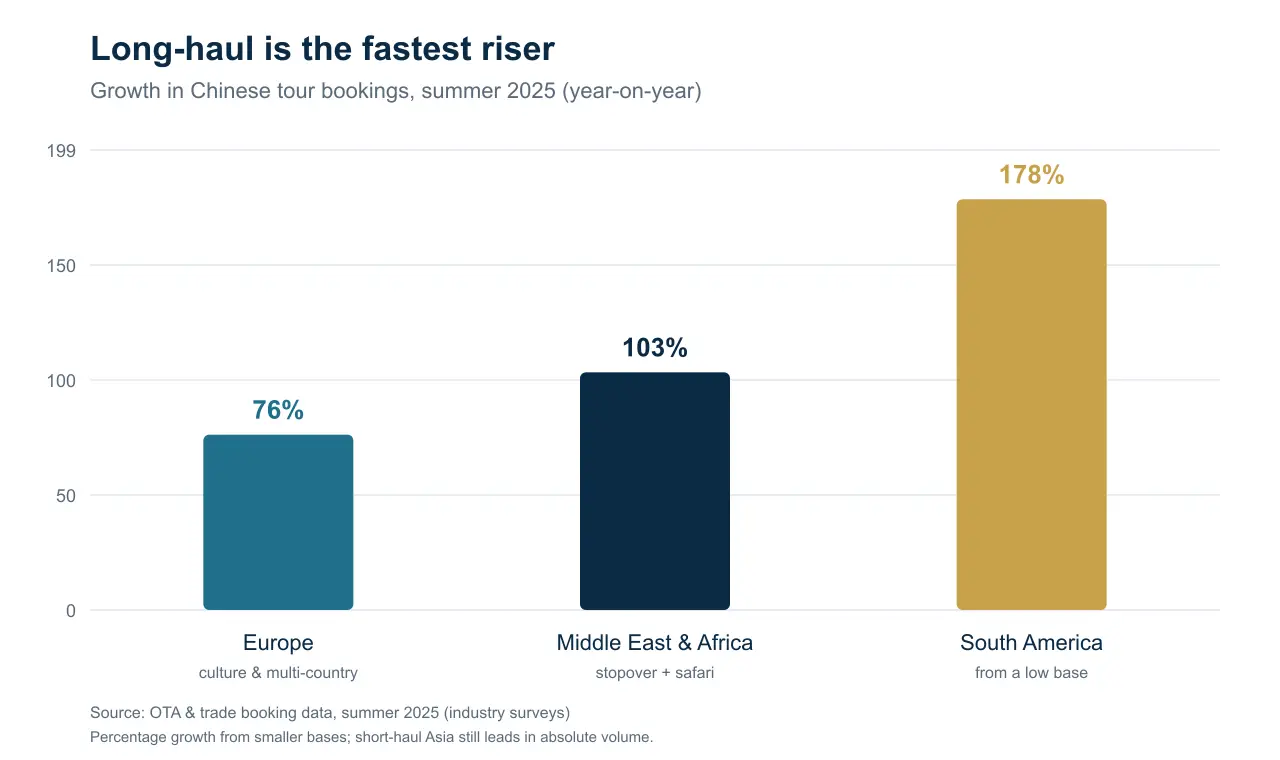
Long-haul destinations grew fastest in percentage terms, though from smaller bases than short-haul Asia.
Europe: Culture, Scenery & Multi-Country Routes
Europe remains the premier long-haul destination for Chinese travelers seeking art, architecture, history, food, shopping and multi-country itineraries. Summer 2025 saw approximately 76% year-on-year growth in Chinese visitors to Europe, with Golden Week 2026 showing continued momentum.
Destination | 2026 H1 Visitors | Summer 2025 Growth | Key Attractions for Chinese Travelers |
|---|---|---|---|
France | ~500K (est.) | Strong | Paris landmarks, Provence, wine regions, luxury shopping |
Italy | ~500K (est.) | Strong | Rome, Florence, Venice, Tuscany, food culture, art |
Switzerland | -- | +50%+ | Alpine scenery, luxury watches, scenic trains, ski resorts |
Germany | ~500K (est.) | Stable | Castles, beer culture, Berlin art scene, Autobahn road trips |
United Kingdom | ~360K (est.) | +75% summer | London landmarks, Harry Potter, universities, shopping |
Nordic (Iceland, Norway, Finland, Sweden) | -- | +50%+ | Northern lights, fjords, Santa Claus Village, eco-tourism |
Average stay: 10-16 days for multi-country Europe; 7-10 days for single country.
Visa: Schengen Area visa covers 27 European countries. UK requires separate visa. Processing times can be 2-4 weeks during peak seasons.
Trip types: Multi-country bus tours (budget/mid-range), private customized tours, self-drive, rail journeys (Interrail/Eurail), themed trips (Christmas markets, wine, art).
2027 outlook: Europe will continue to grow as a premium long-haul choice. The trend is toward deeper, slower travel in fewer countries rather than rushed 10-country whistle-stop tours.
Middle East: Stopover Hub & Standalone Destination
The Middle East serves both as a long-haul destination and a strategic stopover between Asia, Europe and Africa. Dubai and Abu Dhabi are well-established, while Saudi Arabia, Qatar, Oman and Israel (when conditions permit) are emerging as distinct itinerary options.
United Arab Emirates: Dubai remains the most visited Middle Eastern destination for Chinese tourists - luxury shopping, desert safaris, Burj Khalifa, theme parks. Visa-free entry. Strong Alipay/WeChat Pay acceptance.
Saudi Arabia: Fast-growing emerging destination with visa liberalization. Historical sites (Al-Ula), Red Sea coast, Riyadh modern culture. Strong growth in Chinese visitor interest.
Qatar: Growing since the 2022 World Cup; stopover destination with Hamad International Airport; cultural sites and desert experiences.
Average stay: 3-5 days standalone; 1-2 days as stopover.
Best time to visit: November-March (cooler weather).
Africa: Egypt, Morocco & Safari Destinations
Africa offers some of the most distinctive and fastest-growing long-haul experiences. Egypt recorded over 20% growth in Chinese visitors in 2025, driven by visa-on-arrival access and direct flights.
Egypt: Pyramids, Sphinx, Nile River cruises, Luxor temples, Red Sea diving. Visa-on-arrival available. 10-14 day typical itinerary.
Morocco: Medina cities (Marrakech, Fez), Sahara desert, Atlas Mountains, coastal towns. Visa-free for Chinese passport holders. 10-14 day trips.
East Africa (Kenya, Tanzania): Safari, wildebeest migration, beach holidays (Zanzibar). High-value, longer-stay market. June-October peak season.
Growth: Middle East & Africa overall grew 103%+ in summer 2025 Chinese tour bookings (from a lower base).
The Americas & Oceania: High-Value, Longer-Horizon Trips
United States: Estimated 1.5 million Chinese visitors in 2025. Major segments: VFR (visiting friends/relatives), students' families, West Coast road trips, East Coast city tours, Hawaii. Visa processing remains a bottleneck with long appointment wait times.
Canada: Similar profile to US - VFR, education-related travel, nature and ski. Visa required.
Australia: ~1.3 million Chinese visitors; ranked in top 10 satisfaction destinations. Nature, wildlife, Great Barrier Reef, Sydney/Melbourne city trips, family holidays, working holiday visas for young people.
New Zealand: Growing destination for self-drive, nature, adventure tourism. Summer (December-February) is peak for Chinese travelers escaping northern hemisphere heat.
South America: Very fast growth (+178%+ in summer 2025 bookings from a low base). Brazil, Argentina, Chile, Peru. 15-25 day itineraries typical. Long flights and visa requirements limit mass-market appeal.
Chinese Tourist Spending Patterns by Destination
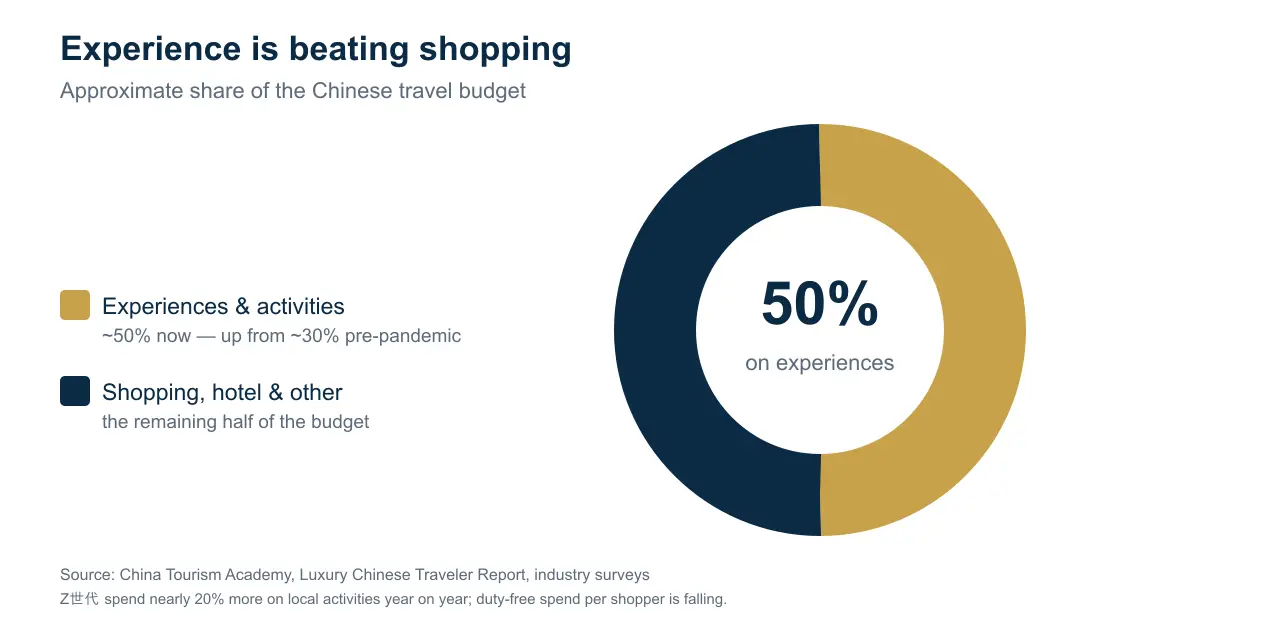
Experiential spending has risen to roughly half of the travel budget, at the expense of shopping.
Understanding how Chinese travelers spend their money is crucial for destination marketers and travel businesses. The spending mix varies significantly by destination type and traveler segment.
Destination Type | Avg Total Spend | Shopping | Hotel | Food & Dining | Experiences | Transport |
|---|---|---|---|---|---|---|
Japan | High | Very High | High | High | Medium | Medium |
South Korea | Medium-High | High (declining) | Medium | High | Growing | Low-Medium |
Thailand | Medium | Medium | Medium | High | Growing | Low |
Vietnam | Medium-Low | Low-Medium | Low | High | Growing | Low |
Singapore | High | Medium-High | High | High | Medium | Low |
Europe | Very High | High (luxury) | High | High | Growing | Very High |
Middle East | Very High | Very High (luxury) | Very High | Medium | Growing | Medium |
US/Canada | Very High | Medium | High | High | High | Very High |
Note: Table shows relative spending levels (qualitative, based on industry reports and available per-capita data). Exact figures vary by season, traveler segment and trip duration. Sources: China Tourism Academy, EternityX, Fliggy, Luxury Chinese Traveler Report.
Key Spending Trends for 2027
Experiential spending share has risen from approximately 30% to 50% of total travel budget, at the expense of shopping.
Gen Z travelers spend nearly 20% more on local activities and experiences year-on-year.
Group tour average spend: ~RMB 12,000 per person; independent travel: ~RMB 18,000 per person.
High-net-worth travelers: 1.8 outbound trips per year (up from 1.4 in 2024); average spend per trip: USD 4,760 (up from USD 4,280).
Luxury hotel bookings represent only ~5% of Golden Week 2026 outbound reservations - mid-range and budget hotels dominate.
Duty-free spending per shopper is declining in some markets (e.g., South Korea -19%) even as visitor numbers grow (+74%).
Cruise travel bookings grew ~30% in 2025, with higher per-passenger spending on board and at shore excursions.
Mobile payments overseas: WeChat Pay cross-border mini-program transactions surged during 2026 National Day - duty-free 8.5x, ferry tickets 3x+, ride-hailing 60%+.
Traveler Segment Analysis: Who Travels Where
Chinese outbound travelers are not a monolith. Different age groups, city tiers and travel styles show markedly different destination preferences, booking behaviors and spending patterns.
Segment | Top Destinations | Preferred Trip Type | Booking Channel | Key Drivers |
|---|---|---|---|---|
Gen Z (18-26) | Japan, South Korea, Thailand, Vietnam, Bali | Free & independent; short trips; local experiences | Xiaohongshu, Douyin, Trip.com, Fliggy | Pop culture, food, shareable moments, value for money |
Millennials (27-42) | Japan, Europe, Southeast Asia, Australia, US | Honeymoon, anniversary, boutique travel, small groups | Trip.com, Ctrip, Fliggy, offline agencies | Quality experiences, cultural depth, Instagrammable spots |
Family Travelers | Singapore, Japan, Thailand, Malaysia, Australia, Hong Kong | Family packages, cruises, theme parks, safe destinations | Ctrip, Fliggy, offline agencies, WeChat groups | Safety, convenience, kid-friendly activities, predictable schedules |
Silver Travelers (55+) | Southeast Asia, Russia, Korea, Japan, cruise, Europe tours | Group tours, slow pace, cultural/heritage, comfort | Offline travel agencies, WeChat, Ctrip | Visa-free access, short flights, comfort, medical safety |
High-Net-Worth | Europe, Middle East, Africa safari, South America, polar expeditions | Private custom tours, luxury resorts, yachting, private jet | VIP travel agencies, personal concierge, exclusive clubs | Exclusivity, privacy, unique experiences, status, service quality |
Lower-Tier Cities | Thailand, Vietnam, Malaysia, South Korea, Japan (first-timers) | Group tours, all-inclusive packages, first-time international | Tongcheng, offline agencies, Douyin live-stream | Value for money, ease of planning, trusted brands |
Sources: Fliggy 2025 Trends Report, TTG Asia Survey, Dragon Trail Trade Survey, EternityX Golden Week Report, Turespaña China Market Reports.
Visa Policy Guide for Chinese Tourists (2026-2027)
Visa access is one of the most important factors influencing destination choice. As of 2025, China has mutual visa-free agreements with 29 countries, and 48 countries offer unilateral visa-free entry to Chinese passport holders. Below is a practical guide for the most popular destinations.
Country | Visa-Free | Visa on Arrival | E-Visa | Advance Visa Required | Max Stay | Processing Time |
|---|---|---|---|---|---|---|
Japan | No | No | Yes | Yes | 15-90 days | 5-10 business days |
South Korea | Group tour only | No | Yes | Yes (individual) | 15-90 days | 3-7 business days |
Thailand | Yes (policy extended) | Yes | Yes | No | 30 days | N/A (visa-free) |
Singapore | Yes (mutual) | No | No | No | 30 days | N/A |
Malaysia | Yes | Yes | Yes | No | 30 days | N/A (visa-free) |
Vietnam | 15 days only | No | Yes (90 days) | No | 15-90 days | 3-5 days (e-visa) |
Indonesia | Yes (30 days) | Yes | Yes | No | 30 days | N/A (visa-free) |
Russia | Yes (30 days) | No | Yes | No | 30 days | N/A (visa-free) |
UAE (Dubai) | Yes | Yes | Yes | No | 30 days | N/A (visa-free) |
Schengen (Europe) | No | No | Partial | Yes | 90 days / 180 | 2-4 weeks (peak) |
United States | No | No | No | Yes (interview) | Typically 10 years | 2-6 months (wait + interview) |
Australia | No | No | Yes | Yes | 3-12 months | 2-4 weeks |
Egypt | No | Yes | Yes | No | 30 days | On arrival |
Morocco | Yes | No | No | No | 60-90 days | N/A |
Important: Visa policies change frequently. Always verify current requirements with the destination country's official embassy/consulate website or China's Foreign Ministry visa list before booking. This table reflects policies as of late 2026.
Booking Channels & Travel Planning Behavior
Chinese travelers use a diverse ecosystem of platforms for research, comparison and booking. Understanding the channel landscape is essential for reaching target audiences.
Platform | Role in Journey | Strengths | Key User Base | Trends |
|---|---|---|---|---|
Trip.com (携程国际) | Booking & planning | Global inventory, English/Chinese, flights + hotels + packages | International Chinese, expats, younger travelers | AI trip planning, multi-destination search growing |
Ctrip (携程) | Primary booking platform | Largest OTA in China, full-service, business + leisure | Tier 1-2 cities, business travelers, families | ~31.7% market share; outbound GMV RMB 48.96B |
Fliggy (飞猪) | Booking + discovery | Alibaba ecosystem, Taobao traffic, promotions (618, Double 11) | Younger, price-sensitive, e-commerce users | Double-digit order growth; 618 GMV +130% |
Tongcheng (同程) | Value booking | Lower-tier cities, WeChat integration, budget travel | Tier 3-4 cities, price-sensitive travelers | Growing fast in lower-tier market |
Qunar (去哪儿) | Price comparison | Metasearch, budget focus, flight + hotel comparison | Budget travelers, students, young professionals | Part of Ctrip group; focus on value segment |
Xiaohongshu (小红书) | Inspiration & research | UGC content, travel tips, destination discovery, reviews | Z世代, millennials, female-skewed, trend-driven | Primary research platform; "planting grass" (种草) effect |
Douyin (抖音) | Discovery + live booking | Short video, live-stream selling, viral destination trends | All ages, especially Gen Z and silver surfers | Live-stream travel sales booming; impulse bookings |
WeChat (微信) | Social + payment + mini-programs | Mini-programs for bookings, groups for recommendations, payment | Broad user base, all demographics | Cross-border mini-program transactions surging |
Offline Agencies | Group tours + complex planning | Trusted for visa help, complex itineraries, group tours, seniors | Silver travelers, families, lower-tier cities | Declining but still relevant for complex/long-haul trips |
Sources: Company reports, industry analysis, EternityX, Fliggy data. Market share figures are approximate and vary by measurement methodology.
The Travel Planning Journey
A typical Chinese outbound traveler follows a multi-stage, multi-channel journey:
Inspiration: Xiaohongshu, Douyin, WeChat Moments, friends' recommendations, celebrity/influencer posts.
Research: Xiaohongshu guides, Mafengwo (蚂蜂窝) travel forums, Baidu search, Zhihu Q&A, official tourism accounts.
Comparison: Ctrip/Trip.com, Fliggy, Qunar for price comparison; reading reviews across platforms.
Booking: Ctrip, Fliggy, Trip.com, airline/hotel direct, offline agency (for groups/visas).
In-destination: WeChat Pay/Alipay for payments, Dianping (大众点评) for restaurant recommendations, maps, translation apps.
Post-trip: Sharing on Xiaohongshu/Douyin, leaving reviews, recommending to friends.
Seasonality & Peak Travel Periods
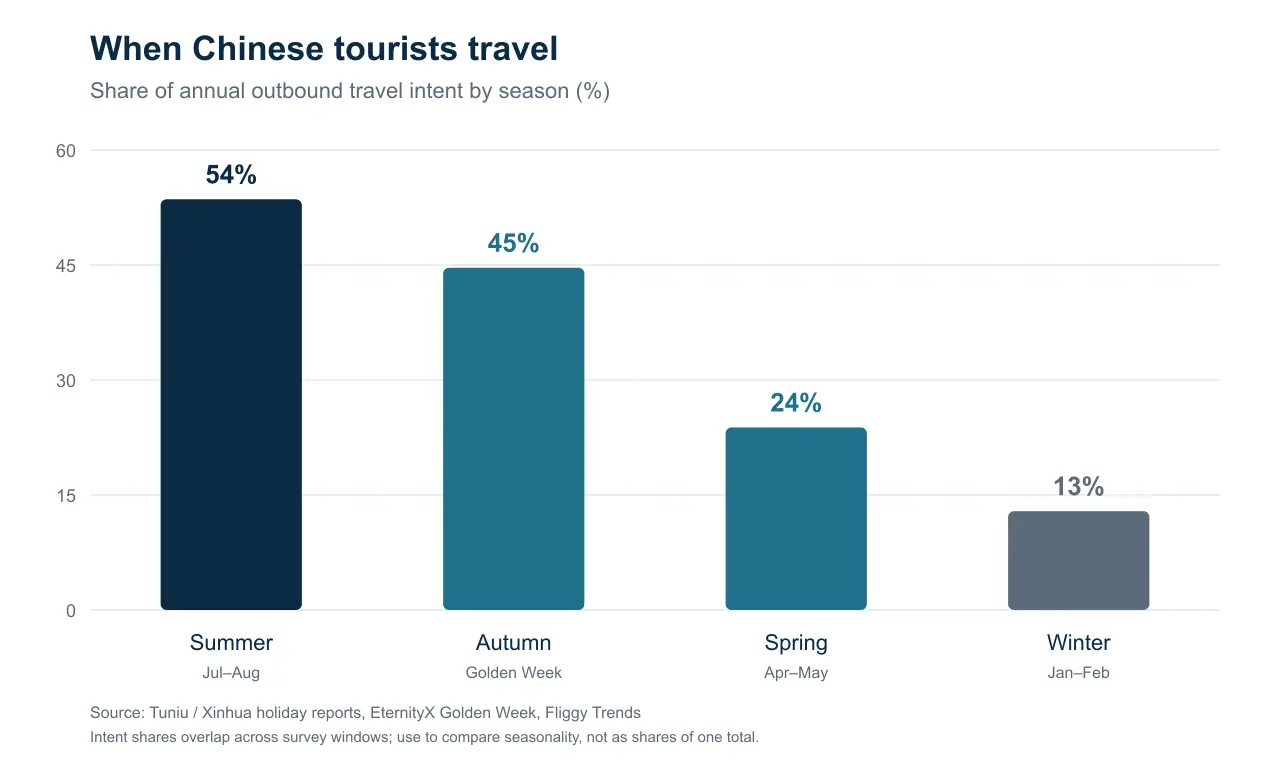
Summer and the autumn Golden Week drive the bulk of Chinese outbound travel intent.
Chinese outbound travel follows a distinct seasonal pattern driven by the national holiday calendar, school vacations and weather preferences. Understanding seasonality helps both travelers find the best times to go and businesses optimize their offerings.
Period | Key Holidays | Top Destinations | Traveler Profile & Notes |
|---|---|---|---|
Jan-Feb (Winter) | Spring Festival (7 days + leave) | Southeast Asia (warm escape), Japan/Korea (ski), Maldives, UAE, Australia | Family travel peak; 13% of annual outbound intent; long domestic + international combo trips popular |
Apr-May (Spring) | Qingming, Labor Day (5 days) | Japan/Korea (cherry blossoms), Southeast Asia, short-haul Asia | 24% of annual intent; short breaks popular; moderate prices outside peak cherry blossom season |
Jul-Aug (Summer) | Summer vacation (2 months) | Europe, Japan, Australia/New Zealand (winter down under), Southeast Asia, Russia | 54% of annual outbound intent; family travel, student travel; peak prices and crowds; long-haul strongest |
Sep-Nov (Autumn) | Mid-Autumn, National Day (7 days + leave) | Japan/Korea (fall foliage), Europe, Southeast Asia post-monsoon, Egypt, Middle East | 45% of annual intent; Golden Week is major outbound peak; multi-destination and long-haul trips surge 84% |
Dec (Year-End) | Christmas, New Year | Europe (Christmas markets), Japan/Korea (winter/ski), Southeast Asia, Maldives | Younger travelers, couples; shorter trips; festive season packages popular |
Sources: Xinhua/Tuniu 2026 Spring Festival Report, EternityX Golden Week Report, Fliggy Trends Report, industry surveys.
Winter vs. Summer Destination Preferences
Winter travelers seek: Warm beach escapes (Thailand, Vietnam, Philippines, Maldives, Sanya alternative), snow and ski experiences (Japan, Korea, Switzerland, Canada), festive markets (Europe), and Lunar New Year family trips (Southeast Asia, Australia).
Summer travelers seek: Cooler climates (Australia, New Zealand, Nordic countries, mountain regions in Europe), European culture and scenery, summer sales/shopping (Europe, Korea), and student travel (all destinations).
Emerging Destinations for Chinese Tourists in 2027
"Emerging" means destinations with credible signals of rising attention, improved access or expanding product interest - not just unfamiliar places. These are watchlist markets with strong growth momentum, though from smaller bases.
Destination | Growth Signal | Key Drivers | Visa Status | Best For |
|---|---|---|---|---|
Saudi Arabia | Very Strong | Visa liberalization, Al-Ula heritage, Red Sea tourism, direct flights | E-visa / visa on arrival | Cultural exploration, luxury desert, stopover + extension |
Iceland | +50%+ | Northern lights, Blue Lagoon, unique landscapes, social media viral | Schengen visa | Nature lovers, photographers, honeymoon, bucket list |
Georgia | Strong | 30-day visa-free, wine culture, mountain scenery, Caucasus heritage | Visa-free (30 days) | Off-the-beaten-path, food & wine, history, budget-friendly |
Kazakhstan | Strong | Visa-free, Silk Road heritage, modern Astana, mountain lakes | Visa-free (14 days) | Silk Road enthusiasts, nature, multi-country Central Asia |
Morocco | Very Strong | Visa-free, exotic culture, desert, colorful medinas, social media | Visa-free (60-90 days) | Instagram travel, cultural immersion, desert adventures |
Uzbekistan | Strong | Visa-free, Silk Road cities (Samarkand, Bukhara), unique architecture | Visa-free (10 days) | History buffs, Silk Road route, photography, culture |
Serbia | Fastest growing | Visa-free, Balkan culture, affordable, festival scene, Belgrade nightlife | Visa-free (30-90 days) | Young travelers, budget Europe alternative, festivals |
Tanzania | +50%+ | Serengeti safari, Kilimanjaro, Zanzibar beaches, wildlife | Visa on arrival / e-visa | Safari enthusiasts, honeymoon, wildlife photography, luxury |
South America (Peru, Chile, Brazil) | +178%+ | Bucket list appeal, Machu Picchu, Easter Island, Rio, Iguazu Falls | Varies by country | High-end travelers, long vacations, bucket list experiences |
Armenia | Growing | Visa-free, ancient culture, Caucasus mountains, monastery sites | Visa-free (90 days) | History, culture, off-the-beaten-path travel |
Sources: Fliggy 2025 Trends Report, China Economic Net, EternityX,众信旅游 (Utsour) data, ITB China 2026/27 Report, Dragon Trail surveys.
Specialty Travel Segments
Cruise Travel
Cruise travel is one of the fastest-growing segments in Chinese outbound tourism, with 1.265 million cruise passengers in January-November 2025, up 27.8% year-on-year.
China was the world's 2nd largest cruise source market pre-pandemic; ranked 7th in 2025 but recovering fast.
Chinese-owned cruise lines now hold ~40% of market share (up from <10% in 2019).
Popular home ports: Shanghai, Tianjin, Guangzhou, Shenzhen, Xiamen.
Popular routes: Japan, South Korea, Southeast Asia (Vietnam, Thailand, Philippines), Taiwan (when policy allows).
Overseas embarkation growing: Singapore, Vietnam, Spain, New Zealand, UAE, Greece.
Key player: Royal Caribbean's Spectrum of the Seas sails 20+ China itineraries annually, serving ~100,000 guests.
Cruise passengers skew toward families, silver travelers and first-time international travelers.
Medical & Wellness Tourism
Medical and wellness tourism is a growing niche, with Chinese travelers seeking healthcare services combined with leisure travel.
Japan: Health check-ups, cancer screening, hot spring wellness - the most popular medical tourism destination.
South Korea: Plastic surgery, dermatology, medical aesthetics - long-standing favorite.
Thailand: Medical check-ups, dental work, wellness retreats, spa resorts.
Singapore: Premium healthcare, health screenings, medical travel hub.
Switzerland: Anti-aging treatments, luxury wellness, detox programs.
Wellness tourism in Bali, Thailand and Maldives: Yoga, meditation, detox, spa.
Education & Study Tours
Educational travel and study tours are popular among Chinese families, especially during summer and winter vacations.
US/UK: University campus tours, summer schools, language programs - top destinations for academic-oriented families.
Singapore: Education system tours, international school visits, safety attracts families.
Japan: School exchange programs, robotics and tech camps, cultural study.
Australia/New Zealand: Nature-based education, farm stays, English language programs.
Europe: Art and music study tours, history programs, language immersion.
Mobile Payment & Digital Infrastructure Overseas
One of the most practical concerns for Chinese travelers is whether they can use their familiar payment methods abroad. Alipay, WeChat Pay and UnionPay have made significant inroads in popular tourist destinations.
Country/Region | Alipay | WeChat Pay | UnionPay | Notes |
|---|---|---|---|---|
Japan | Wide - tourist areas | Growing - major stores | Very wide | Department stores, drugstores, electronics; cash still needed for small shops |
South Korea | Very wide - duty-free | Direct QR integration (2026) | Wide | WeChat Pay directly integrated with Korean local QR systems since April 2026 |
Thailand | Very wide | Wide - tourist areas | Very wide | 7-Eleven, malls, hotels, restaurants all accept; cash still used in markets |
Singapore | Very wide | Wide - PayNow integrated | Very wide | Highly cashless society; almost universal at tourist spots |
Malaysia | Wide | Wide - DuitNow integrated | Wide | Growing coverage in KL, Penang and tourist destinations |
Indonesia | Alipay+ connected | Growing | Wide | Bali has best coverage; cash needed outside tourist areas |
UAE | Very wide | Wide | Very wide | Dubai malls, hotels and taxis widely accept both apps |
Europe | Growing - tourist spots | Limited - major retailers | Wide | Department stores, duty-free and luxury shops accept; cash and cards still primary |
Vietnam | Tourist areas | Limited | Wide | Cash is still king outside major tourist areas; US dollars widely accepted |
Sources: Xinhua News (April 2026), Alipay+ announcements, WeChat Pay cross-border reports, industry coverage.
Destination Satisfaction & Key Decision Factors
Top 10 Satisfaction Destinations (2025)
China Tourism Academy's annual outbound tourist satisfaction survey rates destinations on a 100-point scale. The 2025 results show Macao leading for the second consecutive year with a score of 80.17 overall ("satisfied" level).
Rank | Destination | Category | What Travelers Like |
|---|---|---|---|
1 | Macao | SAR | Service quality, entertainment variety, food, safety, convenience |
2 | Australia | Long-haul | Nature, wildlife, clean environment, safety, friendly people |
3 | Singapore | Southeast Asia | Cleanliness, efficiency, safety, food variety, family-friendly |
4 | Japan | Northeast Asia | Service quality, cleanliness, food, transport efficiency, shopping |
5 | New Zealand | Long-haul | Nature, scenery, safety, clean air, outdoor activities |
Note: Full top 10 ranking details beyond top 5 may vary by survey wave. Source: China Tourism Academy, 2025 Outbound Tourist Satisfaction Report.
What Matters Most When Choosing a Destination
Dragon Trail International's January 2026 trade survey of 300+ travel professionals identified the following factors as most influential in Chinese travelers' destination choice:
Safety (79% said "extreme impact") - The single most important factor across all traveler segments.
Visa policy and ease of entry - Visa-free destinations see immediate booking surges.
Direct flight connections and air capacity - More routes = more visitors.
Value for money / exchange rate - Currency depreciation can significantly boost arrivals.
Social media content and viral moments - Xiaohongshu and Douyin create fast-rising "internet-famous" destinations.
Cultural affinity and food - Chinese-language services, Chinese food availability, cultural familiarity.
Mobile payment acceptance - Alipay/WeChat Pay availability reduces friction.
Seasonal experiences - Cherry blossoms, fall foliage, snow, festivals drive timing.
Geopolitical relations and official travel advisories - Can rapidly shift demand between competing destinations.
2027 Outlook: Scenarios, Not Certainties
Predicting destination popularity for 2027 requires looking at multiple factors that can shift rapidly. The following scenarios represent the most likely trajectories based on current data and trends.
Most Likely Scenario: Continued Diversification
In the baseline scenario, Chinese outbound travel continues its steady growth, with Asia-Pacific retaining its dominant share (~70-75%) while long-haul and emerging destinations grow faster from smaller bases.
Short-haul Asia remains the volume leader: Japan, South Korea, Thailand, Vietnam, Singapore, Malaysia and Indonesia will continue to capture the bulk of travelers, though their relative rankings may shift.
Long-haul growth outpaces short-haul: Europe, Middle East, Africa and the Americas will grow faster in percentage terms, driven by rising middle-class incomes, more flight options and experience-seeking travelers.
Emerging destinations continue to appear: Visa liberalization, new flight routes and social media will continue to unlock new destinations (e.g., Saudi Arabia, Central Asia, Caucasus, South America).
Experience over shopping deepens: The shift from shopping-led to experience-led travel will continue, with more spending on activities, dining, wellness and unique experiences.
Small-group and customized travel grows: The trend away from large bus tours toward smaller, more personalized experiences will accelerate.
What Could Change the 2027 Destination Map?
Visa policy shifts - New visa-free agreements or visa restrictions can immediately alter demand patterns.
Airline capacity changes - New routes, more flights, or route cancellations directly affect accessibility.
Safety incidents or geopolitical events - Can cause rapid demand shifts between competing destinations.
Currency fluctuations - A stronger RMB makes certain destinations more affordable; weakness can shift travelers to cheaper options.
Major events - Olympics, World Expos, major sporting events and cultural festivals can drive destination spikes.
Pandemic or health scares - While less likely than in 2020-2023, health concerns can still impact travel.
Social media viral moments - A single viral video or influencer campaign can rapidly boost interest in a niche destination.
Technology - AI trip planning, language translation tools, and better mobile payment integration reduce friction for all destinations.
Practical Guide: Choosing Your Destination
Use this quick reference to match your travel needs with the right destination.
Traveler Need | Best Destinations | Why |
|---|---|---|
First international trip | South Korea, Singapore, Malaysia, Thailand | Short flights, easy logistics, Chinese-language support, familiar food options, visa-free or simple visa |
Beach & resort holiday | Thailand (Phuket), Indonesia (Bali), Malaysia (Langkawi), Maldives, Vietnam (Da Nang) | Range of price points from budget to ultra-luxury; direct flights from major Chinese cities |
Food & street food | Japan, Thailand, Vietnam, South Korea, Singapore, Malaysia (Penang) | World-renowned cuisines; street food culture; Chinese-language menus increasingly common |
Shopping & beauty | Japan, South Korea, Hong Kong, Singapore, Dubai, France (Paris) | Tax-free shopping, beauty and cosmetics, luxury brands, department stores |
Culture & history | Italy, France, Egypt, Japan, Turkey, Morocco, India | UNESCO sites, museums, ancient civilizations, architectural treasures |
Family travel | Singapore, Japan, Australia, Thailand, Hong Kong (Disneyland), Malaysia | Safe, clean, efficient transport, family-friendly attractions, predictable itineraries |
Nature & wildlife | New Zealand, Australia, Iceland, Tanzania/Kenya (safari), Canada | Spectacular landscapes, unique wildlife, outdoor activities, photography opportunities |
Budget-friendly | Vietnam, Thailand, Malaysia, Indonesia, Philippines, Cambodia | Low daily costs, cheap local food, budget accommodation, value for money |
Luxury & premium | UAE (Dubai/Abu Dhabi), Maldives, Switzerland, France, Japan (luxury ryokan) | Five-star hotels, private tours, high-end dining, exclusive experiences, VIP service |
Off-the-beaten-path | Georgia, Morocco, Uzbekistan, Kazakhstan, Armenia, Serbia, Chile | Less crowded, unique culture, growing visa-free access, authentic experiences |
Conclusion: A Diversified, Experience-Driven Future
The Chinese outbound travel market in 2027 will be defined by diversification - more destinations, more travel styles, more traveler segments and more booking channels. Short-haul Asia will continue to dominate in volume, but long-haul and emerging destinations will grow faster as travelers seek richer experiences.
For travelers, the good news is that there have never been more options - visa-free access to 48+ countries, more flight routes than ever before, and a wealth of information and booking tools at your fingertips. The key is to match your destination choice to your travel style, budget and interests.
For travel businesses and destination marketers, the lesson is clear: don't chase a single "top destination" ranking. Build your strategy around specific traveler segments, remove friction from the planning and booking process, and deliver experiences that are worth sharing. The destinations that win in 2027 won't just be the most popular - they'll be the most relevant to the travelers they're trying to reach.
As always, verify visa policies, check travel advisories and compare prices before booking. The only certainty in travel is change - and the best-prepared travelers and businesses will adapt fastest.
How to Cite This Article
If you use these destination figures, rankings or charts in your own research, journalism, deck or blog, all we ask is that you credit Your Way Holiday and link back to this page so your readers can access the full data, definitions and primary sources.
Suggested citation:Your Way Holiday. (2026). Where Are Chinese Tourists Traveling in 2027? Top Destinations & Emerging Markets. Your Way Holiday Travel Data. https://yourwayholiday.com/blog/china/where-chinese-tourists-travel
Every chart on this page is original and free to reuse for non-commercial purposes with attribution and a link to the source URL above. For the underlying trip totals and statistical methodology, see the companion China Outbound Tourism Statistics 2027 report.
Sources & Verification Notes
This article synthesizes data from official government sources, industry reports, OTA platforms and travel trade research. All statistics are labeled with their source and reporting period. Time-sensitive data (visa policies, arrival figures) should be re-verified before publication or travel planning.
China Tourism Academy - Annual Report on the Development of China's Outbound Tourism 2025-2026
National Bureau of Statistics of China - 2025 National Economic and Social Development Statistical Communiqué
China National Immigration Administration - Q3 2026 Immigration Statistics (October 2026)
China Tourism News - 2025 Outbound Tourist Satisfaction Study Report (July 2026)
Fliggy (Alibaba Travel) - 2025 Inbound & Outbound Travel Trends Report (December 2025)
EternityX / TourExpi - Golden Week 2026: Chinese Outbound Travel Analysis (October 2026)
TTG Asia - Chinese Outbound Demand Survey (August 2026)
TravelAndTourWorld - China Outbound Travel 2026 Forecast (August 2026)
Dragon Trail International - Chinese Outbound Travel Trade Survey (January & July 2026)
ITB China Travel Trends Report 2026/27 (September 2026)
Turespaña - China Emitting Market Report 2025 & 2026
Japan National Tourism Organization (JNTO) - Monthly Visitor Arrivals
Korea Tourism Organization (KTO) - 2025 Visitor Statistics
Ministry of Tourism & Sports Thailand - 2025 International Arrivals
Vietnam National Administration of Tourism - 2025 Visitor Data
Singapore Tourism Board - Visitor Arrivals Statistics
Tourism Malaysia - Visitor Arrival Data
Ministry of Tourism and Creative Economy Indonesia - Visitor Statistics
Xinhua News Agency / 迈点研究院 - 2025 China Tourism Market Analysis Report
People's Daily - China Cruise Travel Report (June 2026)
Xinhua - Mobile Payment Overseas Expansion Report (April 2026)
China's Ministry of Foreign Affairs - Mutual Visa Exemption Agreement List
World Travel & Tourism Council (WTTC) - China Tourism Forecasts
Sabre - China Outbound Travel Report 2025









Traveler Discussions
Questions from travelers